

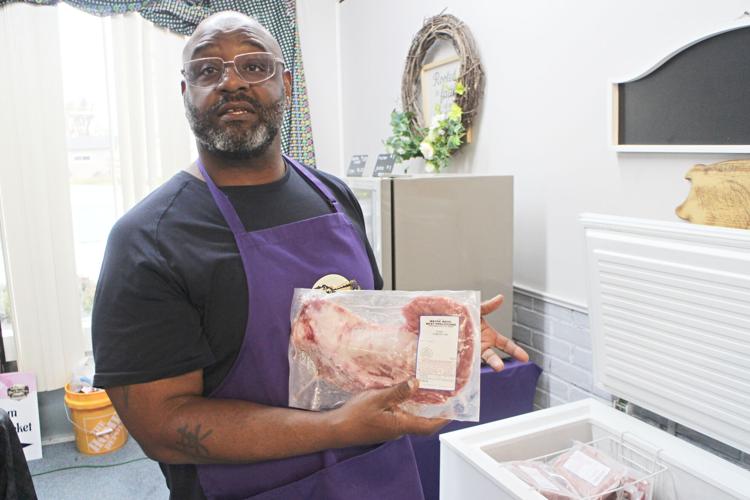

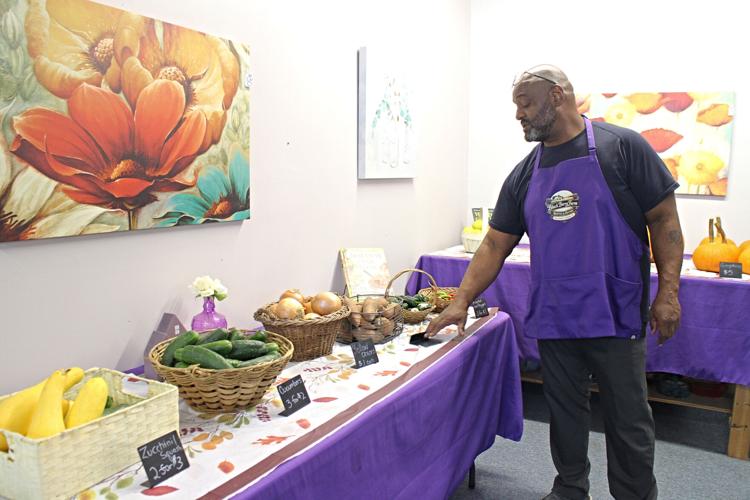


Raymon Trowery was busy Wednesday, Nov. 4, stocking tables and shelves with fresh vegetables at Black Berry Farm’s small storefront on Lakeview Acres Road in Berrytown.
“Although you have civilization around you here, to me there was a lack of farm-fresh produce,” he said, loading a deep freezer with pork from hogs processed a day earlier. “There’s a couple of small farm stands, but you have to travel to get to the other farms.”
Trowery and his wife, Lanette, have big plans for their 20-acre property, but Black Berry Farm is not their primary source of income. Lanette works full time, and Raymon receives disability benefits from the military. He said he will be content even if the farm just breaks even.
Their experience reflects what business registrations and inquiries to the Burke County Cooperative Extension office suggest is growing interest in small-scale agriculture.
So far this year, 14 businesses with agriculture-related names have registered in Burke County, bringing the five-year total to more than 40. The registrations alone do not establish whether each business is actively farming, but the figures line up with the experience of Burke County Extension Director Damon Pollard, who said he has fielded many calls from people asking how to make a farm profitable.
“There’s been quite a few of those,” he said. “A lot of times, they’re wanting something small to kind of grow into their market. … Growing some vegetables or some herbs for the farmers market. That’s the start of their operation.”
Most of the new farms Pollard has interacted with are not the primary source of income for their owners.
“Those that are full time, and there are very few of those left, most of those revolve around large grain operations or poultry houses,” he said. “Those give enough size and scale to support a family.”
Small family farms accounted for about 86% of U.S. farms in 2024 yet produced only 17% of the total value of agricultural production, according to the U.S. Department of Agriculture. The agency defines small family farms as those with less than $350,000 in annual gross cash farm income.
Meanwhile, large-scale family farms with annual gross cash farm income of at least $1 million represented about 5% of farms and accounted for half of the country’s agricultural production value.
For Trowery, concerns about supermarket produce and the fragility of supply chains helped turn a backyard garden into what he described as a calling to raise hogs, grow vegetables, and be a good neighbor.
Trowery, a former grocery store manager, said he did not learn of Berrytown’s Black heritage until after he and Lanette bought the property, which had previously been operated as a hog farm by the Deal family.
Trowery, who is Black, said farming and agriculture are intimately tied to his love for food and community, which he described as hallmarks of Black culture. He was delighted to learn that Berrytown is “the Black part of Valdese,” he said.
“We want to connect with that history,” he said. “It’s important to us to respect and honor and understand that history.”
This winter, Trowery plans to experiment with hydroponics to grow lettuce year-round. In the spring, he hopes to start a flock of sheep. Chickens are inevitable, he said, although he wants to pace himself in adding elements to the farm.
Trowery said the storefront adjacent to his property will be key to keeping the operation profitable.
The store reflects the product diversity and collaboration that small farms often need to remain in business. Honey from local producers shares shelves with art from a local painter. Lanette’s baked goods sit across from vegetables grown by the Trowerys and several other local farms.
The storefront is already becoming something of a gathering place for local children, who come for inexpensive candy and sometimes stay to do homework. Trowery said he hopes the farm itself will eventually become a place where people can come “just to be,” whether by wandering through wildflower fields or watching the hogs root in their pen.
“We want to have a positive effect on our community,” he said.
On their first night at the farm, Trowery said he and his wife were overwhelmed by the uncertainty surrounding their new enterprise. When he awoke the next morning and looked over his own fields, however, his excitement returned.
“It’s a dream come true,” he said.























(0) comments
Welcome to the discussion.
Log In
Keep it Clean. Please avoid obscene, vulgar, lewd, racist or sexually-oriented language.
PLEASE TURN OFF YOUR CAPS LOCK.
Don't Threaten. Threats of harming another person will not be tolerated.
Be Truthful. Don't knowingly lie about anyone or anything.
Be Nice. No racism, sexism or any sort of -ism that is degrading to another person.
Be Proactive. Use the 'Report' link on each comment to let us know of abusive posts.
Share with Us. We'd love to hear eyewitness accounts, the history behind an article.