

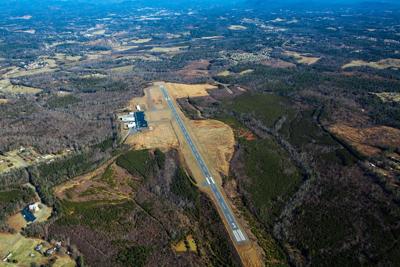

Foothills Regional Airport is experiencing stronger fuel sales and high demand for aircraft hangars as it moves forward with millions of dollars in infrastructure improvements, although construction complications and pending grant decisions could affect the cost and timing of its expansion.
The airport, which serves Burke and Caldwell counties and the cities of Morganton and Lenoir, is pursuing projects intended to improve aviation operations and strengthen its role in regional economic development.
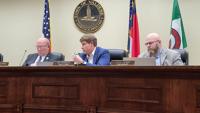
Details of these and other developments were presented during the Foothills Airport Authority’s Oct. 28 meeting by Airport Manager Brent Brinkley, Assistant Manager Derek Brown, and Accountant Norm Sherwood. Lenoir Mayor Joe Gibbons serves as chairman of the authority.
One of the airport’s largest projects, construction of a parallel taxiway, has encountered unexpected complications that could increase costs and extend the construction schedule.
During initial clearing and erosion-control work, surveyors discovered significant differences between actual ground elevations and the topographical information originally used to design the project, Brinkley said.
Engineers subsequently revised portions of the erosion-control plan, including relocating a sediment basin and adding a smaller basin to manage runoff.
The revisions require additional permitting through the N.C. Department of Environmental Quality.
The changes also mean more earthmoving work than originally anticipated. A contract extension also may be required. State aviation officials indicated additional funding could be available to help cover the unexpected expenses, Brinkley said.
The $5.3 million taxiway project began Aug. 17 and originally carried a construction timeline of approximately 360 days.
The airport’s new eight-unit T-hangar project is considerably further along but has encountered its own construction dispute, Brinkey said.
Although electrical service, lighting, and hangar doors were operational by September, differences in elevation between the new concrete floor and surrounding asphalt raised concerns about water collecting outside hangar doors.
Engineers presented a proposed $58,912 change order covering asphalt modifications and other construction requirements.
Authority members questioned why the airport should bear the additional paving expense. They declined to approve the change order and directed staff to investigate responsibility for the discrepancy.
The airport’s operating results present a more encouraging picture.
Airport Accountant Sherwood said financial statements show operating sales revenue of $275,329 during the first three months of the 2026-27 fiscal year, compared with $202,343 during the same period last year.
That represents an increase of approximately 36%.
Jet fuel sales generated $206,430 through September, compared with $146,121 a year earlier. Aviation gasoline sales also increased, reaching $59,574 compared with $46,319.
The airport sold 32,966 gallons of Jet-A fuel during July, August and September, approximately 30% more than the comparable period last year, said Brown.
Fuel sales are an important revenue source because they reflect aircraft activity and contribute to the airport’s ability to cover operating costs.
Airport managers said that 51 of 52 available hangar spaces were occupied, a 98% occupancy rate for those facilities. Overall occupancy, including aircraft tie-down spaces, was approximately 87%.
The airport reported a Sept. 30 cash balance of approximately $8.6 million. Most of that money was held in capital accounts, including previously received state appropriations, rather than unrestricted operating funds.
Beyond aviation, the airport continues to pursue infrastructure improvements that could support industrial development.
A proposed sewer extension from Lenoir to the airport remains dependent on a federal Economic Development Administration grant of approximately $12.5 million.
Previous authority reports identified $1.5 million in Golden LEAF funding and more than $700,000 in state Commerce Department assistance for the project.
Sewer service could make airport-area property more attractive for industrial development, particularly for manufacturers requiring substantial utility infrastructure.
Authority members also received favorable feedback from Project Scrimmage, a simulated industrial recruitment site visit conducted with Deloitte and Duke Energy.
Officials emphasized that the exercise did not involve an actual company prospect. Instead, it tested the airport’s readiness and the community’s response to a potential industrial recruitment opportunity.
The evaluation found the airport to be a viable location for future economic development consideration.





















(0) comments
Welcome to the discussion.
Log In
Keep it Clean. Please avoid obscene, vulgar, lewd, racist or sexually-oriented language.
PLEASE TURN OFF YOUR CAPS LOCK.
Don't Threaten. Threats of harming another person will not be tolerated.
Be Truthful. Don't knowingly lie about anyone or anything.
Be Nice. No racism, sexism or any sort of -ism that is degrading to another person.
Be Proactive. Use the 'Report' link on each comment to let us know of abusive posts.
Share with Us. We'd love to hear eyewitness accounts, the history behind an article.