Jo and Claude Sitton with their dear friend, the late John Greene. Greene, who died last year, was a key supporter of the History Museum of Burke County.
The idea was born several months ago — a joint interview with Claude and Jo Sitton.
Poteat
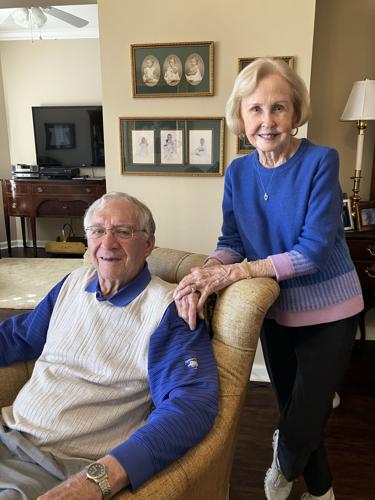
The Sittons have been powerful influences on life in Burke County for more than 60 years.
Claude, a successful attorney, a respected judge, and the founder of the History Museum of Burke County.
Jo, an innovative businesswoman, community pacesetter, and a powerful voice for progressive causes and candidates within the N.C. Democratic Party.
The Sittons are busy people, of course, and it wasn’t until late October that the stars aligned and they were able to share with me a bit of their remarkable life stories.
And here is what they told me.
INDIAN SUMMER
The late afternoon sun shines brightly on the balcony and into the living room of the couple’s spacious apartment on the fourth floor of the D wing at Morganton’s Grace Ridge Retirement Community.
Open those balcony doors, and the unexpected warmth of a mild late October afternoon comes flooding in, accentuated by a sweeping view of the nearby hills with a depthless blue sky arching above.
In times past, such weather was referred to in Burke County as Indian Summer, a period of warm sunny weather coming after the first frosts of October, but before the gloom and gray of late autumn and early winter arrive.
Sitting with the Sittons at their kitchen table, reminiscing about the history through which they have lived, the friends they have known, and the community they have helped build, I cannot help but contemplate how the season outdoors reflects the season of their own lives.
The pair, married now for more than 66 years, are both in their late 80s, most definitely the autumn of life. And yet their energy, their spirit, their intelligence, and their compassion proclaim they are living in and relishing their own Indian Summer.
JUST A DREXEL BOY
While he was born in Arden, a community in Buncombe County, Claude was largely reared and educated in Burke County. His father came east, Claude recalls, because he wanted to be a farmer, and a large tract of land was available between Bethel and Parker roads.
Later, the family moved to a house on Drum Straight on U.S. 70 between Drexel and Morganton. His father, who had suffered a heart attack in 1954 and was no longer up to the rigors of farm work, built and operated a small store adjacent to the highway.
Living on Drum Straight meant Claude was in the Drexel school district, a district presided over by an authoritarian with a heart of gold — the late Principal Harry L. Hallyburton.
“I loved Drexel High School,” Claude remembered. “Mr. Hallyburton was my role model, my mentor. He devoted his life and his energy to helping those students in Drexel be the best they could be.”
Claude was a three-sport athlete at the high school, which closed in 1974, and served as student body president for the class of 1956. We enjoyed a laugh when I reminded him that it was an honor we shared. Seventeen years later I was student body president for the penultimate class of 1973.
“That was quite the graduating class I had,” Claude says with a sly smile. “Robert McNeely was the valedictorian. Maxine McCall was the salutatorian, and I (pausing for comic effect) was very popular.”
Before his graduation in the summer of 1955, Sitton was sponsored by the local American Legion to attend Boys State, a week in Chapel Hill devoted to the study of government and all its functions.
Serving as a counselor at the camp was recent law school graduate Bob Byrd, himself a Drexel boy. Offering Claude a ride home when Boys State ended, Bob counseled his young protege about how to become an attorney.
It was during the week at Boys State, and in that long ride home with Bob, that Claude’s dreams of attending law school were born. But first, there was a bachelor’s degree to be earned.
COLLEGE YEARS
As high school graduation neared in the late spring of 1956, Claude was faced with a choice — go directly to Chapel Hill as a freshman or go to the much smaller junior college, Mars Hill.
“The deciding factor was a partial football scholarship to play at Mars Hill,” he recalled. “In my fantasies, I was going to go straight from Mars Hill to playing with the Green Bay Packers.”
While an offer from Vince Lombardi never came, Claude enjoyed the small, close-knit feeling on the Mars Hill campus and made friends during his two years there that would last for a lifetime. Those friendships later proved pivotal in where he went to law school.
Arriving in Chapel Hill in the late summer of 1958 as a junior, Claude found that the quality of teaching in Mars Hill had prepared him well for success at what was then the largest university in the state.
During his time at Chapel Hill, Claude met a high-spirited young woman who was then living in Raleigh, Jo Bailey. Jo’s roommate at the time had attended Mars Hill and was friends with Claude, so Claude brought his “girlfriend” by for a visit.
The roommate was not home at the time so Claude and his “girlfriend” ended up visiting with Jo instead.
“He was a thing to behold,” said Jo of the young Tar Heel at her door. “I just thought he was really special.”
Soon enough, the “girlfriend” was yesterday’s news and young Jo Bailey was in the headlines.
Jo had grown up on a tobacco farm east of Raleigh and, “No,” she said, preempting a question. “It wasn’t a plantation. It was hardscrabble tobacco farming.”
Her parents split up when Jo was 13 and her mother brought Jo and her three siblings to Raleigh. The family lived in public housing. Her mother worked two jobs to make ends meet. And Jo got an early lesson on just what a strong, independent woman looked like.
“My mother was a liberated woman before anybody knew what that meant,” Jo recalled.
Growing up “hard” left Jo with a special affinity for those struggling to break the bonds of generational poverty and shaped the progressive political beliefs which have helped mark her life for the past seven decades.
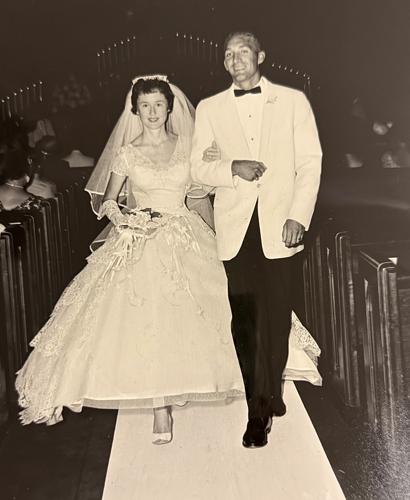
Though it may not have been love at first sight, only a few second glances were required. Claude graduated from Chapel Hill in May of 1960 and the young couple were married just before Labor Day in September.
Jo and Claude Sitton on their wedding day in 1960.
FOR THE PAPER
LAW SCHOOL AND BEYOND
As noted earlier, Claude developed some deep and lasting friendships during his two years at Mars Hill College. Several of those friends, it turned out, planned to attend law school at Wake Forest College in the autumn of 1960. (The school attained university status in 1967.)
“The cost was about the same as Chapel Hill,” Claude said, “so I decided on Wake. I was accepted, admitted, and as things worked out, I loved it.”
Claude must have also loved hard work for in addition to his demanding course work, he also held part-time jobs during his entire three years. He refereed high school basketball games to pick up cash and also worked as a cigarette inspector in one of the R.J. Reynolds tobacco factories.
Jo worked full time the entire time Claude was in law school.
“It wasn’t much fun, but it got us through,” Claude remembers.
And when “through” was attained on graduation day in the spring of 1963, what sort of law was Claude looking to practice?
“I didn’t know,” he responded. “But I knew that I wanted to come home.”
The Burke County legal landscape was populated by giants and legends in those years, men like John Howell “Doggie” Hatcher, John McMurray, Harold Mitchell, John Ervin, Tom Starnes, and brothers Joe and Bob Byrd.
Also included in that number was Graham Devann, who had studied accounting at Chapel Hill and the law at Wake Forest. Both a practicing attorney and an active Certified Public Accountant, Devann told Sitton that Burke County’s soil would prove fertile for a young, talented, dedicated attorney.
Claude found the place to hang his shingle when Hatcher offered him the opportunity to rent an office and share a secretary.
The attorneys of Burke County, he said, were “extremely ethical, honest men, and the Burke County Bar was much more active. We met every month for lunch at the Community House and in summer months we’d often head up to Dan Simpson’s house on the lake. We liked each other and respected each other.”
BUILDING A CAREER
For his first couple of years after law school, Claude had a solo practice in Morganton. During 1965 and 1966, he served as the prosecutor for what was then the Burke County Criminal Court.
Later, he became a partner in the firm of Hatcher, Sitton, Powell and Settlemyer. During those years he served as the town attorney for Drexel for a time and then as the county attorney for Burke County.
His reputation grew during those years as an honest and dependable attorney, well-schooled in the law, well-skilled in the courtroom, and always thoroughly prepared for whatever situation he was facing.
His exemplary record did not escape the attention of Gov. Jim Hunt, who in 1980 appointed Claude as a Superior Court Judge for North Carolina’s 25th District.
Was he reluctant to leave private practice and don the robes of a judge?
“I was hesitant,” he responded. “I was enjoying the fruits of a successful practice with a successful firm. But I reasoned that, ‘If I don’t like it, I can always go back and be better for the experience.’”
Claude never went back. He settled into the routine of running the courtroom. “I enjoyed the respect that went with the job, and I enjoyed the work itself. But most of all I enjoyed the camaraderie — the respect and affection that judges had for each other.”
I interrupt Claude to tell him a story.
After retiring from public school teaching, I worked for The Gaston Gazette in Gastonia for five years. In 2019, an assignment took me to the Gaston County courthouse and a meeting with several Superior Court judges.
Retired Superior Court Judge Jesse Caldwell
When I told them I was from Burke County, they immediately expressed their admiration for Judge Sitton. Judge Jesse Caldwell, himself a revered figure, said, “If an attorney wanted to get half his ass chewed off, all he had to do was show up in Claude’s courtroom unprepared.”
Claude and Jo both laugh when I tell the story, but neither disputes its content.
MOVING FORWARD
Even though he could have served longer on the bench, Claude decided he would retire in 2003. The last place he held court was in Murphy, county seat of Cherokee County.
Next door to the courthouse was the local history museum. At lunch one day, Claude went to the museum, walked through its exhibits, was impressed by what he saw, and wondered to himself, “Why can’t we have something like this in Burke County?”
The question proved to be prophetic, for Claude has devoted his “retirement” years to founding, building, growing, and bettering the History Museum of Burke County.
Jo and Claude Sitton with their dear friend, the late John Greene. Greene, who died last year, was a key supporter of the History Museum of Burke County.
FOR THE PAPER
The success of the museum and the embracement of it by the community has surprised even Claude.
“I never realized that so many people would want to get involved,” he said. “The people who have helped that effort have simply been amazing. Folks like Betty Elmore and Bob Pruett, Ruby Pharr, Phyllis Wogan.”
For 17 years, the museum was a completely volunteer effort, with Claude carrying the title of Executive Director. Earlier this year, however, two staffers were hired — Curator and Assistant to the Director Corwin Keys and Director of Education Bethany Mace.
When asked how long he wants to continue as executive director, Claude ponders before answering.
“The death of Waits Gordon was really a wake-up call to me,” said Claude. Gordon was a longtime supporter of the museum and was serving as chairman of the board of directors at the time of his death.
“The truth is, I may not be here tomorrow. And I’m not sure I want to go too much longer devoting that much time and energy to the museum,” he said. “It’s dear to my heart, but I’ve got some decisions to make.”
SUMMING UP
A glance at my watch tells me I have been talking with the Sittons for more than two hours. That October sun, so brilliant just two hours earlier, is descending in the west toward the Black Mountains.
Yet I have one more question I want to ask.
Claude has been recognized as Morganton’s Man of the Year by the Rotary Club, and has had honors heaped upon him by Morganton First Baptist Church and Western Piedmont Community College. He’s even a recipient of the Order of the Long Leaf Pine.
Jo Sitton in an exercise class at Grace Ridge Retirement Community in Morganton.
FOR THE PAPER
Jo has carved a legacy in her own right. Mother, business woman, mover and shaker in the N.C. Democratic Party. Both the Sitton daughters, Juleigh and Janie, are successful attorneys in their own right. Jo served for years on the board of the Morganton Housing Authority and on the boards of both UNC Health Blue Ridge Morganton and the Blue Ridge Healthcare Foundation.
My question to each of them is simple: What are you most proud of?
Claude answers quickly, with no hesitation, although tears lurk in the back of his eyes: “My wife and family. I’ve been lucky, awfully lucky. To have this wife, to have two successful and well-educated daughters. To have a granddaughter we love. I’ve been lucky.”
Jo takes a moment to praise her husband before responding.
“I’m so proud of this man,” she says, and the gleam in her eyes testifies that she speaks the truth. He was the first one in his family to ever go to college, and look what he’s done.
“And my answer is the same,” she continued. “I’m most proud of our family, of Claude and the girls.”
As I leave the Sittons and step back into the late afternoon sunshine, I find myself thinking again about Indian Summer. The season is fleeting, a brief and beautiful gift before the inevitable chill of winter.
But perhaps that is what makes it so precious. Claude and Jo Sitton have spent more than eight decades gathering the things that matter most — love, family, friendship, service, and a deep commitment to the place they call home.
Bill Poteat is editor emeritus. He may be reached at 828-445-8595 orbill@thepaper.media.
Keep it Clean. Please avoid obscene, vulgar, lewd,
racist or sexually-oriented language. PLEASE TURN OFF YOUR CAPS LOCK. Don't Threaten. Threats of harming another
person will not be tolerated. Be Truthful. Don't knowingly lie about anyone
or anything. Be Nice. No racism, sexism or any sort of -ism
that is degrading to another person. Be Proactive. Use the 'Report' link on
each comment to let us know of abusive posts. Share with Us. We'd love to hear eyewitness
accounts, the history behind an article.












































(0) comments
Welcome to the discussion.
Log In
Keep it Clean. Please avoid obscene, vulgar, lewd, racist or sexually-oriented language.
PLEASE TURN OFF YOUR CAPS LOCK.
Don't Threaten. Threats of harming another person will not be tolerated.
Be Truthful. Don't knowingly lie about anyone or anything.
Be Nice. No racism, sexism or any sort of -ism that is degrading to another person.
Be Proactive. Use the 'Report' link on each comment to let us know of abusive posts.
Share with Us. We'd love to hear eyewitness accounts, the history behind an article.