The State Board of Elections is reminding voters that election officials are the best sources for accurate, reliable, and timely information about the voting process. If you encounter problems or have questions while attempting to vote, please take the following steps:
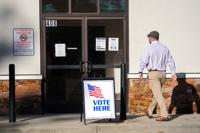
If you are at a voting site, talk to a poll worker. They are best positioned to address your problem or question immediately and escalate it to the chief judge at the voting site or the county board of elections, if necessary.
If you encounter an emergency at a voting site, dial 911 and notify a poll worker immediately.
If at any time you feel harassed or intimidated at a voting site, please notify an election official immediately. The State Board asks that all voters respect the right of others to participate in the election. Intimidating any voter is a crime. Also, please be courteous toward others at the voting place, regardless of differences of opinion, and always remain calm.
If you have questions or concerns and are not at a voting site, contact the county board of elections in your county of residence. The county board in your county is who administers your county’s elections and can answer questions about the voting process and your eligibility to vote. Contact information for county boards of elections is available here: vt.ncsbe.gov/BOEInfo/.
The State Board of Elections supervises the conduct of elections statewide. Voters may contact the State Board by sending an email to elections.sboe@ncsbe.gov or calling (919) 814-0700. Voters can also find accurate information about the election process at the State Board’s website, NCSBE.gov.
Some partisan and nonpartisan organizations offer hotlines that voters can call if they have trouble voting. These services are not run by election officials. While they may be helpful in some circumstances, the State Board wants to ensure that voters know that election officials are the best source of information about voting.
The second day of early voting flipped the narrative with more registered Republicans than Democrats casting a ballot. Unaffiliated voters, however, still remained the largest contingent.
For Burke and Caldwell residents, a trip to the polls can be a stop after work or part of a Saturday’s errands rather than another obligation squeezed into Election Day. Starting Thursday, voters will have more than two weeks to find a time and place that work for them.
Aside from a few cameras and the candidates speaking, Sept. 24’s 2026 Candidates Forum left the Leviton Auditorium at Western Piedmont Community College relatively empty.
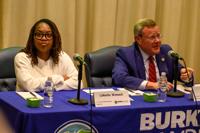
Candidates for offices ranging from congress to mayor attended the Burke County Chamber of Commerce’s 2026 Candidates’ Forum in WPCC’s Leviton Auditorium on the evening of Sept. 24.
Eligible voters not registered to vote have less than two weeks to act if they want to cast a ballot in the Nov. 3 general election, which will decide races for Congress, the General Assembly, the courts and county and some municipal offices.
When the Caldwell County Republican Party’s Executive Committee chose Corey Moore as the nominee to replace Commissioner Donnie Potter in the November County Commissioner election, it sparked a swath of social media backlash.
With the March primary elections concluded, Burke County set itself on course for a new district attorney, a returning district court judge, and the official beginning of an elected term for a superior court judge.
Incumbent Burke County Commissioners Randy Burns and Phil Smith won the Republican primary Tuesday with 4,323 and 3,526 votes respectively, and will advance to the November election.
Burke County Board of Elections Director Kenny Rhyne said voter participation in the primary was slightly higher than typical for an election year without major local offices such as sheriff or clerk of court on the ballot. Tuesday’s turnout exceeded his projections by several percentage points, he said.
We are in the waning days of the early voting period for the March 3 partisan primary in Burke County. You can vote at any of the five locations through Saturday.
Early voting for the March 3 primary has opened in North Carolina, giving residents an opportunity to voice their concerns, hopes, and priorities at the ballot box.






























Commented