

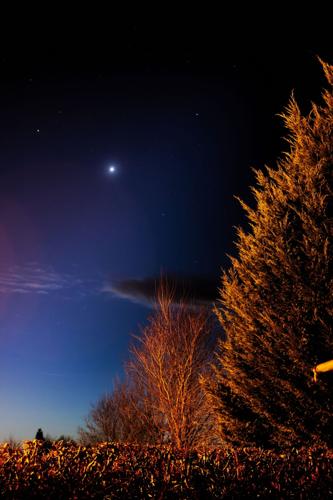



I took a few minutes early last Sunday evening to say a temporary goodbye to an old friend, the planet Venus.
Don’t laugh. We really are good pals.
Venus has been stationed in the western sky as the Evening Star after sunset since late last winter, first peeking over the horizon in very early March, a herald of the coming spring.
As the days grew both longer and warmer, Venus climbed higher in the sky, away from the sunset, and was still above the horizon in full darkness during the warm months of June, July, and August.
As autumn approaches (its official start date is Tuesday, Sept. 22, at 8:05 a.m.) Venus has dipped lower and lower and by the time this column is printed the planet will be very difficult to see.
I live in a bit of a low place in Drexel, and our house is surrounded by towering trees, so Venus disappeared from my line of sight more than three weeks ago.
From the parking lot on Red Hill, however, across from the Drexel Industrial site, the white and shimmering planet was easily visible as was the new moon just a short distance to its right.
Although the sun had been below the horizon for less than 30 minutes and the western sky still glowed redly, Venus was bright enough to easily be seen by even the most myopic of observers.
Venus is so bright that it is often reported to authorities as a UFO.
Venus is so bright that under perfectly dark sky conditions, it can cast a shadow and provide enough light to read newspaper headlines.
Venus is so bright that it shines 15 to 20 times brighter than Sirius, the brightest star in the sky.
Venus is so bright that it shines more than twice as brightly as the second brightest planet, Jupiter.
Venus is so bright, that unlike any other star or planet, it can be seen during the daytime, if you know precisely where to look.
Venus is so bright that it is unmistakable, dazzling, awe-inspiring — the most reliable show in the heavens, and I have been in love with her for nearly six decades.
Back when I was but a wee lad, the University of North Carolina’s Morehead Planetarium would publish at the beginning of each month, in The News Herald, the Hickory Record, and other newspapers large and small across the state, a small chart detailing how to locate and see the visible planets.
And in the late summer of 1968, just as school was about to start back and the Democrats were convening for their tumultuous national convention in Chicago, I spotted Venus for the first time, “low in the west soon after sunset.”
As Venus grew higher and brighter that autumn, I realized that I had seen the planet many times as a child, I simply had not known what I was looking at.
Now, I knew.
Later, I recognized Jupiter for the first time, climbing into the eastern sky on a bitterly cold January evening when Burke County lay blanketed under a foot of snow.
Mars in the summer of 1969 was fantastically bright, glowing like a red demon eye in the southern sky as summer advanced.
In the autumn, I saw Saturn for the first time, a bright yellow “star” rising in the east.
Mercury took longer. The little planet, although bright, darts back and forth from one side of the sun to another and is never far enough from the sun to be viewed in full darkness.
But when captured, Mercury is a beautiful sight, suspended above either the sunrise or the sunset looking like a bright, orange star.
As I noted earlier, I said goodbye to Venus last Sunday evening, but in just a few short weeks, I will be saying hello again.
During late September and all of October, Venus will be too close to the sun to be visible. But in early November, she will reappear in the early morning sky and will serve as a beautiful Morning Star right through Christmas and into 2027.
So why does this matter to me?
There is a comfort in knowing what you’re looking at in the night sky.
The planets, the bright stars, and the familiar constellations do indeed become like old friends.
Orion climbing in the east on a winter’s night.
Sirius low in the west on the early evenings in May when the smell of honeysuckle suffuses the evening air.
Arcturus sinking low in the west as autumn deepens and Halloween approaches.
That’s why I’ll miss Venus for these next few weeks. Not because I have some romantic attachment to a ball of rock and clouds 25 million miles away – although, after nearly six decades, I suppose I’m entitled to a little affection.
I’ll miss her because she is familiar. I know where she will be, when she will appear, and what she looks like.
And when she returns as the Morning Star in November, I’ll look up and recognize her just as I did in 1968.
The stars and planets have been keeping me company for most of my life. They were there when I was a kid, they’re here now that I’m an old guy, and if all goes according to plan, they’ll still be there long after I’m gone.
That’s a pretty good definition of an old friend.
























(0) comments
Welcome to the discussion.
Log In
Keep it Clean. Please avoid obscene, vulgar, lewd, racist or sexually-oriented language.
PLEASE TURN OFF YOUR CAPS LOCK.
Don't Threaten. Threats of harming another person will not be tolerated.
Be Truthful. Don't knowingly lie about anyone or anything.
Be Nice. No racism, sexism or any sort of -ism that is degrading to another person.
Be Proactive. Use the 'Report' link on each comment to let us know of abusive posts.
Share with Us. We'd love to hear eyewitness accounts, the history behind an article.