

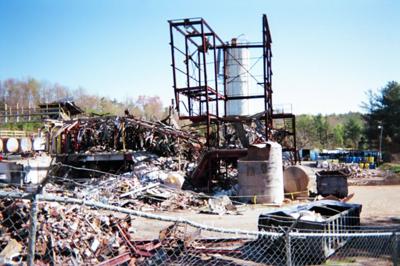
State and federal investigators descended on the scene, including N.C. Occupational Safety and Health Administration (OSHA), and the U.S. Chemical Safety and Hazard Investigative Board (CSB), an independent agency that publishes lessons learned from chemical accidents.
Jim Lay, a retired federal investigator and chemical engineer, recalls investigating the explosion.
“Understanding the Synthron incident was an intellectual puzzle. We gathered facts by listening to employee accounts during interviews and studying the scene,” Lay said.
A few months after the explosion, the NC OSHA and CSB investigators were able to study the damaged equipment. That’s when they found the manway with only four of the 18 fasteners and a physical imprint indicating where the leak had occurred.
They also drilled into the condenser unit and inserted a borescope. What they found was alarming. The condenser unit was fouled with sludgy sediment. Their study showed that the fouling had partially blocked circulation, reducing cooling capacity and further eroding the safety margin.
The CSB also reported that the condenser most likely had never been cleaned under a preventive maintenance regimen.
The CSB report about the Synthron explosion and its lessons is available to the public online. The N.C. Room in the Morganton Public Library has a copy in its Synthron file.
A PREVIOUS HISTORY
The 2006 catastrophic Morganton explosion was not the first for Synthron’s French parent company, Protex. Protex had experienced a large explosion and industrial fire in 1988 at its chemical blending plant in Auzouer-en-Tourain, France.
The facts in the French government report read eerily similar to the CSB Morganton report. A large explosion involving highly flammable solvents was heard for miles. The staff had improvised a change. The explosion caused a large industrial fire and heavy damage.
The 1988 fire caused severe river pollution miles downstream, too. The runoff from the site reportedly turned the local river brown. A fish kill was measured in tons. The 200,000 residents of the town were denied public drinking water for eight days.
Synthron’s leader, Robert Moor, faced a tribunal for this catastrophic incident. The tribunal held the top leader accountable for a long list of safety failures, fire runoff, and widespread water pollution. Protex received hefty fines. Under France’s environmental laws at the time, Moor received personal fines and a suspended sentence.
Eighteen years later, more employees and Morganton would experience the next catastrophic incident.
LAX SAFETY CULTURE
Former employees, who asked to remain anonymous, described the Synthron plant in Morganton as worn down with a lax culture of safety. Daylight could be seen through the roof from the production floor. Rainwater ran inside the building. The production building had a permanent odor of chemicals.
Former employees described experiencing injuries during the manual work. Bumps, bruises, cuts, flash fires, and burns were common, they said.
In one example, an NC Industrial Commission injury report summarizes severe burns on an employee’s legs. A transfer hose failed and sprayed the employee with scalding hot water, requiring hospital care. The injured employee received a workers’ compensation settlement.
Another employee died in a forklift accident. While navigating an icy outdoor lane, the machine tipped over, according to former employees. The operator was crushed. Even with a small workforce, Synthron would experience two employee fatalities at the Amherst Road plant. The worksite also reportedly experienced a smaller explosion about one year before the 2006 incident. A condenser tank exploded. The explosion ruptured pipes and disfigured the metal tank, former employees said.
Perhaps the warning signals were there. Former employees said they never saw or interacted with safety auditors from the parent company. Safety auditing applies a concept called Independent Verification. Auditors evaluate a plant’s hazards and risk levels and verify that safety margins are adequate. Their role is to find gaps, issue corrective actions, and help the staff improve safety before a loss occurs.
Auditing improves protection for employees and the public. It also reduces risk for the business. The CSB investigators found that the parent company, which had $100 million of revenues at the time and had already experienced a catastrophic fire in France, had not conducted safety audits at the Morganton worksite.
LEGACY OF NON-COMPLIANCE
From 2004 to 2016, French newspapers reported on the owners’ ongoing safety and environmental failures. The failures included incidents and poor working conditions. Four French environmental groups kept Moor and the company in the media and courts. In the town where the French plant was located, citizens formed an association with the purpose of holding Sythron/Protex accountable to protect their drinking water.
The non-compliance violations and regulatory fines stacked up. Moor and Sythron/Protex were summoned back into a tribunal during 2014-2015. The prosecution presented evidence of the leadership’s disregard for safety and environmental compliance and corrective actions since the 1988 France explosion. The pattern of failures included the Jan. 31, 2006, explosion at Synthron in Morganton, according to a French newspaper report.
Moor and Synthron/Protex were convicted. The court imposed large fines on the company, personal fines on Moor, and another suspended sentence. Moor was banned from holding a director’s role in France for two years.
VIOLATIONS FOR SAFETY FAILURES
NC OSHA issued 36 citations to Synthron after the 2006 explosion for violating safety regulations. Eight of the violations were categorized as Willful, OSHA’s most severe category. This meant intentional deviations from safety regulations were identified. Another 21 citations were categorized as Serious. The remaining citations were categorized as Other.
Attorney Michael O’Callaghan, who represents employers in EPA and OSHA matters, explained how a serious violation can become a willful violation.
“A serious violation exists where an employer knew or should have known of a hazard that poses a substantial probability of death or serious physical harm to employees,” O’Callaghan said. “The exact same hazard may become a willful violation where the employer intentionally exposed employees to the hazard or actually knew about the hazard and did nothing to fix it,” he said.
NC OSHA determined the safety failures at Synthron had reached the willful level. After Union Carbide’s 1984 chemical disaster in Bhopal, India, which killed more than 10,000 and injured up to half a million more, the EPA and OSHA established mandatory standards in the U.S. for environmental protection and safety aimed at the chemical industry. These standards included the 1986 Emergency Planning and Right to Know Act (EPCRA) and the 1992 OSHA Process Safety Management (PSM).
OSHA PSM regulations create a set of 14 safety processes that govern chemical production safety. The chemical industry had been applying these safety processes voluntarily for years. Industry organizations such as the American Institute for Chemical Engineers (AIChE) and the American Chemical Council (ACC) advocated responsibility for safety best practices among their members.
OSHA PSM essentially made these known safety processes mandatory. Synthron received their willful violations for non-compliance with PSM processes. The safety failures included inadequate understanding of reactivity hazards and safety parameters, a lack of a written action plan that involved employees, failure to perform process hazard analysis, substandard employee training, lack of operating procedures, poor maintenance, lack of management of change process, and electrical equipment not rated for work environments with flammable vapors.
NC OSHA had visited Synthron six times over 30 years before the explosion. The last inspection was in 1996, nine years before the explosion. NC OSHA issued 10 citations after that visit. While OSHA had issued the PSM safety regulations nationally in 1992, the 1996 NC OSHA inspection of Synthron did not result in any citations related to the PSM processes, the same safety regulations for which NC OSHA cited Synthron after the 2006 explosion.
State environmental regulators had also visited Synthron a few years before the explosion. Synthron was cited for violations and received fines. After the explosion, NC OSHA threw the book at Synthron. But like all catastrophic incidents, it was too little too late for the Synthron employees and their families, who had died or been severely injured.
DECISIONS BECAME A SAFETY CASE STUDY
When a catastrophic loss occurs, the industrial safety profession learns as much as possible about the circumstances. Those lessons are integrated into decision-making to prevent future incidents. In the industrial and chemical communities, Morganton became known worldwide as the small town where the tragic Synthron explosion occurred on Jan. 31, 2006.
The discoveries made and the well-presented CSB report live on to teach others about safe operations. The CSB even included the Synthron explosion in a popular educational video. The Synthron explosion became a widely taught case study among industry and academia. The CSB findings and the willful violations issued by NC OSHA became synonymous with how not to run a safe plant.
Universities use Morganton’s example to simulate the runaway reaction and develop mathematical models. Safety trainers and industry groups use the case study in safety courses and training sessions. The takeaways help responsible plant operators understand risk, consider safety margins in their decisions, and recognize early warning signals.
One chemist in a safety course described it best: “If a driver walks outside and sees four flat tires on their car, then they’ll likely decide not to drive it because it will cause a collision. Synthron saw 10 flat tires and drove anyway,” he said.
Jim Lay, the retired investigator, said, “They were operating blind to risk.”
SYNTHRON TODAY
Synthron and Protex websites indicate the companies are still active. They manufacture and distribute chemicals. Sometime after the two-year ban, Moor was back in a leadership role in France involving Protex and its subsidiaries. Synthron found a new director, who pledged in the French media to turn around the safety and environmental management practices and its image.
Cleanup work at the Synthron site continued for nearly a year. By Dec. 2, demolition was nearly complete. Laura Niles, a public affairs specialist with the Environmental Protection Agency, noted that more than 800 drums of hazardous waste had been removed and disposed of. The heavily damaged office trailer was demolished, and crews worked to address an underground storage tank of unknown contents.
While the physical work was wrapping up, the legal and regulatory battles continued, with Synthron contesting the fines proposed by the Department of Labor.
Robert Moor died in October 2024. Protex still owns several subsidiaries operating in the United States. One, in Massachusetts, experienced a large fire in 2022.
Despite the closure of the plant and the subsequent bankruptcy, the legacy of that day remains etched into the landscape of Morganton. Today, the corner of Amherst Road and Kirksey Drive remains an empty fenced lot — a silent reminder of a Tuesday morning 20 years ago when the world shook, and a town changed forever.



























(0) comments
Welcome to the discussion.
Log In
Keep it Clean. Please avoid obscene, vulgar, lewd, racist or sexually-oriented language.
PLEASE TURN OFF YOUR CAPS LOCK.
Don't Threaten. Threats of harming another person will not be tolerated.
Be Truthful. Don't knowingly lie about anyone or anything.
Be Nice. No racism, sexism or any sort of -ism that is degrading to another person.
Be Proactive. Use the 'Report' link on each comment to let us know of abusive posts.
Share with Us. We'd love to hear eyewitness accounts, the history behind an article.