Synthron made staffing changes during the year before the explosion. These changes included a new vice president, plant manager, plant superintendent, and some new operators.
Editor’s Note: Many Americans can point to landmark world events in their lives. They remember where they were when President John F. Kennedy was assassinated. They remember what they were doing when the Space Shuttle Challenger broke into pieces and took the lives of seven astronauts. And they recall the anguish they felt on Sept. 11, 2001, when nearly 3,000 people died in New York, Somerset County, Penn., and Arlington, Va. The Synthron explosion on Jan. 31, 2006, might not reside in the collective consciousness of the world like those events, but many Burke County residents remember exactly what they were doing when they felt buildings shake and windows rattle from the blast repercussions. A dozen Synthron employees were injured that day. Maintenance Supervisor Butch Brackett lost his life. On this 20th anniversary of that fateful day, The Paper has partnered with Morganton resident Bryan Raughley, an industrial safety engineer who uses the case study of what happened in an effort to prevent such a tragedy from happening again.
Bryan Raughley
FOR THE PAPER
Morganton’s Synthron was built in 1963 and went operational the next year. Its president, from Rhode Island, had visited a family friend in Morganton and liked the Burke County town so much that he decided to build a small chemical plant here to serve their Southern customers. Protex International, a French industrial group, acquired Synthron in 1972.
Synthron’s core business was producing chemical additives, produced in batches. Employees followed recipes defining chemical ingredients and blending instructions. The raw materials came from inventories stored in 55-gallon drums and 330-gallon totes that could be seen when driving past the plant at the intersection of Amherst Road and Kirksey Drive.
Synthron’s chemical blending process was carried out manually by employees. The process was hands-on, not automated. Employees transferred heavy chemical containers using forklifts, measured ingredients, connected hoses, ran pumps, opened and closed valves, monitored sight glasses, and cleaned the tanks between batches. No modern automation, remotely activated systems, nor a control room were used to produce the batches.
Around two years before the explosion, according to former employees, Robert Moor, the leader of Synthron/ProTex arrived at the Morganton plant from France to make changes. He wanted to grow the business. That meant more sales and throughput.
A plant superintendent, now deceased, protested the changes according to his daughter and verified by former employees, saying that increasing production was impossible with existing equipment and would be unsafe. She claimed her father, a long-time employee who had dedicated his life to the plant, was fired by Synthron. He filed a wrongful termination lawsuit in 2005, before the explosion. A long-term chemist at the plant was also fired under controversy.
Synthron made staffing changes during the year before the explosion. These changes included a new vice president, plant manager, plant superintendent, and some new operators. The changes also included three different chemists, according to former employees. One chemist reportedly came and left quickly. Then his replacement was terminated. The third successive chemist was on the job only three weeks when the plant exploded, according to the U.S. Chemical Safety Board (CSB) investigation report.
The CSB report showed two additional important findings about turnover and staffing changes. First, these staff members had a short tenure at Synthron during the months leading up to the explosion. Second, the French ownership hired a management team that collectively did not have the depth of practical experience in the type of chemistry that Synthron often performed, called polymerization.
Polymerization is a unique type of chemistry involving reactive chemicals and heat-producing reactions. Polymers are the product of blending chemical building blocks called monomers in a solvent base. As a society, polymers are integral to everyday life. Plastics, your toothbrush, synthetic textiles, wire insulation, and paints are all made from polymers.
Recipes for blending monomers and solvents into polymers demand exact precision for safety. To do this, operators perform a method called dosing to create the correct chemical blend of ingredients. Operators dose by weighing or metering specific amounts of flammable solvents and monomers, then adding the ingredients to a batch reactor vessel — a large stainless steel mixing tank about the size of a four-door sedan.
Knowing how reactive chemicals will interact and change is vital for safety in any chemical plant. Controlling the heat and pressure emitted by the chemical reaction are critical safety parameters.
As the operators blend the solution, they apply external heating, sometimes close to or at the boiling point. After the solution reaches the proper temperature, operators add an initiator, which triggers the chemical reaction for polymerization.
Producing polymers in stages is a common safety practice. Operators blend a polymer in stages to manage the heat release from the chemicals reacting together, an important control to avoid a runaway reaction. The objective of each stage is to allow the cooling capacity to absorb the heat, keeping the chemical reaction under control and within a safety margin.
HEATING FLAMMABLE LIQUIDS
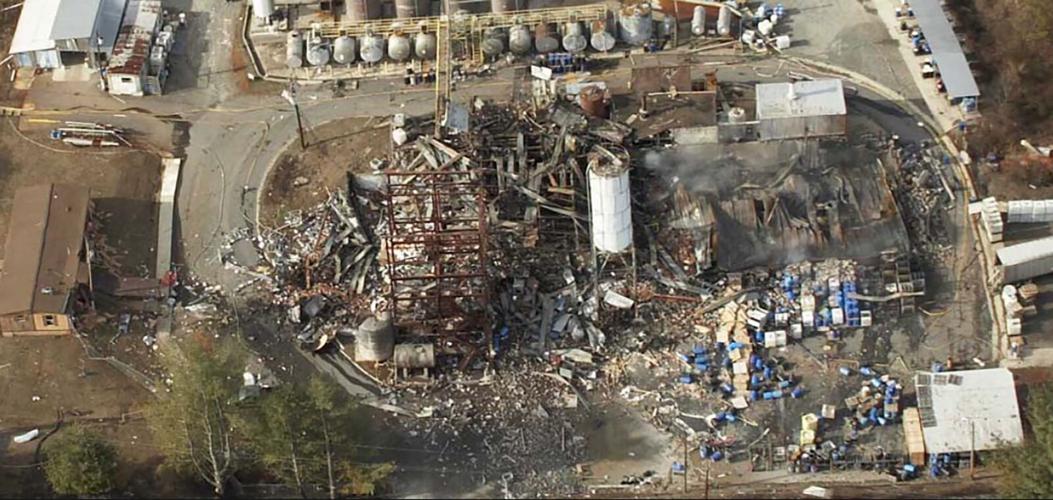
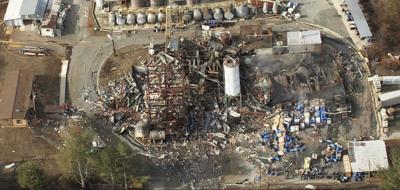
The explosion nearly leveled Synthron, which was located at the intersection of Amherst Road and Kirksey Drive.
CSB PHOTO
On the day of the explosion, Synthron was using two flammable liquids as solvents. Polymerization required heating these flammable liquids above their flash point. Heating a flammable liquid is a high-risk endeavor. As the liquid reaches its boiling point, it changes physical state to a gas or vapor, just like boiling water in a tea kettle changes to steam. The resulting vapor is extremely flammable. The right fuel-to-air mixture can be explosive. That’s why keeping the flammable vapor inside the batch reactor and within range of the cooling equipment is a critical safety parameter.
The 1,500-gallon batch reactor at Synthron was designed to safely boil flammable solvents, control heat, and contain vapor pressure during chemical blending.
The system relied on two cooling methods. The primary system was a condenser loop, which routed hot solvent vapors through a heat exchanger, cooling them back into liquid form and returning them to the reactor. This circulation helped control temperature and internal pressure. Because the system was not automated, operators had to visually confirm proper circulation through a sight glass.
A secondary cooling system used an external jacket surrounding the reactor tank. Operators could circulate water or steam through the jacket to cool or heat the vessel as needed.
Additional safeguards were intended to prevent dangerous pressure buildup. A vent pipe allowed excess vapors to pass through a scrubber and exit the building, while a safety relief valve set below the tank’s 75 PSI limit could release pressure if needed. Together, these systems were designed to prevent flammable vapors from escaping and igniting.
Synthron had received a customer order two months before the explosion. The order was for an acrylic polymer product called Modarez MFP-BH. An acrylic polymer is valuable for producing a strong, glass-like quality. The amount of the customer order turned out to be larger than Synthron’s standard recipe for a batch. The customer needed just 12% more.
Synthron had several options to fulfill this larger-than-normal order. Workers could blend two smaller batches to make the order using the standard recipe. Or, they could consult corporate headquarters in France about how to manage the change necessary to safely produce the batch size. They opted for a different approach.
Synthron made staffing changes during the year before the explosion. These changes included a new vice president, plant manager, plant superintendent, and some new operators.
CSB PHOTO
After some internal analysis, which remains controversial among what the investigators were told and how former employees remember it, a decision was made to scale up the recipe and blend a single, larger-than-normal batch. This decision deviated from the standard recipe and would challenge the safety margin.
Changing a batch recipe in industrial chemistry, especially during polymerization, is a high-risk decision that normally requires formal safety review. Chemical plants use a process called Management of Change, which involves hazard analysis, technical modeling, testing, and approval by qualified chemists to prevent dangerous runaway reactions.
At Synthron, investigators found that the decision to deviate from the standard recipe was made on the production floor, without any Management of Change review. According to the U.S. Chemical Safety Board and NC OSHA, that required safety process was never performed, setting in motion the conditions that led to the explosion.
DECISIONS TRIGGER AN EXPLOSION
The deadline was approaching for the customer order. The staff needed to make the batch. That’s when another abnormality arose. The raw material inventory was low for one of the solvents needed to make the batch. Instead of stopping and ordering more solvent, employees elected to improvise, according to investigations.
They increased another solvent on hand to make up the difference. This last-minute change deviated from the chemist-approved standard recipe developed, altering the proportions and how the chemicals would react.
Employees worked on Tuesday morning, performing their tasks as usual. By late morning, employees had the customer order well underway. The first stage of dosing, heating, and blending the solvents and monomer was already finished. Employees were progressing onto the second stage, adding the next doses of the solvents toluene and cyclohexane, plus the monomer n-butyl acrylate. It was a large dose. Tragically, a decision was made to add the second and third stage doses all at once.
The solution they were blending required heating to achieve polymerization. They heated the solution with flammable solvents. Steam flowed from the plant boiler through a fixed pipe connected to the batch reactor and controlled by a manual valve. When the temperature gauge indicated the specified temperature, an operator stopped steam flow by closing a valve.
The next step was to activate the reaction that would transform the solvents and monomer into a polymer. An operator dosed the initiator of benzoyl peroxide. Investigators learned that vapor hissing was heard from the batch reactor vessel quickly after the initiator solution was added.
The gas laws we learned in high school chemistry class took over. The reactants generated heat — much more than expected. As more and more heat was produced inside the closed vessel, internal pressure increased. That further elevated the heat release, which built pressure as the liquid solution boiled into vapor.
A runaway reaction was happening, a self-feeding monster of physics. The managers and chemist reportedly had expected a slight temperature increase of only a few degrees. In reality, the changes made to the recipe generated an energy release that investigators later would estimate in megajoules, a measurement usually used in large-scale energy processes.
The last safety failure was the tank manway or opening to the tank interior, basically a lid atop the reactor tank. The lid sealed shut with 18 fasteners. Investigators found a shortcut. The lid had only been sealed with four fasteners. Normally, hot vapor from the runaway reaction would discharge through the safety relief valve and pipe to the building exterior. Instead, this flammable vapor leaked and hissed inside the building from the weakest point, the inadequately sealed manway.
The layers of protection providing the safety margin had been defeated. The CSB stated four employees were inside the production area. They were forced out by the irritating vapor cloud that was rapidly filling the large production room from the leaking tank. The employees huddled near a doorway just outside the building. One employee donned a self-contained breathing apparatus like firefighters use. He re-entered the building and made his way to a control valve. He let cooling water into the tank jacket, an attempt to contain the overheating. The last-ditch effort was futile.
Seconds later, the vapor cloud exploded. Some employees were thrown. Another employee was knocked down by a door that flew off the hinges. The maintenance supervisor was caught inside the building.
SCENE OF TOTAL DESTRUCTION
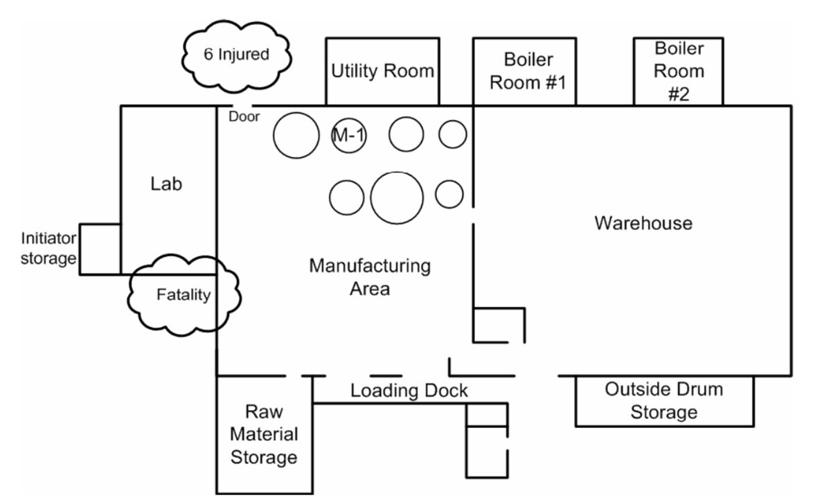
Layout of Morganton’s Synthron plant.
CSB PHOTO
Twelve of Synthron’s 18 employees were injured, several seriously. Some employees immediately went into action, rescuing and initiating first aid to their injured coworkers. Five employees were hospitalized, with two transported by helicopter to critical care in Charlotte and Winston-Salem. Head and thoracic trauma. Fractured bones and vertebrae. Deep burns.
Emergency calls flooded the 911 center. Arriving Burke County EMS providers, Morganton public safety officers, mutual aid firefighters, incident commander, and other first responders would face the call of a career, challenging both grit and skill.
A large-scale incident was happening in a small town. Casualties necessitating rescue from a building collapse. Plus, an industrial fire and flammable, toxic, and reactive hazardous materials all around them.
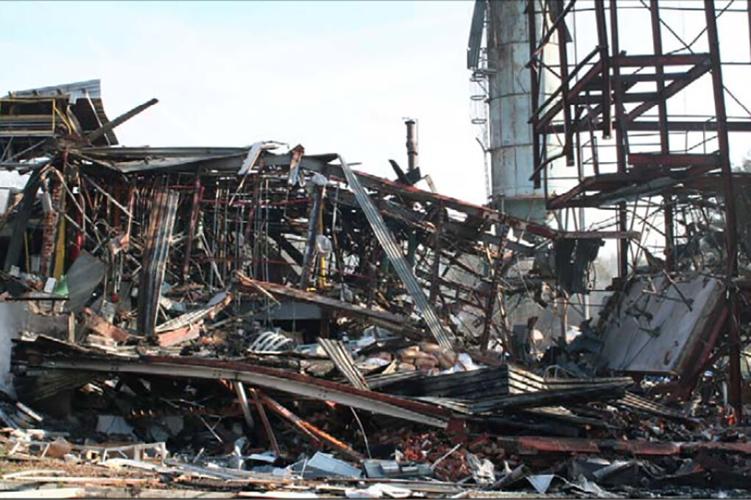
The scene was one of total destruction. Residents in the immediate vicinity were instructed to stay inside and keep their heating and air systems off to avoid drawing in the dust and chemical remnants once heavy machinery began stirring the wreckage.
Tragically, five days after the explosion, the maintenance supervisor, Butch Brackett, died from his injuries.
Bryan Raughley is an Industrial Safety Engineer living in Morganton.
Keep it Clean. Please avoid obscene, vulgar, lewd,
racist or sexually-oriented language. PLEASE TURN OFF YOUR CAPS LOCK. Don't Threaten. Threats of harming another
person will not be tolerated. Be Truthful. Don't knowingly lie about anyone
or anything. Be Nice. No racism, sexism or any sort of -ism
that is degrading to another person. Be Proactive. Use the 'Report' link on
each comment to let us know of abusive posts. Share with Us. We'd love to hear eyewitness
accounts, the history behind an article.













(0) comments
Welcome to the discussion.
Log In
Keep it Clean. Please avoid obscene, vulgar, lewd, racist or sexually-oriented language.
PLEASE TURN OFF YOUR CAPS LOCK.
Don't Threaten. Threats of harming another person will not be tolerated.
Be Truthful. Don't knowingly lie about anyone or anything.
Be Nice. No racism, sexism or any sort of -ism that is degrading to another person.
Be Proactive. Use the 'Report' link on each comment to let us know of abusive posts.
Share with Us. We'd love to hear eyewitness accounts, the history behind an article.