

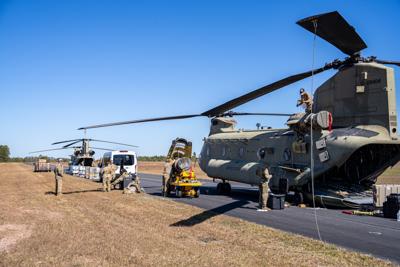

Foothills Regional Airport showed its value in spades in the days following Hurricane Helene.
During the height of the recovery period, the airport became a key operations hub for rescue teams, supply planes, power companies, news crews, and elected leaders. Its high traffic volume and proximity to hard-hit areas led the National Guard to establish a forward-area refueling unit for its Black Hawks and Chinooks, which were carrying out relief missions.
With local hotels at capacity, airport staff opened the concourse for National Guardsmen to set up cots, while Caldwell County provided shower units so they could rest between shifts.
“We would get a new tanker of fuel and empty it just as fast as it arrived,” said Airport Manager Brent Brinkley during the Foothills Airport Authority Meeting on Oct. 30. On multiple occasions, there were up to seven aircraft waiting to be refueled or loaded with supplies.
Derek Brown, the assistant airport manager, praised the volunteers who arrived alongside the last wave of staff to help organize, weigh, and load supplies onto aircraft.
“One pilot told us this was the most organized operation he’d ever seen,” Brown said. “But for us on the ground, it felt like we were running around like crazy. We were blessed, though — things just fell into place and worked.”
In his update to the board, Brinkley noted that “staff worked tirelessly from the beginning” to support a continuous flow of supplies in and out of the terminal. The board noted in their discussion that volunteers were instrumental in ensuring the efficiency and their work allowed airport staff to focus on fuel and logistics.
After the first few weeks, the airport’s role as a relief center began to scale back, and operations shifted toward normalcy. In partnership with the Caldwell and Burke Chambers of Commerce, the airport authority hosted a networking event, Business at the Border, on the taxiway. The event brought together new and established business owners from both counties.
Looking ahead, the authority discussed infrastructure improvements, including a new door system for the hangar to replace one damaged during the storm. The hurricane also brought another to light: The airport’s generator couldn’t provide the wattage needed to power the fuel farm efficiently. A fuel farm is storage tanks and related equipment necessary to store and dispense aviation fuel, lubricants, and related petroleum products. The authority is exploring grant funding options to purchase a generator to handle the load during future outages.
Financially, the airport reported a solid cash balance increase, thanks in part to fuel sales during the hurricane. Although September’s report showed lower operating revenues, early October marked a record for fuel sales, with over 33,000 gallons sold during the recovery period—nearly five times the usual demand for this time of year.
The authority continues to accept bids for T-hangar site preparation and construction, with a review planned for its December meeting.
























(0) comments
Welcome to the discussion.
Log In
Keep it Clean. Please avoid obscene, vulgar, lewd, racist or sexually-oriented language.
PLEASE TURN OFF YOUR CAPS LOCK.
Don't Threaten. Threats of harming another person will not be tolerated.
Be Truthful. Don't knowingly lie about anyone or anything.
Be Nice. No racism, sexism or any sort of -ism that is degrading to another person.
Be Proactive. Use the 'Report' link on each comment to let us know of abusive posts.
Share with Us. We'd love to hear eyewitness accounts, the history behind an article.