

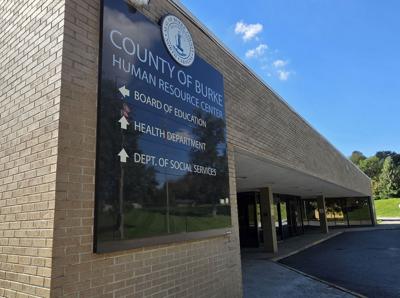


Burke County is officially footing 75% of the bill for Food and Nutrition Services (FNS) administrative costs administrative costs, a change that brings a $550,000 price tag with it.
On Oct. 1, three months into the fiscal year, legislation went into effect that reduced the federal contribution of administrative costs across the FNS program.
The federal contribution decreased from 50% to 25%, adding about $550,000 to the county’s expenditures for the year — a cost county officials expect to grow to approximately $650,000 next year once the county has to manage the decreased contribution for the entire fiscal year.
“The state chose not to pick up any of that cost, and shift all that cost to counties,” said Korey Fisher-Wellman, director of the Burke Department of Social Services (DSS), explaining that in fiscal year 2027-28, the county will be responsible for 75% of the cost for the entire year.
About 11% of DSS staff, or 22 employees, manage FNS benefits for nearly 9,700 recipients across Burke. According to Fisher-Wellman, the estimations of cost are based on budget projections calculated through the number of staff hours expected over the course of the year, provided by the North Carolina Department of Health and Human Services (NCDHHS).
“It’s not like we took the budget and cut X to pay for Y,” he said. “When you start the budget out each year, for the county as a whole, we say, ‘Here’s our known costs,’ and we work from there.”
Burke Public Information Officer Chris White said county commissioners knew about the change for about a year prior to implementation. Their focus on economic development, tax base growth, and spending parameters provided enough revenue to fund the budget without reductions in service.
Fisher-Wellman reiterated that only a third of DSS’ budget — the largest portion of the overall county budget — is local money.
“We’ve worked really hard in the last couple of years to make sure that we’re maximizing all those federal and state drawdowns, that we’re not leaving money on the table and that we’re trying to lower the county’s share as much as we can,” Fisher-Wellman said. “This is an increase, obviously, to the county share, but we’re trying to ensure that we’re not missing out in any other areas.”
According to Fisher-Wellman, recipients will not be affected by this change in administrative funding.
MEDICAID CHANGES COMING
Starting Jan. 1, recipients of the Medicaid expansion must adhere to expanded work requirements and semi-annual check-ins.
The expanded work rules require one of two criteria be met: a household income of at least $580 each month, whether it be from a job, through a spouse, or another income source such as unemployment; or through 80 hours of approved activities, including:
- Working a job
- Doing an internship
- Participating in a work training program
- Some kinds of approved unpaid work
- Attending school at least half-time
- Volunteering or doing community service in an approved setting
The changes affect most Medicaid expansion recipients ages 19 to 64 who do not have a disability. If they do not adhere to these stipulations and don’t participate in eligibility redeterminations twice a year, they may lose coverage.
The NCDHHS site states that recipients need to meet the requirements for only three of the six months before recertification.
During the COVID-19 pandemic, remote redetermination became more commonplace, meaning recipients won’t necessarily have to come into DSS for a check-in, said DSS.
However, the biggest hurdles Fisher-Wellman and DSS Assistant Director Amanda Grady foresee are recipients forgetting to file for redetermination or deciding it’s too much work entirely and losing their benefits.
“I also think that people who were on Medicaid expansion may decide they want to file for Medicaid disability,” Grady said, explaining that should recipients receive Medicaid disability, they would only have to check in once each year.
Burke expects the Medicaid changes to generate about 19,600 additional staff hours across the program in Burke County, which is equivalent to about 9.5 full-time employees, said White.
“At this time, we’re not adding additional staff,” Fisher-Wellman said. “We’ve done a lot of work internally preparing to look at different things and we’re maximizing what we have. … You can never say never — but our belief is that we can at least initially meet internal work needs with existing resources.”
There are some exemptions to the work requirements rule. According to a flier provided by DSS, examples of exemptions include parents and guardians of dependents under 14, caregivers of individuals with a disability, people living with a disability, and people who are pregnant or were pregnant in the last 12 months.
The flyer directs inquiries to medicaid.nc.gov/changes to find whether the new rule applies to them.



























(0) comments
Welcome to the discussion.
Log In
Keep it Clean. Please avoid obscene, vulgar, lewd, racist or sexually-oriented language.
PLEASE TURN OFF YOUR CAPS LOCK.
Don't Threaten. Threats of harming another person will not be tolerated.
Be Truthful. Don't knowingly lie about anyone or anything.
Be Nice. No racism, sexism or any sort of -ism that is degrading to another person.
Be Proactive. Use the 'Report' link on each comment to let us know of abusive posts.
Share with Us. We'd love to hear eyewitness accounts, the history behind an article.