

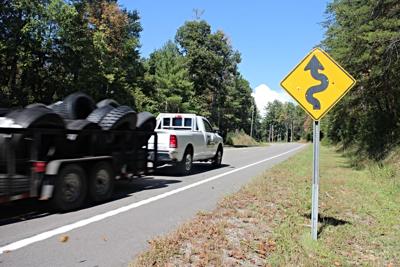

As part of a federal program that addresses safety issues on roads prone to car accidents, several stretches of road in Burke County will have rumble strips, long-life reflective pavement markers, and high-visibility crosswalks installed to keep drivers alert and prevent further accidents.
State officials said the Federal Highway Safety Improvement Program identifies roads and intersections prone to accidents, ranking them for review and funding safety improvements.
As of Thursday, Oct. 15, such work was in progress on N.C. 181, with rumble strips and reflective markers already in place at least as far northwest of Morganton as the Brown Mountain scenic overlook, while paint striping has yet to be completed on some sections of the road.
NCDOT Division Traffic Engineer Randy Tritt said high-visibility crosswalks, rumble strips, and permanent reflective markings are part of NCDOT’s “toolkit” for catching drivers’ attention in areas where extra caution is needed.
On N.C. 181, for example, “You get just a few miles outside of Morganton and you start climbing the mountain, and you get a lot of horizontal changes,” said Tritt. “(It’s) definitely one where the driver has to be alert when they’re driving and certainly slow their speeds down.”
Rumble strips and reflective markings have already been installed on N.C. 18 from Drexel Road to the Catawba County line as part of the HSIP, according to Tritt.
U.S. 70 west of Glen Alpine, where the road is relatively straight but traverses a series of sharp hills, will get rumble strips and reflective markings as well, according to a North Carolina Department of Transportation document outlining approved HSIP projects.
Several portions of U.S. 64 north and south of Morganton have also been approved for rumble strips and reflectors, as well as Miller Bridge Road between N.C. 18 and Interstate 40.
According to NCDOT’s online Projects Near Me map, safety improvements are forthcoming for South Sterling Street at Bethel Street and Poteat Street near the Broughton Hospital entrance, including pedestrian signals, curb ramps, and high-visibility crosswalks at both intersections.
According to Casey Fulbright, senior transportation planner at the Western Piedmont Council of Governments, safety improvement work is also being planned in Glen Alpine for U.S. 70 at London and Bridge streets, including high-visibility crosswalks and curb improvements.
Fulbright said some Glen Alpine Elementary School students cross U.S. 70 on foot at the London Street intersection, increasing the need for a clear, safe crossing.
The HSIP map shows dozens more intersections around Burke County that are prone to accidents.
NCDOT ranked 825 road sections statewide in its preliminary 2026 review using a weighted formula that considers crash frequency, the percentage of crashes matching a particular pattern, and crash severity. Here is how five Burke County road sections ranked. A lower number indicates a higher priority for analysis and investigation.
- Meytre Avenue Northeast near McGalliard Falls Park in Valdese due to four drivers running off the road, including one at night and one in wet road conditions. Statewide rank: 61.
- Ninth Avenue Drive Northwest at the Hickory Regional Airport due to two drivers running off the road, one at night. Statewide rank: 67.
- Airport Rhodhiss Road near Liberty Church Road due to two drivers running off the road, one at night. Rank: 450.
- Old N.C. 18 in the Yellow Gap area due to two drivers running off the road, one at night. Statewide rank: 497.
- Route 126 near Watermill Glen Alpine Road and Table Rock Middle School due to a driver running off the road. Statewide rank: 679.
Tritt said safety measures are installed when there is a “potential deficit” or “potential hazard,” but was quick to follow up saying that “doesn’t mean there’s one there, or that people need to be scared of navigating them.”
NCDOT Western Communications Manager David Uchiyama objected to describing any road as inherently dangerous, saying that label can overlook differences in roadway design, changing conditions, and driver behavior.
In a prepared statement, he said, “While roads are built and maintained to roadway standards, no two roads are exactly the same, especially in a region with roads and highways that have variable vertical and horizontal alignments.”
He added that factors like “weather, congestion, maintenance condition, emergency-related hazards” can “change road conditions,” while both Uchiyama and Tritt emphasized drivers’ responsibility to remain alert and eliminate distractions.





















(0) comments
Welcome to the discussion.
Log In
Keep it Clean. Please avoid obscene, vulgar, lewd, racist or sexually-oriented language.
PLEASE TURN OFF YOUR CAPS LOCK.
Don't Threaten. Threats of harming another person will not be tolerated.
Be Truthful. Don't knowingly lie about anyone or anything.
Be Nice. No racism, sexism or any sort of -ism that is degrading to another person.
Be Proactive. Use the 'Report' link on each comment to let us know of abusive posts.
Share with Us. We'd love to hear eyewitness accounts, the history behind an article.