


HICKORY — Executives with Charlotte Water wanted input about their request to siphon more water from the Catawba Basin. Concerned citizens and public officials — including a large contingent from Burke County — gave it to them by the bucketful.
Charlotte Water hosted a public meeting in Hickory Wednesday to hear comments and answer questions about its plan to nearly double the amount of water the Queen City pulls from the Catawba River via the long-standing interbasin transfer agreement from 33 million gallons per day (MGD) to 63 MGD.
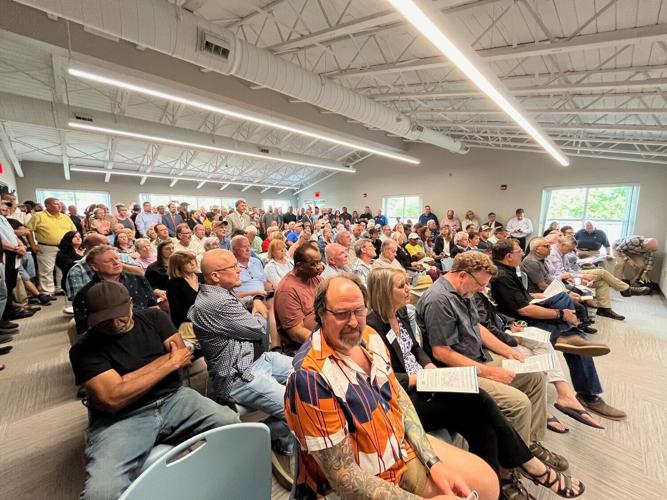
In response, folks filled Ridgeview Public Library to overflowing and peppered Charlotte Water with questions and often pointed comments.
By the time the meeting began, the modestly sized conference room was at its 200-person capacity, with seated attendees flanked on three sides by a standing crowd, three or four deep in places.
Elected officials and representatives from nearly every municipality along the upper Catawba, including Morganton, Valdese, Rutherford College, and Rhodhiss, showed up and announced their official opposition to the move.
Many, including Morganton, Valdese, and Rutherford College, had already passed resolutions against the transfer, as had the Burke Board of Commissioners.
Burke County Manager Brian Epley and Deputy Manager Alan Glines were joined by their counterparts from McDowell and Catawba counties. Members of conservation groups like Catawba Riverkeeper and the Lake James Environmental Association were in attendance as well.
Several times, a random voice from the audience punctuated the proceedings by bellowing, “No Water!”
The initial IBT in 2002 sparked a groundswell of opposition, as did a request for additional water for the towns of Concord and Kannapolis in 2005. The IBT’s foes contended the transfer and the subsequent lower water levels it might produce would adversely affect the Catawba Basin, especially in times of drought.
Last week, the Western Piedmont Council of Governments issued a statement listing some of the possible negative effects the increased consumption could have upstream from Charlotte.
The WPCOG said transferring water from the Catawba Basin reduces future growth opportunities for communities in our region; reducing the flow of the river could lead to greater concentration of pollutants; and IBTs of this size subsidize growth in other areas using the Catawba’s limited resources.
Wednesday’s event was the first in a series of five meetings Charlotte Water is holding to gather public comments about its request to the Environmental Management Commission to up its transfer rate dramatically.
It was, however, the only meeting currently scheduled for the upper Catawba basin. The others will be held in Charlotte, Albemarle, and downstream Catawba Basin towns Camden and Florence, South Carolina, although Charlotte Water officials did promise to hold a follow-up meeting in this area.
Comments from the public meetings will eventually be included in a comprehensive environmental impact statement (EIS) Charlotte Water must produce and present to the Division of Environmental Quality (DEQ).
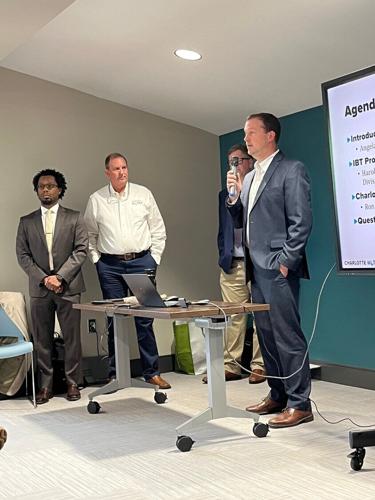
Harold Brady, the DEQ’s Water Supply Development Coordinator, detailed the history of IBTs in the state and outlined the nuts and bolts of the process. Several Charlotte Water executives also spoke before opening the floor to the public.
At times Wednesday, answers to questions posed by members of the audience were vague, but this much is certain: This is only the beginning of a lengthy and complicated process that will almost certainly take several years to resolve.
Opposition to the move came from all sides of the room.
“It’s our water, folks,” said Valdese Mayor Charlie Watts. “They can say it’s not about money, but I have a hard time believing that.”
Hickory Mayor Hank Guess said his city is against the increase as well.
“The city of Hickory’s stance on this is, we’re going to do everything we can to oppose this,” Guess said.
N.C. Rep Jay Adams, whose House district includes part of Catawba County, said the entire process is off to an inauspicious start.
“I know you’re upset,” he said to the audience. “I’m upset. This did not start off well.”
Angela Charles, Executive Director for Charlotte Water, tried to strike a conciliatory tone, telling the crowd: “This area is upstream from us, and we take what comes down the river to our community, and we treat it well, and we treat it with respect. We are here to listen. We are here to get your comments. We are here to hear your questions.”
But the majority of the speakers sounded a lot like Cajah’s Mountain Mayor Ronnie Setzer.
“I just think this is all about what Charlotte wants,” Setzer said. “If we’re going to be fair about this and talk about the impact it’s going to have on Charlotte, let’s hear about the impact it’s going to have on us, because we’re a growing area ourselves.”
Beth Heile, Executive Director of the Burke River Trail Association, sat in the front row at Wednesday’s meeting. After reflecting overnight, she said she’s prepared for a long fight.
“Protecting the Catawba River for all uses — water supply, recreation, economic development, power generation, and wildlife habitat — is critical,” said Heile Thursday morning. “We are at the very start of a long process for the Charlotte Water Interbasin Transfer and we will advocate until the final vote.”
Both sides understand they’re in the opening skirmish of a protracted battle.
“We’re very early on in this process,” Charles told the crowd Wednesday. “There will be ample opportunity for input.”
























(0) comments
Welcome to the discussion.
Log In
Keep it Clean. Please avoid obscene, vulgar, lewd, racist or sexually-oriented language.
PLEASE TURN OFF YOUR CAPS LOCK.
Don't Threaten. Threats of harming another person will not be tolerated.
Be Truthful. Don't knowingly lie about anyone or anything.
Be Nice. No racism, sexism or any sort of -ism that is degrading to another person.
Be Proactive. Use the 'Report' link on each comment to let us know of abusive posts.
Share with Us. We'd love to hear eyewitness accounts, the history behind an article.