




Editor’s Note: This is the fourth installment in an investigative series.
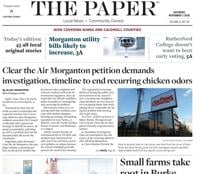
Frustrated by what they describe as years of municipal and corporate inaction over a recurring, offensive odor, Morganton residents presented City Council on Monday with a grassroots strategy to identify its source, demand accountability, and bring an end to a problem they say has disrupted daily life across the community.
Organized under the banner Clear the Air Morganton, the campaign combines a growing petition, an interactive website that documents odor complaints and connects residents with state environmental regulators, and a demand that city officials establish a public timetable for investigating and correcting the problem.
The concern centers on a recurring smell that residents associate with chicken slaughter, dressing, processing, and packing operations at Case Farms, 121 Rand St., near the North Carolina School of Science and Mathematics campus.
(Emily Cunard, director of communications at NCSSM, said students have mentioned the odor, but it has not been a pervasive problem on campus because the school’s buildings generally prevent the smell from entering.)
The organization’s message delivered during the public comment portion of the council’s Nov. 2 meeting was straightforward: Residents are less interested in assigning blame than determining who is responsible for fixing the problem and ensuring that it gets done.
In a Nov. 4 follow-up letter to Mayor Ronnie Thompson and City Council, Clear the Air Morganton formally requested three actions:
- Immediate investigation: Open an investigation into the source of the recurring offensive odor affecting Morganton.
- Clear timeline: Provide the community with a specific timeline for the investigation and its findings.
- Public progress report: Place a progress report on the investigation first on the agenda for the December City Council meeting.
In response to questions from The Paper, City Manager Sally Sandy said on Thursday in an email, “As with any odor complaint, the City will try to locate any odor as described in the complaint. The City does this by driving, walking and visual observation in the area of suspicion.
“Visual observation would be to check our assets, storm drains, wastewater lines, manholes or outfalls for signs of deficiency or degradation,” she said. “If we find leaks or failures in our assets, we will fix them. If we find discharge that is unusual or unexpected, we will try to locate the source.”
Sandy said that city staff met with Case Farms officials after the October City Council meeting and toured the company’s Rand Street facility.
Case Farms operates as an industrial wastewater pretreatment customer under a city-issued permit, which is incorporated into the city’s state-regulated wastewater treatment program.
City staff monitor and sample the company’s wastewater to determine compliance with what officials describe as stringent water-quality limits. That monitoring does not address odors.
“No upgrade to our wastewater facilities was required to serve Case Farms and the expanded facility,” Sandy said. “It is my understanding that the expansion accommodates a packaging process, not a treatment process.”
The organization also requested that city officials acknowledge the petition and explain how they intend to proceed by the end of Friday, Nov. 6.
Several Morganton City Council members have requested information about how the city investigates odor complaints, Sandy said. City staff are compiling that information and have briefed council members on their recent visit to Case Farms.
“I believe this to be in preparation for a formal response to the ‘Clear the Air’ group,” she said. “It is certainly worth noting that the City has no legal authority to issue, regulate or evaluate air quality issues or air quality permit violations.”
Within the petition’s first week, organizers reported about 700 signatures, with approximately 100 additional signatures a day. More than 100 residents also submitted written comments describing their experiences with the odor.
Some particularly relevant examples include residents reporting that they cannot open their windows, business operators saying the odor discourages customers, people avoiding downtown businesses, and residents reconsidering buying homes in Morganton.
The 131 written comments submitted through the Clear the Air Morganton petition were grouped into seven overlapping categories:
- 100 comments addressed the intensity or frequency of the offensive odor.
- 37 comments described effects on local businesses, shopping, and dining.
- 28 comments reported difficulty enjoying homes, yards, and outdoor activities.
- 21 comments raised concerns about housing, relocation, or property values.
- 20 comments described physical discomfort or health-related concerns.
- 20 comments expressed concern about the odor’s effect on visitors and Morganton’s reputation.
- 17 comments demanded accountability, an investigation, or corrective action.
But organizers emphasize that determining the source, rather than assigning blame prematurely, is central to their campaign. They say the odor could originate at the processing plant, within the city’s wastewater system, or through some combination of the two.
“I’ve been shocked by how much frustration there is in the community,” said organizer Augusta Patton, who participated in the council presentation. “The (community) response has been really overwhelming.”
For Patton, the issue is personal.
“I grew up here,” she said. “I moved my family down here from New Jersey. I didn’t realize I was moving them into this.”
“It’s been horrible. My kids cry on their way to school when it smells like sewage. This past summer and early fall have been embarrassing.”
Patton said she was struck by how many residents appeared resigned to the smell despite sharing her frustration.
“I’m dropping my kids off in school, and you look around and people are just like ignoring it,” she said. “But it turns out everybody cares a lot. There was just no community action around it.”
That realization helped motivate the effort to organize residents and take their complaints directly to the city government. Step one was the website, ClearTheAirMorganton.com, which launched in January. The petition was launched on Halloween.
Patton also questioned what she described as a lack of response from the City to earlier concerns.
“We haven’t had a response for the specific requests, yet,” she said. “Yes, it’s been (just a few) days, but we were also there a month and a half ago. We didn’t get any response after that one either.”
Central to the campaign is its website, www.cleartheairmorganton.com, which gives residents several ways to participate while providing options for protecting their identities.
Visitors can sign the Stop the Stench petition, report odor incidents, and submit complaints to the North Carolina Department of Environmental Quality, the state agency responsible for environmental regulation and enforcement.
An interactive reporting system allows residents to record the location, date, time, and severity of an odor incident using a five-point scale.
The website also maps the reported incidents, creating a visual record of where and when the smell occurs.
Organizers hope the information will help identify patterns and give regulators more useful evidence than complaints submitted days after an incident.
That distinction matters because the odor is intermittent. Residents may experience an intense smell for several hours, only for conditions to return to normal before an investigator arrives.
Although Case Farms remains a focus of residents’ complaints, organizers say the campaign is not intended to punish the company or presume its responsibility before the evidence is established.
They acknowledged Case Farms’ importance to the local economy as a major employer, while maintaining that economic development and residents’ quality of life should not be competing interests.
For residents, the ultimate objective is less complicated.
They want to open their windows, spend time outdoors, and travel through Morganton without encountering an offensive smell.
























(0) comments
Welcome to the discussion.
Log In
Keep it Clean. Please avoid obscene, vulgar, lewd, racist or sexually-oriented language.
PLEASE TURN OFF YOUR CAPS LOCK.
Don't Threaten. Threats of harming another person will not be tolerated.
Be Truthful. Don't knowingly lie about anyone or anything.
Be Nice. No racism, sexism or any sort of -ism that is degrading to another person.
Be Proactive. Use the 'Report' link on each comment to let us know of abusive posts.
Share with Us. We'd love to hear eyewitness accounts, the history behind an article.