





Hildebran has put the brakes on a proposed artificial intelligence data center that its developer continues telling investors it plans to build, unanimously imposing a 12-month moratorium while town leaders study the industry’s potential costs and benefits.
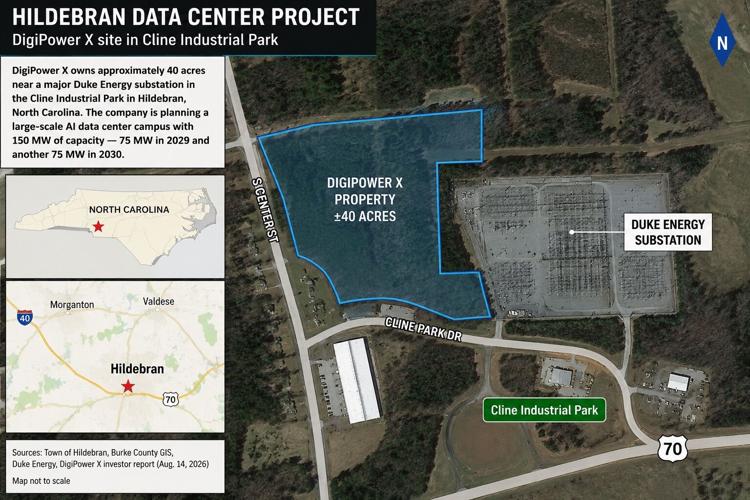
The decision temporarily blocks data center development in a town where DigiPower X already owns about 40 acres near a major electrical switchyard and is planning up to 150 megawatts of computing capacity beginning in 2029.
Town Manager Logan Shook said the pause will give council members time to learn more about data centers and examine both their potential impacts and benefits before deciding how Hildebran should regulate them.
The Aug. 24 decision comes as Hildebran joins a rapidly growing list of North Carolina communities putting at least temporary brakes on data center development.
Counties including Chatham, Clay, Gates, Harnett, Orange, Rowan, and Swain have enacted one-year moratoriums, while Northampton County adopted a longer pause. Durham County, which is home to an office park that helped North Carolina emerge as a global tech powerhouse, last week enacted a nearly nine-month moratorium on data center projects.
(Moratorium proponents in Durham County, some of whom claimed affiliation with groups like the Democratic Socialists of America and the Party for Socialism and Liberation wanted a moratorium with “no loopholes [and] no carve-outs,” Business North Carolina reported this week.)
Apex, Brevard, Canton, and Spring Hope are among municipalities that have approved year-long moratoriums, while other communities have adopted shorter pauses.
The actions reflect a statewide and national debate over an industry expanding rapidly to meet the enormous computing demands of artificial intelligence.
For Hildebran, however, the debate is anything but theoretical.
DigiPower X, a publicly traded AI infrastructure company, owns approximately 40 acres near a large electrical switchyard in Hildebran. It continues to identify the property as the location of a future large-scale AI data center campus.
In an Aug. 14 report to investors, DigiPower X said it is “advancing development planning” for the North Carolina property. Its current plan calls for approximately 75 megawatts of capacity in 2029 followed by another 75 megawatts in 2030.
The company’s continued interest makes Hildebran’s moratorium more than a precaution against some future project.
It temporarily interrupts a development possibility already taking shape.
DigiPower X is rapidly moving into the AI infrastructure business. The company reported approximately $1.1 billion in contracted future AI data center revenue and said an expansion option could increase the potential value of that relationship to approximately $2.5 billion.
The Hildebran debate began publicly in March.
At a March 11 special meeting of the Hildebran Town Council, Town Planner Katelyn Smith told the council the town had recently been approached about potentially developing a data center within the municipal limits.
Hildebran’s zoning ordinance did not specifically address data centers, although it contained regulations for cryptocurrency mining. Smith said that town staff recommended replacing those provisions with broader regulations covering “critical digital infrastructure facilities.”
The resulting ordinance required conditional zoning approval and established standards for noise, vibration, generator operation, lighting, buffers, and setbacks.
It also required developers to obtain verification from electric, water, and sewer providers that sufficient capacity existed without adversely affecting existing customers. Developers would have to submit water conservation plans and comply with monitoring, enforcement, and eventual decommissioning requirements.
Council unanimously approved the changes.
But the town’s concerns were already apparent.
At the March 23 council meeting, Council Member Ben Honeycutt addressed publicity surrounding the proposed data center and said state legislation approved in 2024 prevented Hildebran from simply banning the project.
Honeycutt said the town had done what it could by adopting an ordinance intended to discourage the company from proceeding and encouraged residents to contact their state representatives.
Public opposition intensified during subsequent meetings.
In April, Belinda Cline raised environmental concerns and asked what Hildebran could do to prevent the project from moving forward. Arianna Archer cited a series of potential negative effects and asked the town to impose a moratorium of at least one year.
More residents appeared in May.
James Boggess raised environmental and tax concerns. Thomas Fanizza suggested placing the burden on a developer to demonstrate that adequate water and electricity would remain available and requiring operations to stop if the facility fell out of compliance.
Patricia Fanizza and Jim Rubel also spoke against data centers.
Kurt Schroeder, a beekeeper, raised concerns about potential effects on bees.
Mayor Pro Tem Mike Stroupe responded that Hildebran had updated its zoning regulations to address data centers and encouraged residents to read the ordinance.
By July, residents were explicitly asking for a moratorium. Pat Fanizza presented a petition from opponents, while Tommy Wentz urged council members to pause development while Hildebran studied the industry and its regulations.
The council ultimately did that this week.
Monday’s agenda included a formal public hearing on the temporary moratorium, a presentation by Poyner Spruill, public comments, and consideration of the ordinance. Council members also continued a separate discussion of the town’s noise pollution ordinance.
The vote was unanimous.
Data centers present an unusual economic development equation for communities considering them.
They can bring hundreds of millions — and sometimes billions — of dollars in capital investment and significant additions to local property tax bases. Construction can require large numbers of workers and specialized contractors.
But they typically create considerably fewer permanent jobs than a traditional manufacturing operation carrying a similar investment.
A proposed Lee County data center illustrates the tradeoff. That project could represent approximately $900 million in investment on nearly 430 acres but is expected to create about 40 permanent jobs.
Data centers can also require enormous amounts of electricity, and some designs require significant water for cooling. Noise, generators, transmission infrastructure, and proximity to residential neighborhoods have become issues in communities across North Carolina.
Those competing considerations are now Hildebran’s to study.
The town began the year trying to write rules for an industry it knew might be coming. Residents spent the spring and summer asking officials to slow the process down.
DigiPower X, meanwhile, continues telling investors that Hildebran is part of its future.
For at least the next 12 months, however, that future is on hold.

























(0) comments
Welcome to the discussion.
Log In
Keep it Clean. Please avoid obscene, vulgar, lewd, racist or sexually-oriented language.
PLEASE TURN OFF YOUR CAPS LOCK.
Don't Threaten. Threats of harming another person will not be tolerated.
Be Truthful. Don't knowingly lie about anyone or anything.
Be Nice. No racism, sexism or any sort of -ism that is degrading to another person.
Be Proactive. Use the 'Report' link on each comment to let us know of abusive posts.
Share with Us. We'd love to hear eyewitness accounts, the history behind an article.