

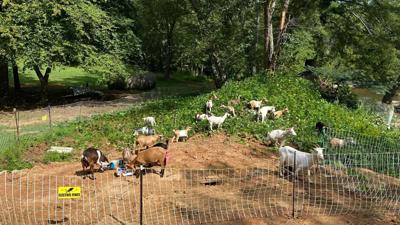

If you’re looking for an alternative to herbicides or mowing equipment for brush control, there is a new crew in the area relying on a process that has been around for millennia: digestion.
Tracie Adams, owner and goat-wrangler-in-chief of Carolina Goatscapers in Connelly Springs, said customers are turning to her herd of brush-devouring goats as an alternative to herbicides and mechanical brush clearing.
“We have so far had very happy clients,” she said. “They love the process.”
Adams said the “goatscaping” process is simple: She shows up with about 20 goats in a trailer, sets up a temporary electric netting fence around the area to be cleared, sets the goats loose and waits.
“They get on the site and they get to eating,” she said.
Varying widely based on terrain and brush density, the goats can eat through about half an acre in a week, she said.
Adams will either cart the goats back and forth from her farm each day, or camp onsite with her flock for a discounted price.
“We’re very protective of the goats,” she said, partly because they are key to her business, but mostly because they are her friends. All 47 goats in her flock have names, and she knows all their ages, personalities and food preferences.
By the end of each job, Adams said, her customers are friends with the goats, too.
“The owners don’t have to do anything,” she said. “They can just hire us and be entertained. I call it dinner and a show. The goats get dinner and everyone else gets a show.”
In one case, everyone got dinner and a show when customers invited the whole neighborhood over for a pizza party to watch the goats hard at work. Of course, some of the work crew took a break for petting and “snuggles,” said Adams.
One customer had so much fun with the goats, they ended up getting a herd of their own to keep their land maintained, Adams said.
Adams said goatscaping is more than a novelty and can be effective at controlling unwanted vegetation. A goat’s stomach has four compartments, she said, and its digestive process can reduce the number of viable seeds returned to the soil through manure.
“Only about 10% of the seeds are going to be viable,” said Adams. “If you want to eradicate something with goats, if you put goats on them a couple times a year, you will eradicate that plant.”
Adams said her goats do especially well with invasive or persistent plants like kudzu, poison ivy, and wisteria.
The goats also can work in hard-to-reach areas. In one case, the property was so steep she had to tie herself off just to set up the fence safely. The goats, on the other hand, had no problem with the terrain.
Adams said her pricing varies widely from job to job and acknowledged the process is not as cost-effective as using herbicides or machinery, but said her customers consider it a worthwhile investment.
“I’m really proud of seeing how many people are trying to get away from spraying herbicides,” she said. “We’re seeing a big change. People used to just throw Roundup on everything. A lot of people … come to me not wanting to spray.”
Brush control is only one facet of a business born from a lifelong love for animals, said Adams.
Adams began taking horseback riding lessons at age 5 and participated in 4-H and FFA programs as a teenager. After college, she left livestock behind and pursued a corporate career, but it wasn’t long before she decided to get back into farm life.
Her purchase of two goats in 2016 led to a phone call from a friend asking if she had heard of “goat yoga.”
One thing led to another, and soon the farm was drawing yoga practitioners to strike a pose and try not to laugh as the goats licked and butted.
At the height of the COVID-19 pandemic, Adams said, she hosted “baby goat snuggles” for people who were feeling isolated and needed some connection.
“It just blew up,” she said. “I love trying new ideas with the goats.”
In response to rabies cases among goats at a mobile petting zoo in the area, Adams said all her goats are given rabies vaccines once they are 4 to 6 months old.
“That was so unfortunate,” she said. “It’s super rare for that to happen.”
Although goatscaping is not a petting zoo, Adams said jobs often take on that atmosphere when the goats arrive.
“Everyone’s happy,” she said, adding that the goats bring as much joy to her as anyone else.
“I think goats are some of the most amazing, incredible animals on the planet,” she said. “Everyone around town calls me the goat lady.”




























(0) comments
Welcome to the discussion.
Log In
Keep it Clean. Please avoid obscene, vulgar, lewd, racist or sexually-oriented language.
PLEASE TURN OFF YOUR CAPS LOCK.
Don't Threaten. Threats of harming another person will not be tolerated.
Be Truthful. Don't knowingly lie about anyone or anything.
Be Nice. No racism, sexism or any sort of -ism that is degrading to another person.
Be Proactive. Use the 'Report' link on each comment to let us know of abusive posts.
Share with Us. We'd love to hear eyewitness accounts, the history behind an article.