

At one point last Friday afternoon, in the midst of the deluge and vicious winds brought by Hurricane Helene, the Catawba River at Bridgewater reached 21.39 feet.
It almost certainly got even higher — the water continued to rise long after the rain had stopped falling — but we may never know just how high.
Rising water fried the gauge’s electronics and stopped it promptly at 4:45 p.m. There is no more info after that.
It may be some time before the final weather-related numbers from Helene’s onslaught in Burke County are in, but the ones available so far have been eye-popping.
Burke 911 Assistant Director Chris White — who also runs Foothills Action Network, a well-established source for meteorological information and weather forecasts — said radar estimates indicate more than 30 inches of rain fell in portions of Burke County.
White said wind gusts as high as 60 mph were recorded in Jonas Ridge.
Lake James rose to 110.75 feet, the highest total recorded in the history of the lake, which was constructed between 1916 and 1923. The 6,500-acre impoundment is considered to be full at 100 feet.
White said the headwaters of Linville River reached a height of 15.47 feet, which is also almost certainly a record. Average for this time of year is around a foot and a half, according to the U.S. Geological Survey.
This much is certain: Helene did far more damage to the area than Hurricane Frances, which caused disastrous flooding 20 years ago this month. During Frances, Lake James hit a maximum level of more than 107 feet; substantial to be sure, but Helene eclipsed that mark by nearly 4 feet.
Records were set above Lake James as well. The Catawba River at Pleasant Gardens hit 18.03 feet, topping the previous mark of 17.6 set during flooding in 2004.
And down toward the lake it came.
All the water from the Linville and Catawba rivers and Paddys Creek surged into the lake and thundered over the spillway in Burke County.
By Wednesday afternoon, Duke Energy reported that Lake James had dropped to 101 feet.
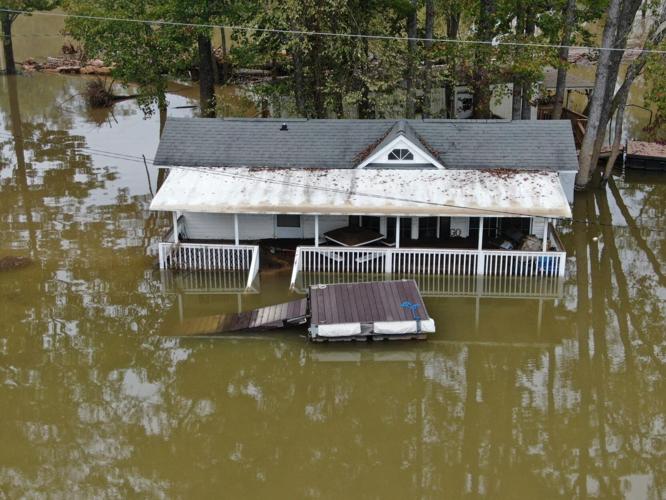
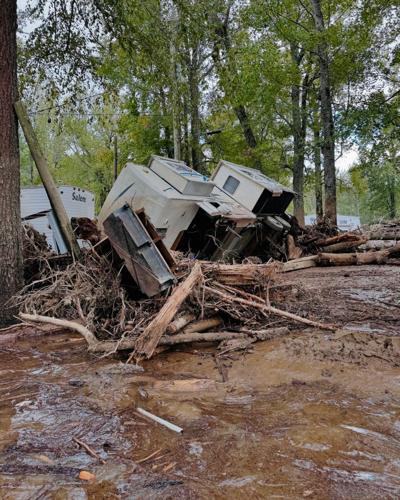
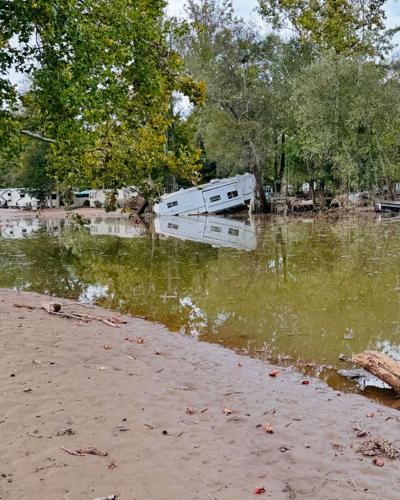
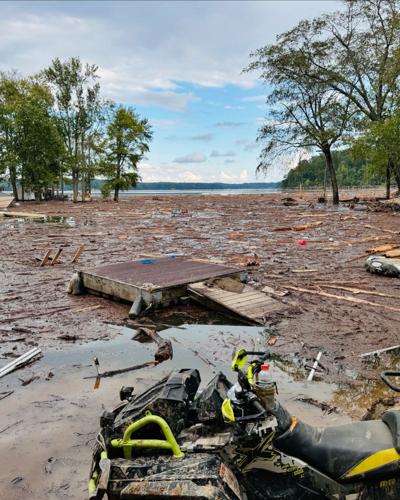
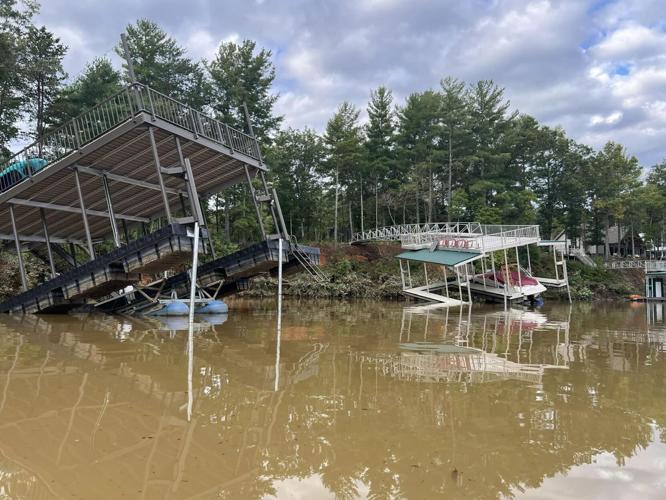
That’s a relief, but little consolation for folks who live and recreate on the shores of the scenic lake. The unprecedented water levels flooded homes, swept campers away, and set boat docks adrift.
Video and photos from Powerhouse Road below the lake posted on social media showed mass destruction to homes and campers.
Reid Scott of Glen Alpine owned the former Mountain Harbour Marina at the Canal Bridge for 20 years from 1981 to 2001 and owns a camper at the Moose Lodge on the shores of Lake James in McDowell County.
He weathered Hurricane Hugo in 1989 but said Helene is worse.
“It’s the worst one we’ve ever had,” Scott said. “(Hurricane) Hugo (1989) was bad; there was a lot of wind. But this was mostly water and some wind.”
“I had a lot of water damage before, but nothing like they got this time.”
Scott’s camper, located on high ground, is fine. But others at the Moose Lodge weren’t so lucky.
“There’s a lot of campers (that were swept into the lake),” said Scott. “I’ve got a camper at the Moose Lodge up on what they call the mountain, but they’ve got a place down there they call the Island, and all the campers on the lake side of the Island are gone. Down the lake somewhere — who knows where? — but they’re gone.”
Gone, too, are a large number of boat docks from homes encircling the lake. It’s a scene similar to 2004 when stories emerged of docks floating many miles from their original locations.
Scott said most docks are anchored with pilings now, but they can still break loose.
“Docks will pretty well take care of themselves,” Scott said. “They’ll float up and float down. You’ve got pilings on most of them anymore to hold them, and as long as they don’t float off of the pilings, when they come back down, they go back in the bracket.”
That wasn’t the case back in ’89 when Hugo struck.
“Back then, everything I had was on ropes, and I was replacing ropes all night long,” Scott said. “As long as the wind was coming from down the canal, it was all right. But when the eye went through and it turned around and came from the other direction, that’s when all Hell broke loose.”
Although the wind associated with Hugo was ferocious — gusts of 60 mph were recorded in the area — that storm didn’t produce anywhere near the volume of water Helene did.
Scott said water that high inflicts severe damage on lakeside homes. He has a good friend who owns a home on the lake with 3 feet of water in the living room.
There are many others in a similar predicament and some much worse.
In the coming days, the waters will recede. The rivers and lakes will return to normal. But Helene’s destructive power will be felt for decades, especially for those on or near the waterways.
























(0) comments
Welcome to the discussion.
Log In
Keep it Clean. Please avoid obscene, vulgar, lewd, racist or sexually-oriented language.
PLEASE TURN OFF YOUR CAPS LOCK.
Don't Threaten. Threats of harming another person will not be tolerated.
Be Truthful. Don't knowingly lie about anyone or anything.
Be Nice. No racism, sexism or any sort of -ism that is degrading to another person.
Be Proactive. Use the 'Report' link on each comment to let us know of abusive posts.
Share with Us. We'd love to hear eyewitness accounts, the history behind an article.