

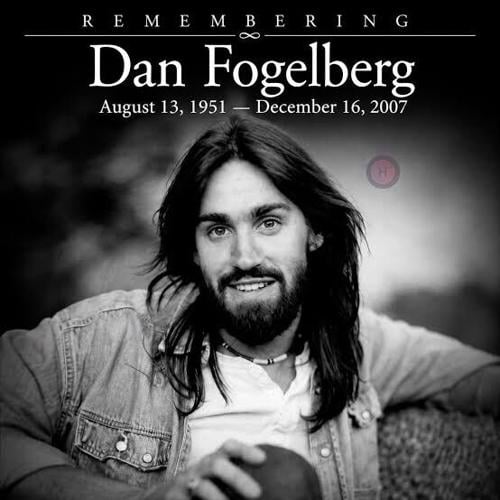




When I heard of Dan Fogelberg’s death at 56 nearly 20 years ago, I called a childhood friend in Philly, and we reminisced about growing up in Hampton singing “Longer” in the acoustically perfect tile showers at Hampton High after tennis practice. Fogelberg’s death felt like a personal loss, and, proverbially, reminded my friend and me of our own fragility.
Many have said, and ‘tis true for me, that Fogelberg’s music was the soundtrack of their lives. Fogelberg was like the older brother I never had, writing dense letters from college about life beyond the tethers of home.
His ballads took me to Tennessee, Tucson, the Wild West, the sea in winter, mountains and small towns, a snowy parking lot with a six pack and an old girlfriend on Christmas eve, to the Kentucky Derby, Sutter’s mill, and, even, the manger.
He told me about his dad, about a hopeful salesman, Scandinavian and Irish immigrants, gamblers, and tired pilgrims aching for the home from which I was eager to spring.
He warned me about nukes and chided me about clogging my life with the traffic of modern distraction and busyness. The mountains, and, later, the sea about which he sang seemed pure and inviting.
I liked his ballads best, but his love songs got more radio airplay. Many of those lyrics now strike me as syrupy. His views on love are romantic and often shallow.
The fluttery love in “Longer” doesn’t last forever, a painful but inevitable surprise to lovers everywhere – at least it was to me. If love doesn’t crash in tangled wings, it becomes stronger and earthier, like a pack mule, maybe, and less giddy, more bowed. And that’s a very good thing but doesn’t make a four-minute pop song.
I’m suspect of such a lyric nowadays. But when his records flew out of the bins at Mother’s Records and Tapes at Ward’s corner in Norfolk and his concerts routinely filled arenas, I hung on every word.
I believed with Fogelberg that my lovelorn euphoria would last longer than the fishes in the ocean, and I doubted that a lasting love was as difficult as his somber “Make Love Stay” suggested.
What did this older brother know that I did not?
Storytellers like Fogelberg exist today, but none captures the sense of longing that soaked most of his songs. Netherlands is drenched in it, and one almost needs resuscitation after listening to “Scarecrow’s Dream” and “Sketches” back-to-back.
I played AC/DC’s “Back in Black” when my first summer girlfriend dumped me. A screaming, defiant Angus Young — or was it simply sheer decibels? — helped mask the pain, helped buck up my broken spirit. But Fogelberg’s “Sketches” was a mirror that revealed the real me:
“Late in the summer/When the cottonwood dies/The fields are on fire/With green bottleflies/And I’m still seeing reflections/Of me in your eyes/And why did you leave/Last summer?”
“Why?” was an excellent question. And I’m glad that he didn’t try to answer it. Not even in his post-divorce album about love-gone-wrong did he dole out lyric answers.
He studied painting before transferring from the University of Illinois to life in the Los Angeles fast lane with his six string and agent Irvine Azoff, half of Blytham Promotions with Bob Nutt.
He brought his painterly sensibilities with him, content with capturing the image and leaving the wherefore and whys to the psychology majors and the well-meaning preachers. Remember how that chance meeting with his old flame ended?
“Just for a moment I was back at school/And felt that old familiar pain/And as I turned to make my way back home/The snow turned into rain.”
You could hang that next to a Norman Rockwell in Stockbridge.
In the days before email, I tamed my sloppy handwriting to write songs of my own, as well as love letters, the beginnings of stories that I’m still trying to finish, and sentimental journal entries.
I warbled on about salt air breezes off the Chesapeake Bay that stirred the neighbor’s magnolia. But anything I wrote, I now know, derived in great measure from Fogelberg lyrics about, among other things, magnolias, and changing horses in the middle of the stream, about rings around the moon, and the end of October and the sleepy brown woods seeming to bow down their heads to winter.
During my junior year of college, I bought “High Country Snows” from Peaches Records and Tapes on Parham Road in Richmond, came back to my drafty Fan neighborhood apartment, and with the rats in the walls, listened on my used couch without moving except to turn the record over.
And over, and over, and over.
If his lyrics seem naïve and his views thinly romantic, I know I should cut him some slack. When his first Greatest Hits album hit stores, he was barely 30 years old.
In the long, December hours between his death and funeral, I dusted off my Dan Fogelberg records. I have his first 13, and various collections since. “Windows and Walls, The Nether Lands, Souvenirs.” They are a scrapbook for me as much as they are a collection of songs.
My teen and tween sons consumed edgier, funnier stuff. Old Elvis Costello. The Barenaked Ladies. My eldest sat a while with me listening to Fogelberg. He was more interested in how my ancient record player worked than the actual music. I cranked up the scratchy volume. Who cared that it was past my two younger sons’ bedtime? My wife and they sensed it best not to interrupt my private auld lang syne.
Not only did these tunes bring me way back, there was something fresh about them. Most still hold up. I shouldn’t have been surprised.
And I knew every word by heart.
























(0) comments
Welcome to the discussion.
Log In
Keep it Clean. Please avoid obscene, vulgar, lewd, racist or sexually-oriented language.
PLEASE TURN OFF YOUR CAPS LOCK.
Don't Threaten. Threats of harming another person will not be tolerated.
Be Truthful. Don't knowingly lie about anyone or anything.
Be Nice. No racism, sexism or any sort of -ism that is degrading to another person.
Be Proactive. Use the 'Report' link on each comment to let us know of abusive posts.
Share with Us. We'd love to hear eyewitness accounts, the history behind an article.