


It is early May. I am sitting near an open window, leaves swaying in the breeze outside. Across the table from me is an unremarkable-looking couple. I assume that they are academic lightweights like myself. Nothing could be further from the truth; both are Harvard-trained linguists. He is an expert on Nordic languages. We are here for a 5-day course. “The Life and Works of C.S. Lewis: Inspiration, Belief and Imagination.”
On a whim, I had chosen this course because it was close to home. If necessary, I could slip down the mountain. Leave if hopelessly bored. Instead, it set me on a path, without really intending it, to think deeply about wonder. I was in for a remarkable five days.
When had I last experienced a stirring of awe? That extraordinary feeling of amazement when you are surprised and overwhelmed by unexpected beauty. C.S. Lewis believed that when wonder encounters the numinous, as it often does, something shifts.
Numinous is, by definition, an experience of the inexpressible, the marvelous. It takes your breath away. It is such a profound encounter that it captures the feeling of being in the presence of something larger than oneself.
The mysterious, the Divine, the “Holy Other.” It is unannounced; it just happens. The numinous is to be found everywhere: in both the grandest and the commonest of places. A sunset, a landscape, a smile, art, a cathedral with soaring arches, music, or a perfectly timed, deep human connection. The list goes on and on.
It is as if, in the words of the poet Gerard Manley Hopkins, “The world is charged with the grandeur of God. It will flame out, like shining from shook foil”. All that is necessary to see this radiance is to be open to the wonder of it all. To allow oneself to be surprised by joy. That, in fact, is the title of C.S. Lewis’s memoir, Surprised by Joy.
C.S. Lewis was a 20th-Century English writer, famous for The Chronicles of Narnia, Screwtape Letters, Mere Christianity, and many others. While teaching at Oxford University, he and writer J. R. R. Tolkien, author of The Lord of the Rings, were members of a small, tight-knit group called the Inklings. They met for nineteen years, twice a week. They met in the back room of the pub, The Eagle and the Child, or in Lewis’s rooms at Magdalen College. They discussed weighty subjects and offered critiques of each other’s writings.
Lewis was fascinated by Norse legends. An avowed agnostic, in the most implausible of ways, it was his friendship with Tolkien and his study of Nordic myth that later convinced him that Christianity was a myth that was real, a fact.
It was the basis for his book Mere Christianity. The book’s manuscript began as a series of 15-minute BBC radio broadcasts delivered on air by Lewis from 1941 to 1944. The series put Lewis’s certainty about Christianity in plain words. It offered spiritual hope and assurance to a dark, war-torn England.
The Lion, the Witch and the Wardrobe is the first in his Narnia series. It is a story about wonder and curiosity. A child, Lucy, opens a large antique wooden wardrobe on a rainy day. Pushing aside the many layers of clothes, she suddenly finds herself in a magical kingdom.
Children, I believe, are more porous and open to wonder than we as adults.
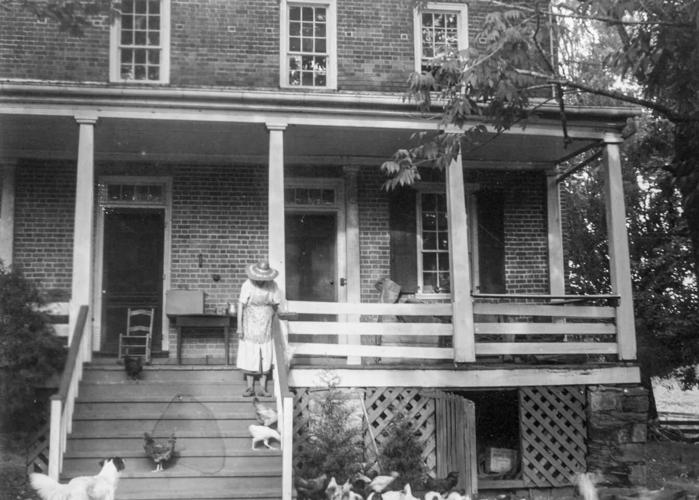
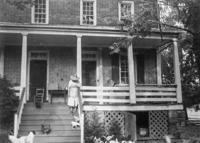
As a child, my magical kingdom was the Perkins Farm, or Pleasant Valley Plantation. My story begins with Susan Elizabeth Perkins, the great-granddaughter of Gentleman John Perkins, for whom the Johns River is named.
The double-front door two-story house stood hard by the river. Wide porches in the front and back of the house were surrounded by outbuildings and fields where sheep, chickens, and ducks wandered.
Miss Susie and my grandmother attended Peace College in Raleigh. After my grandmother moved to Morganton, their friendship deepened.
We visited often. Once the usual niceties had been exchanged, my brothers and I were free to roam. Every barn, smoke house, and corn crib were open to exploration.
Wonder and surprise were just around each corner. We believed there was a small boat hidden in one of the upstairs bedrooms, so that the Perkins could escape when the river flooded. We secretly searched for a canoe but never found it.
Each of us had been rocked in the Perkins cradle. Susie had given her family heirloom to my grandmother. She insisted that my grandmother keep it in the bosom of our family. My Grandmother was unspeakably moved.
Took the cradle home, and my mother and aunt were rocked there. A tradition now in place, my brothers and I and all of our children were rocked in the cradle. Each child, each generation, and so it became a sort of baptism, a sacred rite. Then my own grandchildren.
Laura was the oldest of my grandchildren and the first to sleep in the Perkins cradle.
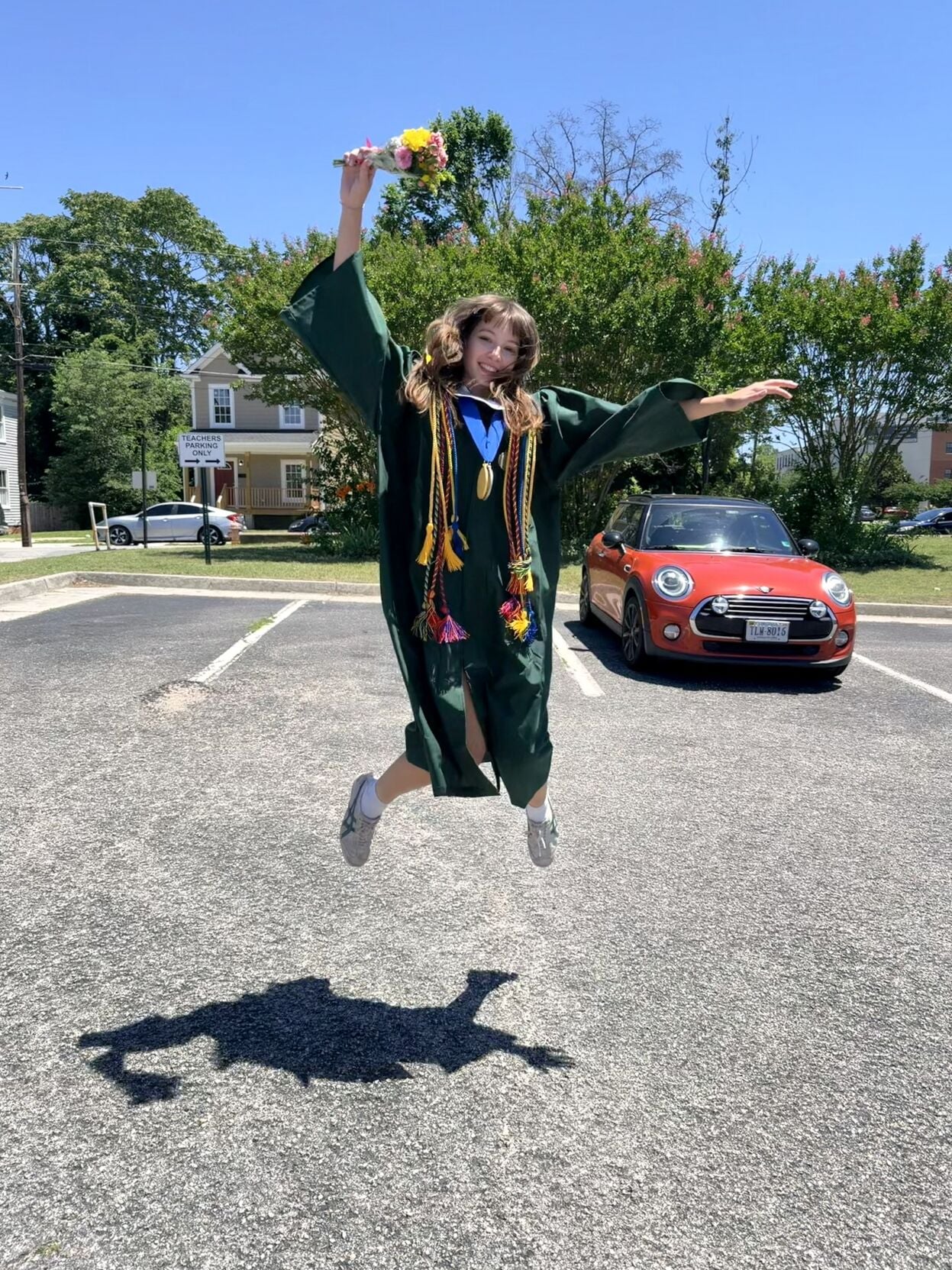
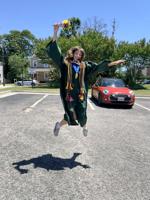
So, it was amazingly serendipitous that Laura’s graduation from high school would be the bookend to my month-long study of wonder. Her high school, The Appomattox Virginia Governor’s School for the Arts and Technology, is unique in its own right. Students balance academic and humanities courses alongside studio time, mentorships, and technology-driven projects. Laura is both a scientist and an artist.
In our cynical and fractured world, can reason and science exist alongside the wondrous, the imaginative? The school and its students are a testimony to the fact that these two disciplines can exist side by side.
On a cloudless blue-sky day, in late May, it became clear to me that hers would be no ordinary graduation. Graduations are joyous occasions, but in all fairness, this one was extraordinarily exuberant.
There were 120 graduates. They came from all over the Appomattox region of Virginia. Big cities and tiny towns. They were racially and culturally diverse. The auditorium was small. A repurposed, beautiful structure, it balanced elegance and function.
The minute that the orchestra began to play Pomp and Circumstance, and yes, it was an orchestra and not a band, after all; the school taught performing arts. I began to cry, albeit quietly.
When the senior class advisor spoke, she wept openly and told the graduates how much she would miss them. They responded with thunderous applause.
The graduation speaker was an alumna of the school and a Carnegie Mellon University graduate, now performing on Broadway. She told the class to hold fast to their dreams, and always to be open to wonder and surprise. Don’t let the world harden you and steal your curiosity and creativity. Trust in the importance of art and beauty.
One by one, graduates walked across the stage and shook hands with the school president. With each graduate, many families stood and shouted, “That’s my girl …,” “That’s my brother …,” “That’s my sister.”
Pride and love were everywhere. The crowd simply erupted into unbridled joy and spontaneity. People danced and stomped in the aisles. The place shone like a thousand suns.
I never expected to be so moved by such a simple ceremony. Or maybe the truth is that I was never as open to spontaneity and awe as in that moment. Never as surprised by joy.
Thank you, Laura, for this gift. It blew this old woman’s socks right off. Safe travels this Fall to California and Berkeley. May you continue always to live in the neighborhood of wonder.



















(0) comments
Welcome to the discussion.
Log In
Keep it Clean. Please avoid obscene, vulgar, lewd, racist or sexually-oriented language.
PLEASE TURN OFF YOUR CAPS LOCK.
Don't Threaten. Threats of harming another person will not be tolerated.
Be Truthful. Don't knowingly lie about anyone or anything.
Be Nice. No racism, sexism or any sort of -ism that is degrading to another person.
Be Proactive. Use the 'Report' link on each comment to let us know of abusive posts.
Share with Us. We'd love to hear eyewitness accounts, the history behind an article.