

“Peculiar travel suggestions are dancing lessons from God.” That line from Kurt Vonnegut’s “Cat’s Cradle” has stayed with me for 60 years.
It suggests that life’s detours — unexpected, even inconvenient — are invitations. Opportunities disguised as disruptions.
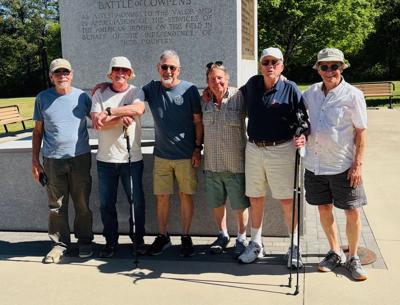
I thought of it when Tommy casually suggested over lunch that a few of us drive to Cowpens last Wednesday. Tommy is a history buff, and it turned out so are Richard, Danny, and Merle.
John offered to drive; his new Toyota Highlander could take six. Remembering Vonnegut, I asked to be the sixth.
We gathered at Tommy’s at nine, and nobody was late, which is actually fairly typical for retired men with nowhere they have to be.
There was mild grumbling about grown men being consigned to the third row, but John’s Highlander earned high marks, as did his driving. I sat up front, kept my seat pulled forward, and my mouth shut.
Thirty minutes in, we stopped at the site of the Biggerstaff Hanging Tree, on what was once the Biggerstaff plantation in Bostic. This was an appetizer before our main course.
Nine Tories were hanged there in October 1780, three at a time. Twenty-seven others had their sentences commuted, a mercy that likely meant more to them than to history.
We reached Cowpens National Battlefield around 10:45. After stretching our legs, we climbed the gentle slope to the modest visitor center, where admission was free.
A helpful docent told us a 14-minute film on Britain’s Southern Campaign would begin at 11. We visited the men’s room, watched the film, browsed the gift shop, visited the men’s room again, and then sat through a second 14-minute film, this one on the battle itself.
Let me set the stage.
Morganton is named for Brigadier General Daniel Morgan, the clear hero of this story. The villain is Lieutenant Colonel Banastre Tarleton. You can guess where they met.
In 1778, the British launched their Southern Campaign, drawn by lucrative crops like rice, tobacco, and indigo that they couldn’t grow on the British Isles, and by the belief that Southern Loyalists would rally to the Crown.
They weren’t entirely wrong. The South Carolina backcountry was nearly split in two, with neighbors fighting neighbors in a cycle of raids and reprisals.
General George Washington sent Nathanael Greene south to manage the crisis. Greene split his army, sending Daniel Morgan west of the Catawba to threaten British supply lines. Lord Cornwallis responded by unleashing Tarleton to hunt him down. Tarleton was only 26 but was already feared and widely despised. At Waxhaws the year before, his troops had slaughtered Americans attempting to surrender.
Morgan knew Tarleton was coming for him, and he chose to fight at Cowpens, ground he knew well. He also knew that Tarleton was fast, aggressive, and confident that Morgan’s militia would break and run as they had in other battles. Morgan turned that expectation into a trap.
Each side fielded about a thousand men. Tarleton’s troops arrived tired from a forced march. Morgan’s were rested. The night before the battle, Morgan moved among the campfires, speaking to his militia — mostly local farmers, many within a day’s ride of their home — steadying their nerves with his calm confidence.
On January 17, 1781, he arranged his army in four groups. First came sharpshooters, told to fire three well-aimed shots, preferably at officers, then turn and run. Behind them stood militia, instructed to fire two volleys, then turn and run. The British recognized retreat and assumed victory. They pressed forward, disordered but eager.
Then they crested a slight rise and met Morgan’s Continental regulars, who delivered a crushing, close-range volley.
When Tarleton tried to turn the American flank, the trap snapped shut. On one side, cavalry under William Washington (George’s second cousin) charged from concealment. On the other side, the “retreating” militia re-formed and surged back into the fight.
The British line collapsed. Some 600 soldiers surrendered. Many of the rest were cut down or scattered. Washington charged at Tarleton, waving his saber. Tarleton narrowly escaped after shooting Washington’s horse.
The battle lasted less than an hour. About 120 British soldiers were killed, 200 wounded, and roughly 600 captured. American losses were strikingly light — about 25 killed and 125 wounded.
Morgan’s victory at Cowpens shattered a British field force, disrupted Cornwallis’s campaign, and helped set in motion the chain of events leading to Yorktown, and ultimately America’s independence.
After touring the field (Tommy and I sensibly turned back after about five hundred yards and retreated to the shade of the visitor center), we drove to Chesnee for lunch at the Bantam Chef, then headed home to Morganton. Morgan’s town.
Like Morgan’s double envelopment battle tactic, our trip had been a good idea, well executed.
Vonnegut would have approved.


















(0) comments
Welcome to the discussion.
Log In
Keep it Clean. Please avoid obscene, vulgar, lewd, racist or sexually-oriented language.
PLEASE TURN OFF YOUR CAPS LOCK.
Don't Threaten. Threats of harming another person will not be tolerated.
Be Truthful. Don't knowingly lie about anyone or anything.
Be Nice. No racism, sexism or any sort of -ism that is degrading to another person.
Be Proactive. Use the 'Report' link on each comment to let us know of abusive posts.
Share with Us. We'd love to hear eyewitness accounts, the history behind an article.