




A group of students at the North Carolina School for Science and Math-Morganton (NCSSM-M) are getting unique hands-on lessons in ecology and cutting-edge DNA science, all thanks to an owl that made itself at home in an old campus building.
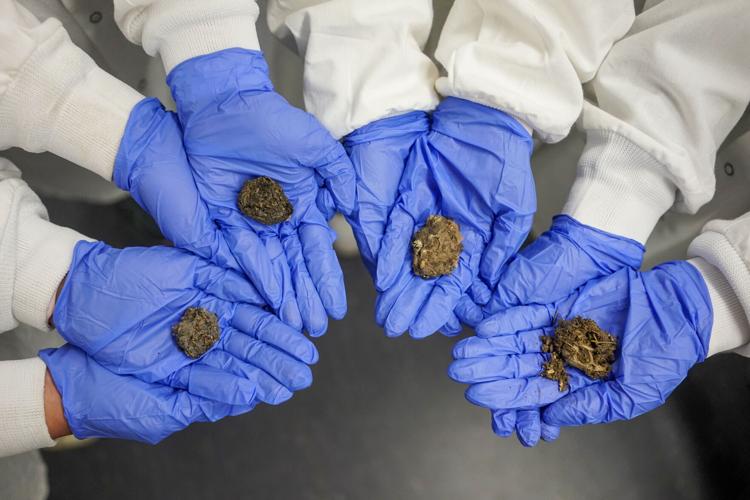
The discovery of owl pellets in Joiner Hall has turned into a two-year, high-tech biological investigation for several students. The pellets are the undigested parts of a bird’s food, such as hair or bones, which form a mass that is regurgitated and cast up through the beak.
Joiner was once part of the North Carolina School for the Deaf (NCSD) campus but had been abandoned and fallen into disrepair long before NCSSM-M created its western campus on land the two institutions now share.
In 2023, NCSSM-M began renovating the colossal building. The repurposed hall will open later this year, transformed into a contemporary educational space featuring advanced classrooms for art, data science, and computing.
As workers gutted the grand old three-story structure, they disturbed the nesting area of at least one owl — possibly more — that had made the cavernous building its home. As a result of the owl’s temporary habitat, the earthen floor of Joiner Hall became littered with owl pellets — hundreds of them.
Jennifer Williams, NCSSM-M science department chair and biology instructor, heard about the owl and the pellets from her husband, a campus facilities worker.
“He was actually in the building and the owl had swooped at him,” Williams explained. “So, he did see the owl, and he’s the person who let us know about the pellets and helped us get access to the building when we were ready to go collect them.”
Three seniors, members of the school’s Class of 2024, dug into dissecting the owl pellets, sorting and categorizing the remains they found inside. The seniors were joined last year on the project by four juniors, now seniors themselves.
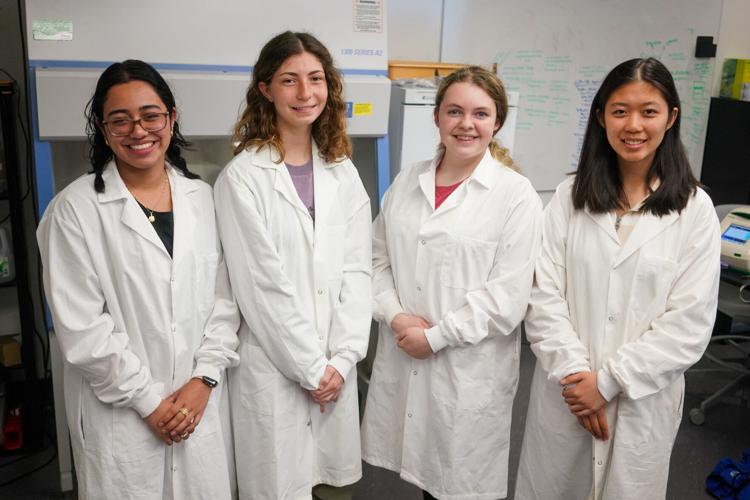
Those students, Adrija Sarkar, Emily Bresseden, Lauren Yu, and Meghan Leonard, have continued work on what is now known as the Owl Pellet Project, with Williams as their faculty sponsor.
“We were really curious about what the owl was eating, and one good way to find out is to dissect the pellets,” said Leonard.
“Owl pellets are the undigested parts of their food that they regurgitate,” explained Yu. “And a common misconception is that people think that owl pellets are like owl poop, which is not true.”
“You can tell they’re pellets because they’re usually filled with bones and covered in hair and fur from what the owl eats,” added Bresseden.
“Most of the pellets were consistent in that aspect, (size and color) and there was evidence that the owl had been there for a while, because some of them were older and slightly broken down and others were obviously fresh,” said Leonard.
“We had to be really careful to keep the whole thing sterile,” said Sarkar. “So, there were a lot of sterilization procedures that went into how we treated each sample to make sure there wasn’t contamination from other samples or ourselves.”
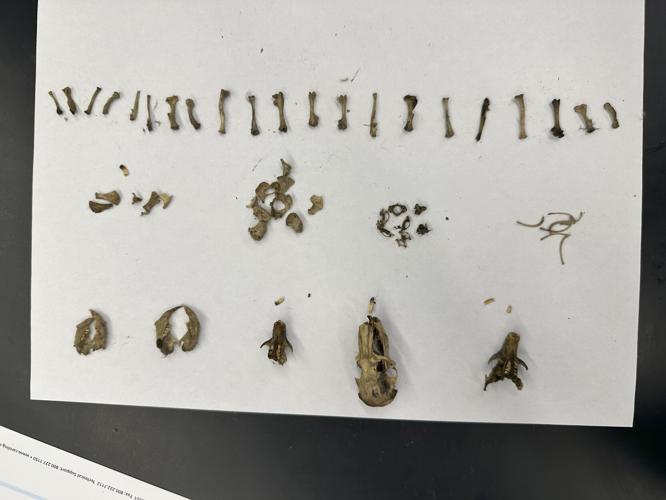
The students said as they took the pellets apart, they found many sizes of skulls, jawbones, and limb bones, as well vertebrae. But as interesting as the assortment of bones was, the women looked for particular body parts to aid their investigation.
“We were looking specifically trying to find some of the prey’s teeth, or incisors, because they hold the most DNA,” explained Sarkar, “and there were some free-floating teeth mixed in with all the fur. So, we tried to extract those as well.”
The young scientists performed DNA extraction from the bones through a complex process.
“There are a lot of steps,” said Yu, “but generally, after we get the bones, we sterilize them, and after that comes DNA extraction.
“First, we pulverize the bones into a powder, and that allows us to access the DNA better,” she said. “From the powder, we extract DNA. And then once we have that, we do a process called PCR, which basically duplicates the specific DNA segment we want billions of times, so we have a lot of that DNA strand. And then we use that to identify which species of rodents that DNA segment belonged to, through an online database.”
All of the samples from 2024 came from one specific species, a rodent known as a hispid cotton rat.
“When we did our study, we got a lot of that same species, but we also got back another one, and it was called a woodland vole,” said Leonard.
“This was a way for us to explore the mammal population here (in Morganton) in an indirect way that did not involve trapping mammals themselves, so that was kind of cool,” added Williams. “And I believe owls have maybe a 3-to-5-mile radius as their range for hunting, so they go out quite a ways and come back.
“We would assume that those are two of the mammal species in the area, and there are likely quite a few of them,” she added.
The four specialists followed in the footsteps of their predecessors and opened the project up to students from this year’s junior class. Six additional underclassmen, all female, have joined the owl pellet project.
The team will present its findings at the end of the month at an NCSSM Research Symposium.



























(0) comments
Welcome to the discussion.
Log In
Keep it Clean. Please avoid obscene, vulgar, lewd, racist or sexually-oriented language.
PLEASE TURN OFF YOUR CAPS LOCK.
Don't Threaten. Threats of harming another person will not be tolerated.
Be Truthful. Don't knowingly lie about anyone or anything.
Be Nice. No racism, sexism or any sort of -ism that is degrading to another person.
Be Proactive. Use the 'Report' link on each comment to let us know of abusive posts.
Share with Us. We'd love to hear eyewitness accounts, the history behind an article.