



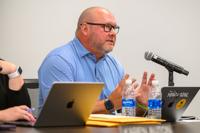
A collection of Wild West-clad Board of Education (BOE) members met for their monthly work session this past week, donning cowboy hats and cowhide vests in the spirit of Halloween.
The BOE met on Monday to discuss first readings on a swath of proposals, covering everything from grant funding plans and central office construction to end-of-semester retesting and dual enrollment directives.
SCHOOL IMPROVEMENT
After a quick series of updates from Superintendent Dr. Mike Swan, the meeting began with a focused discussion around school improvement plans from Director of Elementary Education Dr. Bret Wilson.
Wilson explained that each school has its own school improvement team composed of staff members and parents who are elected by school staff colleagues. This group focuses on analyzing the data from the schools and making decisions on how to move forward.
Plans consist of SMART goals — Specific, Measurable, Attainable, Realistic, and Timely — which are fluid and reexamined throughout the year based on periodic assessment. Plans to meet these goals are submitted between October and November.
These plans intend to improve schools across the board. They are especially important in focus schools — low-performing schools in the county that scored a D or below in a yearly review based on test scores, graduation rates, and student growth.
The North Carolina Department of Public Instruction reviews plans once in November. Burke County Public Schools (BCPS) maintains the approved plans and adjusts as necessary throughout the remainder of the school year.
“At a local level — especially for our focus schools — we keep saying every few months, ‘Where are you at? Where are your students performing?’” Wilson said.
Wilson explained that 25 school improvement plans covering each district school were included in the BOE’s reference packets. The BOE plans to review and consider approving the plans in the next session on Nov. 3.
GRANT FUNDING
Wilson led into the discussion of grant applications, elaborating on the distribution of Title I grant funding. Director of Secondary Education Desarae Kirkpatrick, Director of English Language Development Dr. Lannie Simpson, and Director of Student and Family Services Dr. Dillon Sain discussed Title II, III, and IV funding applications, respectively.
The district uses Title funding to provide financial assistance to a variety of programs:
Title I — Over $4.6 million to local educational agencies and schools with a high percentage of low-income students. These services include reading and math specialists, additional K-5 teachers, and curriculum-related support.
Title II — Over $525,000 to increase student achievement and student growth as well as professional development for staff through secondary instructional coaches, professional development opportunities, a proportioned share to private schools, and special accreditations for high schools.
Title III — Over $156,000 to assist in language acquisition, English learner (EL) proficiency, and helping EL students meet changing standards. Programs assist every student enrolled, but the funding also provides supplemental services for vocabulary acquisition and immigrant students.
Title IV — Over $471,000 to support healthy and safe students through hiring resource officers, hiring a Director of Nursing, purchasing Chromebooks and hotspots, and covering the cost of Gaggle and Go Go Guardian, a web monitoring tool.
While most presenters detailed the specific breakdowns and percentages of each grant, there are some areas where school zones have flexibility — particularly in Title IV.
Swan said, “Districts don’t have a roadmap. They don’t tell you how you have to spend the funds.”
RE-TESTING
Dr. Christine Abernathy, director of advanced learning, testing, and accountability, brought a re-testing plan proposal to the BOE.
“Several weeks ago, we received information from the state that they had approved for us to be able to give retests this year during our test session window or we could offer a summer program,” Abernathy said.
She explained that retesting during the testing window is the optimal choice, since it would allow for proficiency and growth to reflect in the data for the school year. A summer program would only allow proficiency to reflect on the county’s metrics — a concern many educators pointed to during school report card releases.
Retesting during testing windows would also allow students access to school transportation, another inhibiting factor in a summer program. The testing window in high school falls in the last five days of the semester, and the last 10 days in elementary and middle schools.
Though retesting is not required, it will be strongly encouraged. The district learned late last year that it could retest but hopes to be ahead of schedule this year in preparation.
NEW CENTRAL OFFICE
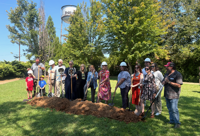
Swan announced that of the 11 contractors requesting bid documents, four submitted final bids for the construction of the central office.
“We went ahead and did some prep work on references,” Swan said. “Similar to what we did with Edifice, we called a lot of folks that they’d done work for.” Edifice is the construction manager at risk for the new elementary school to be built in eastern Burke County.
Following a recap of positive reviews from previous customers, Swan proposed that the BOE offer intent to award Neill Grading & Construction Co. Inc. of Hickory the construction job.
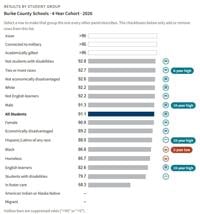
PRIVATE, HOMESCHOOLED STUDENTS IMPACT GRADUATION RATES
Up to six students could negatively impact graduation rates this year, prompting BCPS to reevaluate how students from private schools and homeschools can dual-enroll.
According to Deputy Superintendent Dr. Karen Auton, at least two of these dual-enrolled students appeared as dropouts on metrics from last school year, bringing down the graduation rate on reports.
Students often dual-enroll to participate in sports and other activities that public schools provide, but their homeschool or private school still counts as the one they graduate from, according to the state’s view.
“What’s happening is, if they’re enrolled with us in the spring semester of their senior year, then they are considered one of our students,” Auton said. “If they don’t graduate with [BCPS], then we take that hit. We’d like for them to go back to the parochial school, homeschool, or private school prior to the spring semester so that we don’t incur that hit on our graduation rate.”
Swan followed up, explaining that many students come in as juniors, but don’t get the required 22 minimum credits the state needs to recognize a student as a graduate at a public school.
“It could be an A-student that’s in AP courses [and/or] Western Piedmont Community College courses, but still, that student’s going to show up on [BCPS] as a dropout.”
Swan and Auton confirmed there were no workaround opportunities due to the language constituting the metrics of graduation. They proposed that students who decide not to enroll full-time with BCPS be able to finish the fall semester of their senior year and then fully transfer back.
If the board approves the proposal, they plan to request decisions from impacted families by the end of December at the latest.
The BOE will finalize decisions on this week’s proposals at 6 p.m. on Nov. 3 at the Olive Hill Resource Center. To watch the full working session from Oct. 27 and all subsequent sessions, visit the Burke County Public Schools YouTube channel.




















(0) comments
Welcome to the discussion.
Log In
Keep it Clean. Please avoid obscene, vulgar, lewd, racist or sexually-oriented language.
PLEASE TURN OFF YOUR CAPS LOCK.
Don't Threaten. Threats of harming another person will not be tolerated.
Be Truthful. Don't knowingly lie about anyone or anything.
Be Nice. No racism, sexism or any sort of -ism that is degrading to another person.
Be Proactive. Use the 'Report' link on each comment to let us know of abusive posts.
Share with Us. We'd love to hear eyewitness accounts, the history behind an article.