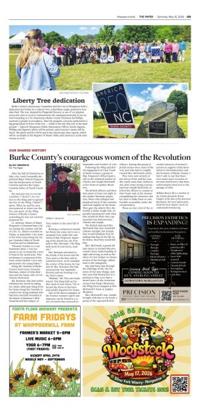




Keith Lawson highlights loan timelines while board member Brad Camp listens.
The cost of the new eastern elementary school leapt by more than 20% this past week to approximately $66.7 million, forcing the district to reconsider how it will fund the school that was previously slated for debt-free construction.
The news came following a soil analysis that revealed ground beneath the site can’t support the necessary foundation without costly remediation.
During the Burke County Board of Education’s annual strategic planning session, Josh Czerniak of McMillan, Pazdan, and Smith Architecture walked the board through the issue, the expected costs, and what avenues Superintendent Dr. Mike Swan had already explored with him.
The board plans to vote on funding options at the next school board meeting on May 18.

Josh Czerniak explains how the soil affects the school’s construction budget.
Czerniak explained that the soil can’t support the weight of the school where it was intended to be built on the site.
The construction team planned to use soil from across the stream to compensate, but analysis revealed the same issue.
“It’s almost a double whammy,” Czerniak said. “Because we have bad soils in both locations, it ends up being a rather — and I’ll say it — a rather astronomical hit in terms of the project budget.”
Czerniak presented two options to the board: address the soil and keep the new elementary school in Hildebran, or relocate the project closer to East Burke High School.
Swan reiterated that the district has been adamant about maintaining the identity of Hildebran Elementary in the town of Hildebran.
The board voted to eliminate the option of moving closer to East Burke High, acknowledging that no soil tests have been conducted at that location, and they could run into the same issue.
“If you were to use those soils (in Hildebran) unremediated, you run the risk of the foundation settling,” Czerniak said. “You have too much differential settling in the building, and then cracking, not only in the foundation, but then running up through the superstructure of the building, largely because we design schools with masonry.”
Czerniak emphasized that the district did nothing wrong and that the geotechnical testing needed to reach this point would have been unreasonable and atypical earlier in the project.
Sampling each possible site before settling on a location, he said, would have taken hundreds of thousands of dollars and a significant amount of time.
FUNDING THE NEW SCHOOL
The district originally planned to pay for the new school with a $42 million N.C. Lottery grant and a $13 million match from the county’s School Capital Fund Balance. Costs, including soft costs like cafeteria kitchens, architect fees, and other expenses, were expected to be encapsulated within that $55 million total.
The current guaranteed maximum price (GMP), which includes remediating the soil and preparing the ball fields, shoots the project to $60,778,516.
With soft costs still unaccounted for in that number, Finance Officer Keith Lawson said the total will likely sit near the $66.7 million range.
Swan and Lawson discussed potential routes for covering the nearly $12 million gap.
Ultimately, the decision comes down to three options, according to Swan:
- Use capital funds to cover the gap, which he specified he doesn’t recommend, as it would leave the district with zero available funds in case of other capital needs.
- Apply for more grants.
- Apply for loans.
Although Swan said he feels certain that the state is going to have to readjust future grant thresholds, he plans to contact legislators “to see if they’re going to open up another grant cycle for folks that received a grant two years ago, to see if, specifically, (we) can reapply for some more grant funding.”
Lawson followed by discussing possible loan options and payment structures, including examples of eight- and 12-year timelines. He also suggested targeting a 2047 payoff date to coincide with the completion of the loan for Mountain View Elementary School.
The lower they’re able to get their yearly payment, the more capital they can set aside and save in case of emergency needs.
COST-SAVING OPPORTUNITIES
Included in the GMP estimates were several cost-saving measures district leaders had already taken, such as adjusting parking and new school elevations, adjusting the building’s square footage, moving the football field, and opting for a steel-framed structure.
Reducing or eliminating the theater space could save another $2.8 million, and grading the baseball fields and using gravel instead of paving the sports fields’ parking lot could lower costs by another $3.3 million. Czerniak confirmed those projects could be done later when more funds were available.
The board seemed to lean away from reducing the theater, citing the expected capacity of the school over time and the goal of emulating the successes of Mountain View Elementary School, which cost the county approximately $25 million to build in 2018.
Construction of the new school must balance housing the two former elementary schools, Icard and Hildebran, while simultaneously opening its doors to the new growth expected in the area over the next few years.
While the board is expected to vote Monday on how the project will be funded moving forward, officials do not anticipate delays to the February groundbreaking — though Swan said he hopes construction begins sooner — or to the planned opening by the start of the 2028-29 school year.