


Buckner
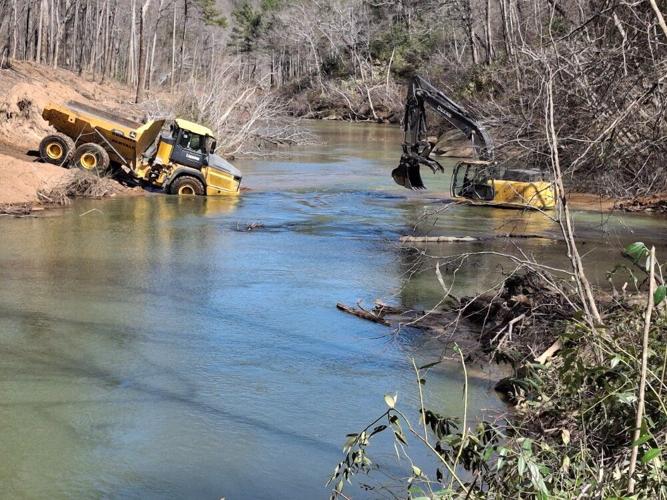
This photo from Conserving Carolina shows heavy equipment being used for hurricane debris cleanup in the Green River in Polk County. Burke is in the planning stages of its stream debris removal.
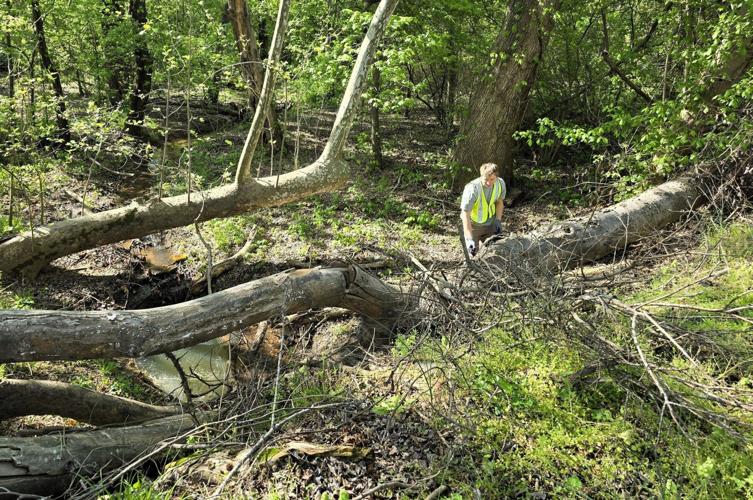
Catawba Riverkeeper volunteers helped remove debris from this stream near Charlotte last month. Woody debris like the fallen trees shown here are important to waterway ecosystems.
Hurricane Helene caused extensive damage to creeks and rivers in Burke County and the rest of western North Carolina.
Now, the challenge is to remove organic debris without making things even worse, something environmental groups say is happening in areas west of here.
In some places, the Army Corps of Engineers and its contractors have taken away too much woody debris — an essential component of the ecosystem.
As Burke County prepares to embark on that phase of the recovery, Catawba Riverkeeper’s Western Basin Director Grant Buckner said following one simple concept could make all the difference.
“I’d like to see the mindset not of taking all we can, but leaving all we can,” Buckner said.

Buckner
FOR THE PAPERTaking a break in the sunshine from a long morning spent in a darkened lab peering into a microscope and gathering data on aquatic insects, Buckner explained the importance of leaving an adequate amount of wood in the water.
“Our rivers really rely on wood for fish habitat, for providing structure for primary producers that really make our streams alive,” Buckner said. “You know, all of the insects I was just looking at depend on leaves. They depend on woody debris in the river.
“And we’ve seen concerns from across the entire footprint of Helene in North Carolina, about how that (removal) is being done.”
In Burke County, the plan is for crews to remove all the debris 1,000 feet upstream and downstream of public infrastructure like bridges and water intakes.
“It’s not simply taking debris out of the waterway,” Burke County Manager Brian Epley said. “It’s debris that could be hazardous in future events to public infrastructure and public safety.”
Buckner said the county’s strategy shouldn’t have a negative effect on the biology of the waterway as long as workers leave enough wood in other areas.
“If it’s (wood) piled around bridges and other infrastructure, it needs to be removed, to alleviate those concerns for our infrastructure. But if it doesn’t pose a threat to infrastructure, leave it,” Buckner said. “The last good bit of research coming out is about how good wood is for streams.”
It’s not clear yet who will be in charge of the work in Burke County.
In March, the county board of commissioners agreed to bring in the Army Corps of Engineers. The project is expected to cost just less than $900,000, but the federal government reimburses counties for work done by the Army.
But a lack of action and communication from the corps — despite repeated requests for information from the county — has prompted Burke to look elsewhere.
Epley said his staff is currently pursuing the state’s NCSmart program as an option. The program would replace federal funding with state funding for the project. As of Wednesday, no agreement was in place.
One advantage of utilizing the state program would be increased local control. Buckner said that would be a good thing.
“If the county can increase its oversight on how debris is removed, I don’t see that as a negative,” he said.
When the task finally begins, there will be other considerations besides pulling out vegetative material that has fallen into the waterways.
Buckner also advised against cutting too many leaning trees along the banks. Flooding and high winds from the storm scraped away enormous amounts of streamside vegetation, which is necessary to reduce erosion and contamination from runoff.
If live trees are cut, he said it’s often important to leave the stumps in place as a deterrent to erosion.
In addition to their concerns about wood debris removal, conservation nonprofits like Conserving Carolina have pointed out how operating heavy equipment across long stretches of streambeds damages aquatic habitats.
Buckner said some sites that are closely monitored by the N.C. Wildlife Resources Commission (NCWRC) because of the presence of rare or threatened species have been negatively impacted by machinery.
“When you’ve got a county that might have 500, 600 sites that they submit and the contractors can drive up and down the streams 1,000 feet from those areas to collect debris, that can have a really detrimental impact on the river,” he said.
But none of that should happen if contractors follow the rules.
Both the NCWRC and the Division of Environmental Quality (DEQ) have issued guidelines on how debris should be removed from streams.
“They’ve got their rules, they’ve got their guidelines,” Buckner said. “I think if they follow those, that would be good. And we’ve seen cases where they are following those and it is done correctly, but all of our partner organizations that we work with, and other watersheds have the same concerns.”
Marty Queen is the senior reporter. He may be reached at 828-445-8595 or marty@thepaper.media.
















Success! An email has been sent to with a link to confirm list signup.
Error! There was an error processing your request.


Sorry, an error occurred.
Already Subscribed!
Cancel anytime
Thank you .
Your account has been registered, and you are now logged in.
Check your email for details.
Submitting this form below will send a message to your email with a link to change your password.
An email message containing instructions on how to reset your password has been sent to the email address listed on your account.
No promotional rates found.
Secure & Encrypted
Thank you.
Your gift purchase was successful! Your purchase was successful, and you are now logged in.
| Rate: | |
| Begins: | |
| Transaction ID: |
A receipt was sent to your email.







(0) comments
Welcome to the discussion.
Log In
Keep it Clean. Please avoid obscene, vulgar, lewd, racist or sexually-oriented language.
PLEASE TURN OFF YOUR CAPS LOCK.
Don't Threaten. Threats of harming another person will not be tolerated.
Be Truthful. Don't knowingly lie about anyone or anything.
Be Nice. No racism, sexism or any sort of -ism that is degrading to another person.
Be Proactive. Use the 'Report' link on each comment to let us know of abusive posts.
Share with Us. We'd love to hear eyewitness accounts, the history behind an article.