

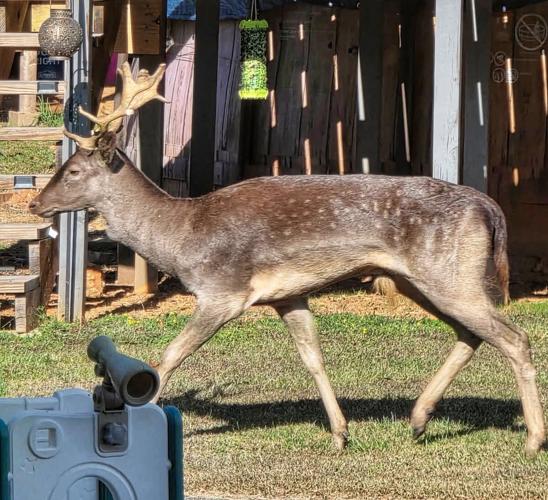

A local wildlife rehabilitation specialist was swamped with Facebook interactions recently when she posted a photo of an exotic deer running wild in Burke County.
Even as arguments broke out in the comments about where it came from and if it could be hunted, Hannah Simmonds wasn’t too bothered — after all, she works with wild animals.
Fallow deer are not native to North Carolina, hailing from the eastern Mediterranean region, but are often farmed in captivity, according to Britannica.
As far as huntability, Wildlife Extension Biologist Falyn Owens of the North Carolina Wildlife Resources Commission said that its non-native status means the commission has no jurisdiction over fallow deer.
Instead, they are considered livestock or private property, like a cow or sheep would be, or an escaped feral animal.
In any case, “If nobody lays claim to it, it’s just kind of out there for the taking, assuming that nobody is breaking any other laws,” she said.
Simmonds, who runs River Rock Wildlife Rehab on Roger Hill Road across the creek from Burke County’s southeastern border, was surprised when her Facebook post about the deer blew up.
“I had to hide a lot of comments,” she said.
Her husband, Andrew Simmonds, said, “That’s Facebook for you.”
Hannah Simmonds, who grew up just down Roger Hill Road from River Rock, knows a thing or two about deer. In 2019 alone, her small wildlife rescue operation was home to 40 deer of various sizes, and she has rehabilitated and released dozens more.
In the original post, she expressed concern that the exotic deer would compete for resources with native whitetails. Owens said while fallow deer are not considered invasive, there is still plenty of room for concern.
“We don’t often know that an animal is going to be invasive until it starts to become a real problem,” Owens said. “Exotic animals free roaming in the wild tend to be something we don’t want, especially if there’s more than one and they can breed … Hindsight is 20/20.”
Fallow deer are desirable for their beautiful coat and mild meat, and as a result they are often found at deer farms — both legal and illegal. The North Carolina Farmed Cervid Program, run by the North Carolina Department of Agriculture, regulates deer farms, requiring special licensure, fencing, and enclosures.
Simmonds said the deer, which was last sighted near Maiden, likely escaped from a farm, but she knows of no licensed deer farms in the area.
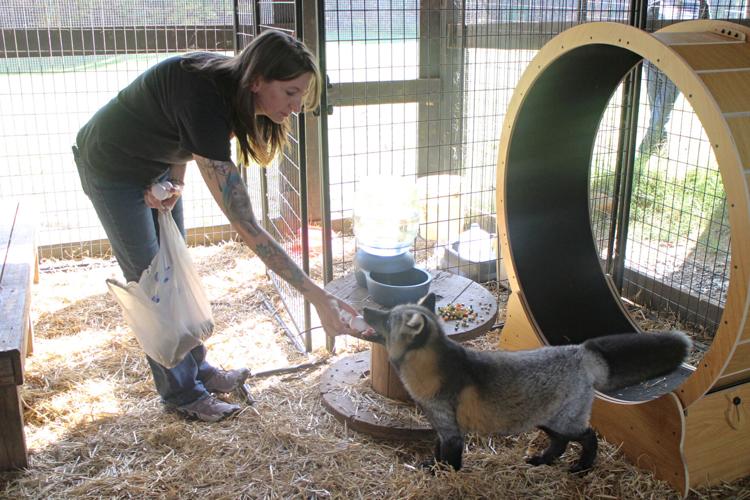
Simmonds is familiar with farmed wild animals, too: She currently holds custody of three marble foxes that were confiscated from an illegal “fur farm” in July.
Since they are captive-bred and non-native, she can’t release them into the wild, which is the usual goal for her tenants. Instead, she is in the process of getting them registered as educational animals.
For as skittish as they are, she said she’s not optimistic about visits to schools or libraries, so she is considering an educational social media channel with pictures and videos of the foxes.
The wildlife rehabilitation community here is small, she said. Simmonds’ operation is one of only three in the area.
Funding for wildlife rehabilitation is hard to come by, she said. Licensure with the WRC is a complex process that is always changing, so the already niche interest comes with a high barrier of entry for those wanting to make it a career.
“You have to be slightly strange,” she said, adding that she has had her share of oddball experiences with folks bringing rescued animals.
There was the time someone had been keeping a baby possum alive using human breastmilk, a squirrel that came wrapped in a pair of underwear, and plenty of misidentification cases, like the time a woman brought what she thought to be a chipmunk but turned out to be a rabbit.
Biting is always a risk — “I’ve been attacked way too many times,” she said — but that’s only part of why she doesn’t accept raccoons anymore, despite a special license that allows her to rehab species that are especially susceptible to rabies.
The 20 raccoons that she rehabilitated and released one year just came right back home and destroyed her barn.
Meanwhile, the rescue calls keep coming in. Simmonds said if she gets a call on the fallow deer, she would have to think twice. Legally, she can only take fawns that still have spots.
“It’s hard to say no,” she said. “Legally, I’d have to say no … But I’d love to have a fallow deer, to be honest.”





















(0) comments
Welcome to the discussion.
Log In
Keep it Clean. Please avoid obscene, vulgar, lewd, racist or sexually-oriented language.
PLEASE TURN OFF YOUR CAPS LOCK.
Don't Threaten. Threats of harming another person will not be tolerated.
Be Truthful. Don't knowingly lie about anyone or anything.
Be Nice. No racism, sexism or any sort of -ism that is degrading to another person.
Be Proactive. Use the 'Report' link on each comment to let us know of abusive posts.
Share with Us. We'd love to hear eyewitness accounts, the history behind an article.