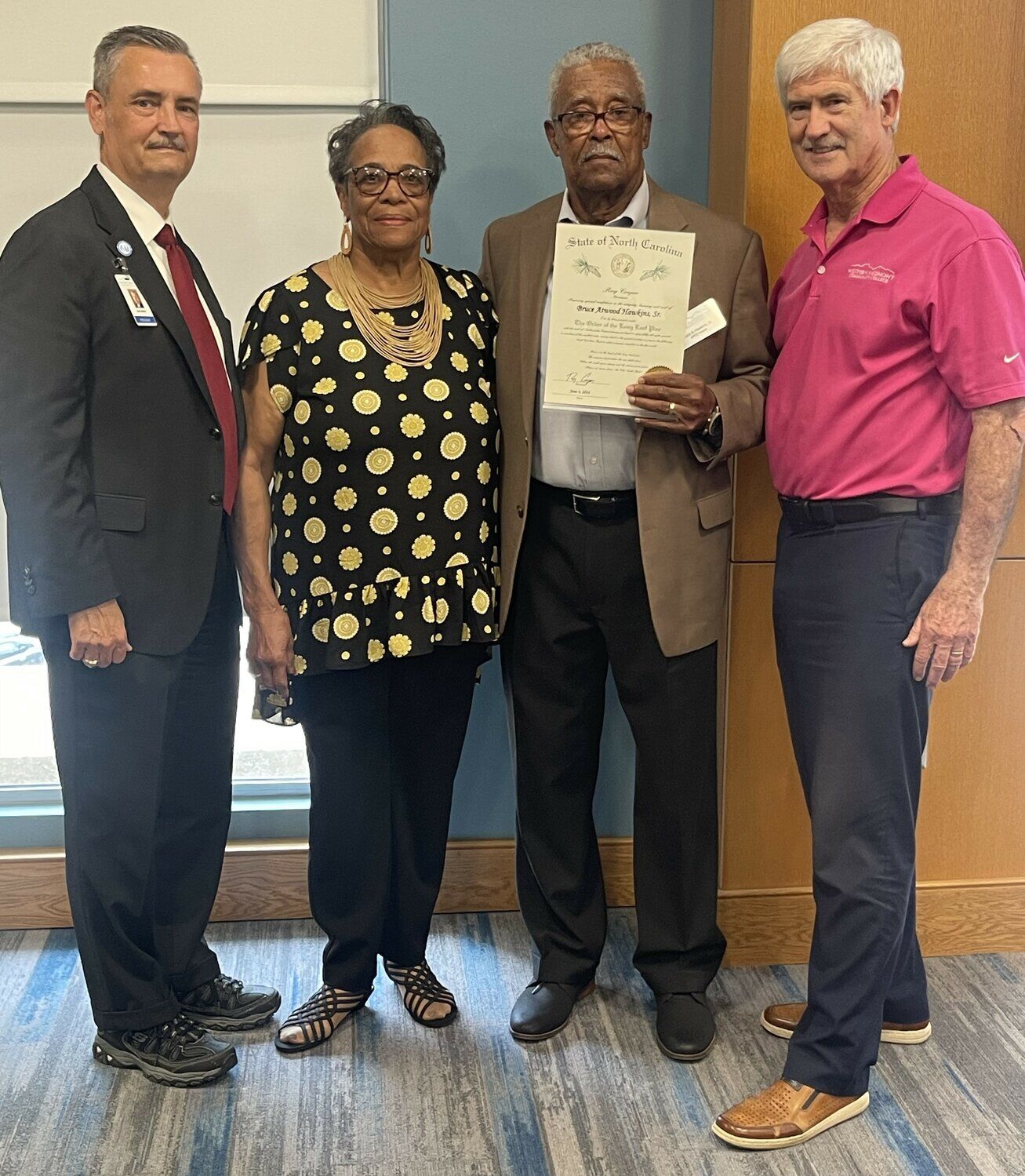
Bruce Hawkins (second from right) was presented The Order of the Long Leaf Pine on Tuesday, June 4, 2024. Standing with him are his wife, Judith; WPCC President Dr. Joel Welch; and Morganton Mayor Ronnie Thompson.
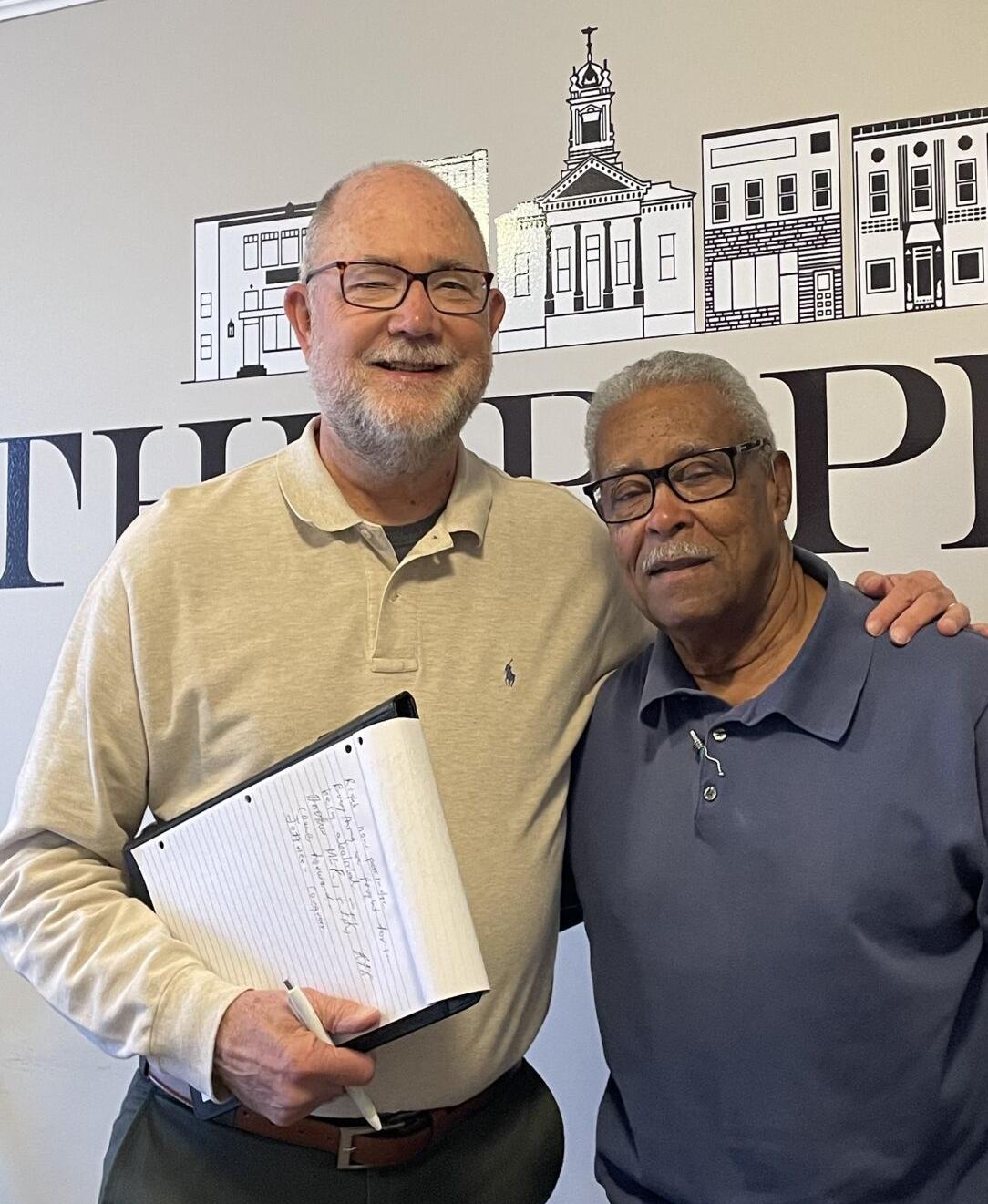
Old friends Bill Poteat and Bruce Hawkins after a long conversation at The Paper.
DEVAN BERRY / THE PAPER
Bill Poteat
Bruce Hawkins and I share a common heritage.
We were both born at the old Grace Hospital in Morganton when it sat atop the hill where CoMMA stands today.
Both of us are sons of World War II veterans, his dad served in the Navy, mine in the Army Air Corps.
We both grew up in the Drexel community, just a couple of miles apart, and we both were blessed with stable and supportive families.
His elementary school had Drexel in its name, as did mine.
But there are sharp differences in our histories as well.
Bruce was born in a segregated hall at Grace Hospital designated for “Colored Only.”
Pat Poteat came home from World War II to a workforce where his talents and ambition led to advancement. Elonzo Hawkins came home to a workforce — and a society — where most doors were closed to him.
I attended Drexel Elementary School. Bruce attended Drexel Colored School, one of four elementary schools for Black children in Burke County.
I was born White. Bruce was born Black. And in the United States of the 1940s and 1950s, the color of one’s skin made all the difference.
On a recent late February morning, when winter seemed vanquished and spring ready to take control, we sat down together in the conference room of The Paper to talk about what that difference meant.
TALKING WITH A HERO
I have known Bruce for nearly 45 years. He served on the Burke County Board of Education when I was a young reporter and then a still-young editor of The News Herald.
We developed a respect for each other during those years and then reconnected when I was teaching at Draughn High School, and he had grandchildren there.
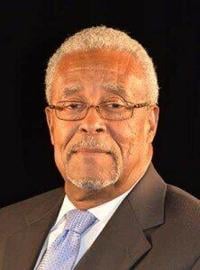
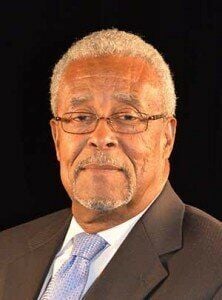
Hawkins
FOR THE PAPER
Might as well be honest here. Bruce is a hero of mine. He has always impressed me with his intelligence, his leadership, and his courage.
Since The Paper launched in February of 2023, I have been wanting to get Bruce to sit still long enough for an interview about his remarkable life. Bruce remains a very busy man, but good things come to those who wait, and last week they came to me.
Bruce will be 82 in a couple of months, but his memories remain vivid, his mind remains sharp, and the beliefs that shaped his life as a young man remain rock solid today.
Bruce grew up in the Berrytown community, literally surrounded by family and friends.
“If there was a need in the community everyone reached out to help,” he remembered. “No one went hungry. I can remember my mom taking meals to neighbors and I can remember my dad putting chains on his tires one night to take a man and his wife to the hospital in Winston-Salem in the middle of a snowstorm.”
Yet while the community was strong and supportive, it was also in many ways isolated by the legal system of discrimination that prevailed at the time and by the racism that guided so many public decisions.
As a child, Bruce could not eat in any of Burke County’s restaurants nor take in a movie at Valdese’s Colonial Theater. If he went to a movie in Morganton, he had to sit in the “Colored” balcony of the Mimosa Theater.
“Separate but equal” was the rule for public schools in North Carolina as Bruce was growing up.
“I can assure you that they were separate, but they were not equal,” he said. “Our textbooks were old, used, and often missing pages. The desks we sat at were used and beat up. Our recreational equipment was very limited.”
A PIVOT IN HISTORY
1955 proved to be pivotal for young Bruce as he began to realize the depth of the discrimination and prejudice faced by Black Americans, especially those living in the South.
It was in that year that Emmett Till, a young Black boy was murdered by a white mob in Mississippi who thought he had been flirting with a young white woman.
And in the same year, in Montgomery, Ala., a Black woman named Rosa Parks refused to give up her seat to a White man and the modern Civil Rights Movement began.
Soon after, Bruce had his own “back of the bus” experience.
“At the age of 14, and as a rising high school freshman,” he recalled, “I had the opportunity to travel by bus to a boy’s camp in Eastern North Carolina. Upon boarding the bus, my friend and I were told we had to take a seat in the back.
“Being a young boy, and very timid,” he continued, “I immediately went to the back. Today, I wonder what the consequences would have been if I had refused to do so.”
When Bruce recounted that story, I was struck by how calm he was in the telling. How, I asked, did he conquer his anger — both then and now?
“I think about that a lot,” he replied. “I grew up thinking things like that were normal. But the more I was exposed, the more I knew it wasn’t right. I began to think I should be treated equally, that I should be able to eat in any restaurant I wanted, sit anywhere I wanted in the theater.
“So yes,” he concluded, “I got angry. But that anger fueled a desire to make things different for my children. I didn’t want them to ever be exposed to the things I was exposed to.”
OLIVE HILL AND BEYOND
In 1957, Bruce entered Olive Hill High School in Morganton, another public school that was “separate but equal.”
“I wonder,” he mused, “what it would have been like to attend Drexel High School, which was just a short distance from my home, rather than riding a bus 8 to 10 miles each way, five days a week.”
As Bruce grew older, he began to notice the prevalence of legalized segregation all around him.
“Signs that read ‘White Only’ were evident in the county, even at a water fountain at our county courthouse. Restaurants would employ black cooks and busboys but deny them the right to eat in the dining room,” he said.
Bruce tells a story of that era that would have been funny if it weren’t so tragic.
One spring night in 1961, he and several of his friends pulled their car into the parking lot of the A&W drive-in on East Union Street, knowing they would not be served.
“Upon parking,” Bruce remembered, “a waitress came to our vehicle and announced they did not serve coloreds. Our response? ‘We don’t want to order coloreds. We want to order hamburgers.’”
Upon graduation from Olive Hill, Bruce decided he had no hope of going to college because he knew his parents could not afford to send him. Instead, he took a job in the Housekeeping Department of Valdese General Hospital earning the princely sum of 87 cents per hour.
Bruce’s life might have turned out very differently had not an older friend and mentor, George Williams, recognized his potential and decided to help that potential be met.
Williams took Bruce to the old Northwestern Bank Office and helped him get a loan for tuition. In the fall of 1962, Bruce enrolled in N.C. A&T University in Greensboro.
Students from A&T, led by student body president and football quarterback Jesse Jackson, were leading the effort to integrate the lunch counter at the downtown Woolworth and to gain admission for Blacks to downtown movie theaters.
Bruce immediately joined the effort, marching in the downtown nearly every afternoon. He was arrested several times for his “illegal efforts” and by the time he graduated in 1966, he was a seasoned veteran of the Civil Rights struggle.
COMING HOME
After graduation, Bruce decided to come home to a rapidly changing Burke County. Civil rights and voting rights legislation, first proposed by President John Kennedy, had been passed into law by Congress at the urging of President Lyndon Johnson.
The public schools were now fully integrated. Restaurants now served all customers. The “Colored Only” balcony at the Mimosa Theater was done away with.
Bruce became a counselor with the Burke County school system, but he continued to be greeted with racial slurs at several local high schools.
Later, he shifted to the Social Work Department at Broughton Hospital, gained a supervisory role, and worked there until he was past 70.
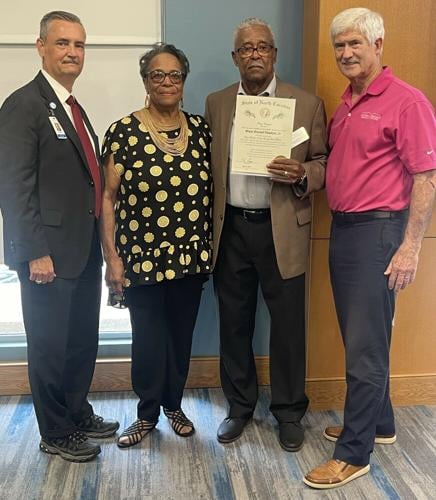
Bruce Hawkins (second from right) was presented The Order of the Long Leaf Pine on Tuesday, June 4, 2024. Standing with him are his wife, Judith; WPCC President Dr. Joel Welch; and Morganton Mayor Ronnie Thompson.
CHARDA PEARSON / THE PAPER
Last year, I wrote this about Bruce when he was selected by then-Gov. Roy Cooper as a recipient of the Long Leaf Pine, the highest civilian honor in the state:
“In his profession, he chose to help others, working as a licensed clinical social worker for decades at Broughton Hospital, aiding patients and their families as they navigated the often confusing medical and legal landscape associated with the public mental health system.
“But he has always known full well that his responsibility to his community did not end with the closing of the workday. Instead, working through positions both elected and appointed, he sought to better the quality of life for his fellow residents of Burke.
“In 1979, he was elected to a seat on the Burke County Board of Education. During his tenure on the board, he helped the system navigate a huge challenge — the aftermath of the explosion which destroyed Salem Junior High School in the spring of 1987.
“During his time on the school board, he served one year as chairman, the first Black person to hold that honor, and another as vice chairman.
“Later, in 2008, he was elected to the Burke County Board of Commissioners, again serving one year as chairman of the board and another year as vice chairman.
“Perhaps even more important than Bruce’s service in those elected positions and on a large number of appointed boards was the way he exerted his leadership in both public and private roles.
“Quiet and dignified, Bruce has always been a seeker of common ground, a healer rather than a divider, a leader by both word and by example.”
THE WORLD TODAY
I wish I could report that my conversation with Bruce ended on a bright and cheery note. It did not. The longtime Burke County leader is dismayed by both the actions and the tone of the new Trump Administration.
“I would urge our young people to go back and study history,” Bruce said. “Learn about the things that I went through, the things that generations of Black people went through. The progress that we worked, and strived, and sweated for.
“And then remember that all of it could be taken away,” he continued, “with an Executive Order, with the stroke of a pen.”
Bruce then shared the contents of a dream he had recently, a dream in which he had a conversation with one of his heroes, Dr. Martin Luther King Jr.
“I told Dr. King about all the progress that has been made since his death. I told him that a Black man had been elected President of the United States,” he said.
“Dr. King looked at me and said, ‘I still cry. I still cry for those four little children blown to bits in Alabama. I still cry when I think of all the hate and the violence. I still cry when I think about how far we have to go.”’
And the message of that dream?
“We can never become complacent,” Bruce answered. “We can never leave the good fight to others. We can never turn our heads and pretend we do not see. The responsibility is ours.”
And to that I say, “Amen, my friend, amen.”
Bill Poteat is editor emeritus. He may be reached at 828-445-8595 orbill@thepaper.media.
So many of the words here so resonate with me. I believe the best quote was “Quiet and dignified, Bruce has always been a seeker of common ground, a healer rather than a divider, a leader by both word and by example.” That is truly the man I have observed through the years. Great article with so many truths.
The Good Old Days were not good old days for Black people. I missed hearing Martin Luther King speak in person when I was a student at Berry College in Rome Georgia. The good old boys burned a cross in the yard of the professor who had invited Dr. King to speak, so it was called off for fear of violence on the campus.
Keep it Clean. Please avoid obscene, vulgar, lewd,
racist or sexually-oriented language. PLEASE TURN OFF YOUR CAPS LOCK. Don't Threaten. Threats of harming another
person will not be tolerated. Be Truthful. Don't knowingly lie about anyone
or anything. Be Nice. No racism, sexism or any sort of -ism
that is degrading to another person. Be Proactive. Use the 'Report' link on
each comment to let us know of abusive posts. Share with Us. We'd love to hear eyewitness
accounts, the history behind an article.

































(2) comments
So many of the words here so resonate with me. I believe the best quote was “Quiet and dignified, Bruce has always been a seeker of common ground, a healer rather than a divider, a leader by both word and by example.” That is truly the man I have observed through the years. Great article with so many truths.
The Good Old Days were not good old days for Black people. I missed hearing Martin Luther King speak in person when I was a student at Berry College in Rome Georgia. The good old boys burned a cross in the yard of the professor who had invited Dr. King to speak, so it was called off for fear of violence on the campus.
Welcome to the discussion.
Log In
Keep it Clean. Please avoid obscene, vulgar, lewd, racist or sexually-oriented language.
PLEASE TURN OFF YOUR CAPS LOCK.
Don't Threaten. Threats of harming another person will not be tolerated.
Be Truthful. Don't knowingly lie about anyone or anything.
Be Nice. No racism, sexism or any sort of -ism that is degrading to another person.
Be Proactive. Use the 'Report' link on each comment to let us know of abusive posts.
Share with Us. We'd love to hear eyewitness accounts, the history behind an article.