



The newly released State of Local News 2025 report from Northwestern University’s Medill School, its 10th comprehensive study of the local news landscape, paints a stark picture of a nation slowly going blind to itself.
The numbers are chilling: circulation has collapsed by 70%, newsroom jobs have fallen by three-quarters, and only a fifth of America’s daily papers still print seven days a week.
Nearly 40% of local newspapers have disappeared since 2005. More than 210 counties now have no local news source at all, leaving 50 million Americans without anyone watching the courthouse, the school board, or the ballot box.
North Carolina alone has lost 38% of its newspapers in the last two decades.
Released this week, the Medill report creates a timely opportunity for The Paper to share with readers what we are doing to protect sustainability for the future. Or, to be highfalutin about it, to help save democracy locally.
The Paper exists because Burke County and its residents choose not to be one of the 210 counties without local news. As the nation’s local lights flicker, The Paper’s still burns. With your support, it will keep burning — brightly and independently.
The loss of a local newspaper is not just a business failure; it’s a civic amputation. It removes a community’s memory, its accountability. The community’s history remains forever locked behind a vanishing paywall. The lights go out, one by one, until no one knows what’s going on beyond their own driveway or what they choose to read on social media feeds.
Yet not all is grim. The State of Local News 2025 report highlights “Bright Spots” across America — places where new journalism hasn’t just survived but adapted. These are small, locally rooted outlets, like The Paper, finding creative and sustainable ways to serve their readers.
The Paper is listed as one of those “Bright Spots,” one of seven in North Carolina. (The six others are Carolina Public Press, the Asheville Watchdog, Axios Charlotte, The Richmond Observer, Port City Daily, and Borderbelt Independent.)
The report declares that the “Bright Spots” are inspiring models of innovation and resilience. They share certain traits: local ownership, strong community ties, creative use of philanthropy, a refusal to abandon accountability reporting, a belief that informed citizens make stronger communities, and that journalism can still be a force for good.
We agree.
Being part of that small group means carrying both a torch and a burden. We know what happens when newspapers disappear: Civic engagement drops, corruption rises, and communities grow isolated.
But when a newspaper thrives — when it belongs to its people — it becomes a unifying voice. It asks hard questions without picking sides. It records triumphs and losses with equal care. It gives a place its narrative and its heartbeat.
The Medill report makes clear that the survival of local news depends on communities deciding they want it. Local news will not be saved by Silicon Valley or hedge funds — it will be saved by citizens who value it. Every subscription, every advertisement, every word of encouragement is a brick in the foundation of a stronger Burke County.
Our measure of success is simple, too: To remain authentic and true to Burke County’s local news; to have the wherewithal to be here tomorrow, and to continually remind readers through local stories that people are Burke’s greatest asset.
Before the end of this year, The Paper will convert from a for-profit LLC to its own IRS approved nonprofit 501(c)(3). The Paper will belong not to one individual. It will be owned by the community.
Coupled with The Paper’s existing endowment at the Community Foundation of Burke County, The Paper with this transition creates a transparent and simple philanthropic mechanism that, if our community wants to continue to have an independent, community-owned newspaper exclusively committed to Burke County, they will have a tax-deductible means to express support and commitment.
That is one piece of the sustainability equation. The other is management succession. The Paper is currently interviewing for a managing editor. With Bill Poteat as editor emeritus, Angela Copeland as editor, and Nina Linens as director of business development, we will be able to build the new leadership structure for tomorrow.
By converting to a nonprofit 501(c)(3), The Paper will join the ranks of trusted public-service news organizations like The Salt Lake Tribune, The Texas Tribune, the Associated Press and many others across the country. This will allow donors to support The Paper directly and ensure that local journalism remains a public good, not a private luxury.
A true community-owned newspaper with the wherewithal to be here tomorrow.
The difference between a vibrant county and a news desert isn’t corporate ownership or technology — it’s people willing to pay for truth, to invest in watchdogs, and to defend the idea that democracy works better when someone’s taking notes.
As the Medill study so thoroughly reports, local news is not dying everywhere. Here, in Burke County, with The Paper, it is alive. And as long as this community continues to believe in itself, The Paper will keep doing what newspapers were born to do — tell the truth, build understanding, and remind us that we are part of something bigger than ourselves.
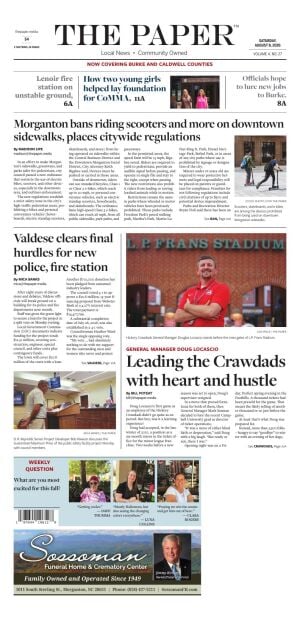
During three successful years of operation, The Paper has grown from an idea into Burke County’s indispensable source for local reporting — 141 editions strong, 8,600 readers weekly, 223 local advertisers, more than 900 public notices published, and 60 state and national awards.
We are just getting started.
















(0) comments
Welcome to the discussion.
Log In
Keep it Clean. Please avoid obscene, vulgar, lewd, racist or sexually-oriented language.
PLEASE TURN OFF YOUR CAPS LOCK.
Don't Threaten. Threats of harming another person will not be tolerated.
Be Truthful. Don't knowingly lie about anyone or anything.
Be Nice. No racism, sexism or any sort of -ism that is degrading to another person.
Be Proactive. Use the 'Report' link on each comment to let us know of abusive posts.
Share with Us. We'd love to hear eyewitness accounts, the history behind an article.