

The weather. Everyone talks about it. Nobody can do anything about it. So why even write about it?
Because everyone is talking about it.
Here’s the latest: It’s hot. It’s going to stay hot. It’s summertime in North Carolina, what do you expect? Get used to it.
But since you asked: A heat dome settled over the state during the first week of July, pushing local temperatures into the low 100s.
Asphalt shimmered (Sterling Street was 147 degrees last week), crops wilted, and everyone suddenly remembered they forgot something inside where the air conditioning lives.
The good news, such as it is, is that the heat should become slightly less ridiculous. The outlook for July 9-15 still calls for above-average temperatures across much of the Southeast, but “not as hot” as the first week of July. In weather terms, that is what passes for mercy.
This according to the North Carolina Climate Office’s short-range outlook
Rain? You wish. Rain chances are also back in the forecast, though the outlook does not exactly promise a countywide soaking. We need a soaking.
Don’t expect that soon, though scattered showers and thunderstorms could return, with the usual summer arrangement: one side of the road gets a downpour, the other side gets humidity and false hope.
On Monday evening it poured buckets in Rutherford College. Not a drop in downtown Valdese. Monday morning it rained in parts of Drexel. Not a drop in Morganton.
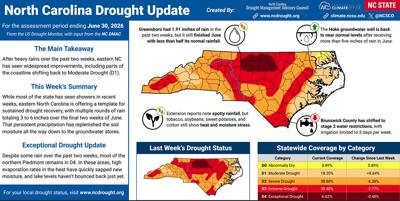
North Carolina needs a massive, sustained rainfall of roughly 12 to 15 inches over the span of a month to completely eliminate the severe-to-extreme drought conditions. In the long term, climate experts report the state needs nearly 3 feet of rain over a six-month period to break the deficits completely.
Statewide, 38.88% of North Carolina was in severe drought, 35.40% was in extreme drought and 6.62% remained in exceptional drought. In other words, the map looks less like a weather report and more like someone spilled orange and red paint across the state.
Agriculture Extension reports cited spotty rainfall and continued heat and moisture stress on crops including tobacco, soybeans, sweet potatoes and cotton. That is official language for: the plants are hot and tired, too.
The outlook for July 16-29 calls for a possible brief cooldown if cooler air can push into the eastern United States, followed by warmth returning by Week 4. Rain chances remain “up in the air,” which is a fine forecast phrase because that is also where rain usually is before it decides not to fall on your yard.
So, the practical advice is simple: Drink water. Check on neighbors. Do not leave pets in cars. Avoid mowing at 2 p.m. unless your life goal is to become a cautionary tale.
And when someone asks, “Hot enough for you?” remember that violence is not the answer.



















(0) comments
Welcome to the discussion.
Log In
Keep it Clean. Please avoid obscene, vulgar, lewd, racist or sexually-oriented language.
PLEASE TURN OFF YOUR CAPS LOCK.
Don't Threaten. Threats of harming another person will not be tolerated.
Be Truthful. Don't knowingly lie about anyone or anything.
Be Nice. No racism, sexism or any sort of -ism that is degrading to another person.
Be Proactive. Use the 'Report' link on each comment to let us know of abusive posts.
Share with Us. We'd love to hear eyewitness accounts, the history behind an article.