




One winter afternoon I was to meet my son for a late lunch in New York City.
We were picking up sausages at Schaller’s on the upper East Side, then would find a park bench on which to eat and people-watch along the East River.
I met him at his job at Hex & Co, a game cafe that carries one of the largest selections of board games in the city. I arrived early. Ben showed me around, then got to work behind the bar straightening for the night manager.
I nursed a soda and took in the place.
On one side of the shop, floor-to-ceiling shelves stocked board games for sale. On the other side, similar shelves were jammed with a library of over a thousand games you could rent.
Centered below low-hanging lights were a dozen or so tables for gaming. In the back corner, four 20-somethings leaned over a game they might have been playing since the invention of the wheel.
They seemed mired deeply and bonded intimately in play. I suspect I looked like that with my teenaged friends when we played Risk on rainy weekends. Games often lasted into the wee hours. World domination takes time.
As I awaited Ben, two women and a boy whooshed in from a sudden rainstorm. They pulled down a battered game of checkers from the rental shelf. One woman got snacks. The other helped the boy arrange the red and black pieces. He sat with a sea captain’s view of the table, on his knees at the edge of his wooden chair. After a few moments of not-so-subtle eavesdropping, I discovered the women were sisters. The boy’s eyes danced as he played with his aunt and mom. What better way to wait out a storm?
This place felt homey. I searched for the word to describe it.
The word sanctuary emerged.
This place offered respite from the world. Ben explained that some people come solo to meet strangers and join a game. Others bring friends. Doctors, students, Uber drivers, and homebodies congregate around Catan, Monopoly, and Magic.
Choose a game.
Order a slice of pie at the bar.
Play until somebody wins or until the rain lets up. Either way, you leave feeling lighter. You owned Park Avenue before bankruptcy. You had conversations with actual neighbors.
I love this place.
I like what often happens around a game. The possibility of mirth, on cat’s feet, slinks in. Generosity warms us into rooting for one another. Real life tension eases as you ponder your next move. The game becomes a kind of invisibility cloak under which you can hide from the world. That’s not a bad trick.
Smug Owls is a social game with no wrong answers that often twists players into knots of hilarity. Flip 7 is filled with unpredictable reverses. Ticket to Ride is an imaginative race game.
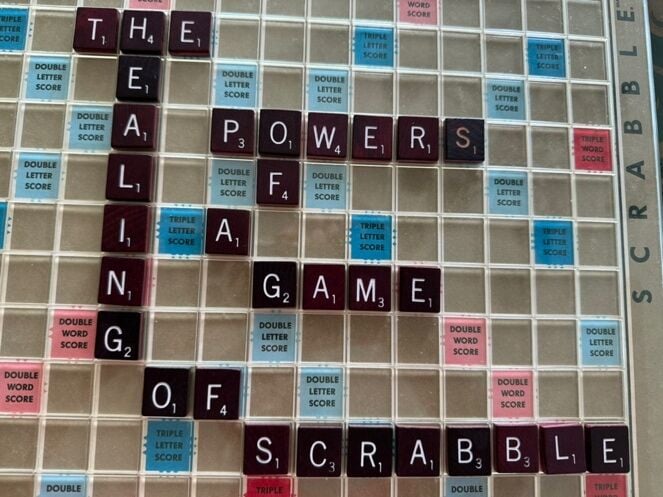
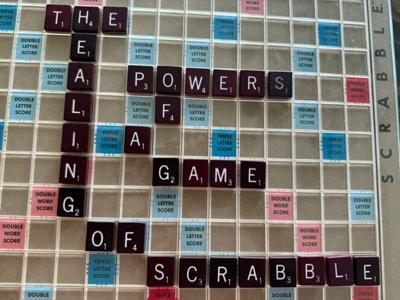
And I cannot resist Scrabble.
Writing for the Guardian on the sixtieth anniversary of the game, Oliver Burkeman reported (in 2008) one in three American households owns a Scrabble board.
I play about a dozen times a year. I’ve saved my score sheets since 1995.
Up to four Scrabble players draw seven letter tiles from a bag of 100. You try to spell words, crossword-style, building upon words on the board.
My wife bested me in our last outing. I started out ahead spelling words like G-A-S and Z-A (short for pizza), for 26 points. But then I drew several racks of nothing but low-scoring vowels, with which I could only spell low-scoring words: H-I (hello), A-A (basaltic lava), and T-A (thank you).
She spelled L-O-R (an expression of dismay) and E-A-G-R-E (a tidal flood). She took the lead by spelling L-I-E twice and buried me with L-Y-E on a triple word score.
Every game is as exciting as World Cup soccer, without the crowds.
I’m not a great player. My average score is 320. My friend Scott beats me, but the nut has committed all two-letter Scrabble words to memory.
Gordon McLerran was a genius wordsmith with a medical background. I was their young minister, and Rachel and I played after enjoying Joyce’s fine cooking. Joyce would spell words like C-A-T and C-A-K-E (a “k” is worth five points). Gordon spelled the likes of A-P-E-X (the top of a bodily organ), H-E-M-E-N (a compound containing iron), P-S-O-A-S (a loin muscle), and E-L-E-M-I-C (pertaining to chemical components).
Gordon slaughtered us.
You get a “Scrabble” of 50 extra points if you use all seven tiles in a single turn. I couldn’t pull out a victory even when I spelled M-O-R-O-N-I-C earlier this year. I won the next game in which I scored 90-points for spelling M-U-S-T-I-L-Y.
Because my family allows looking up words in the dictionary (rules allow this only in cases of formal challenge), we spruce up our vocab. Case in point: a M-U-S-T-H is a state of frenzy occurring in male elephants. H-I-E means hurry. To N-I-X is to veto; add an “e” for the word nymph.
Children learn while playing. They develop problem solving skills and learn how to negotiate with peers and regulate emotions. Play is their natural work.
Too bad we adults have forgotten the value of play.
The word recreation means “an act of refreshment” and derives from the Latin “new birth” and “to revive,” spiritually or otherwise. Play is a means of re-creation, which restores all ages, eases anxiety, and mends frayed nerves.
The world is a serious place.
Playing a board game can go a long way to bringing a little joy and ironing out divisions.
Card games like Hearts are good for the ticker. Chess is good for the brain. Candyland eases diabetes (if it keeps you from consuming carbs while you play). Battleship mends sibling feuds.
And Scrabble spells a million possibilities, including Q-I (lifeforce), G-E-E (an interjection expressing enthusiasm), and P-E-A-C-H-Y (fine, dandy).
Pull up a chair.
Let’s play.



















(0) comments
Welcome to the discussion.
Log In
Keep it Clean. Please avoid obscene, vulgar, lewd, racist or sexually-oriented language.
PLEASE TURN OFF YOUR CAPS LOCK.
Don't Threaten. Threats of harming another person will not be tolerated.
Be Truthful. Don't knowingly lie about anyone or anything.
Be Nice. No racism, sexism or any sort of -ism that is degrading to another person.
Be Proactive. Use the 'Report' link on each comment to let us know of abusive posts.
Share with Us. We'd love to hear eyewitness accounts, the history behind an article.