NCDEQ’s Division of Air Quality is investigating two odor complaints in the area of Rand Street, which is home to Case Farms. Though a source has not been identified, the investigations are still underway.
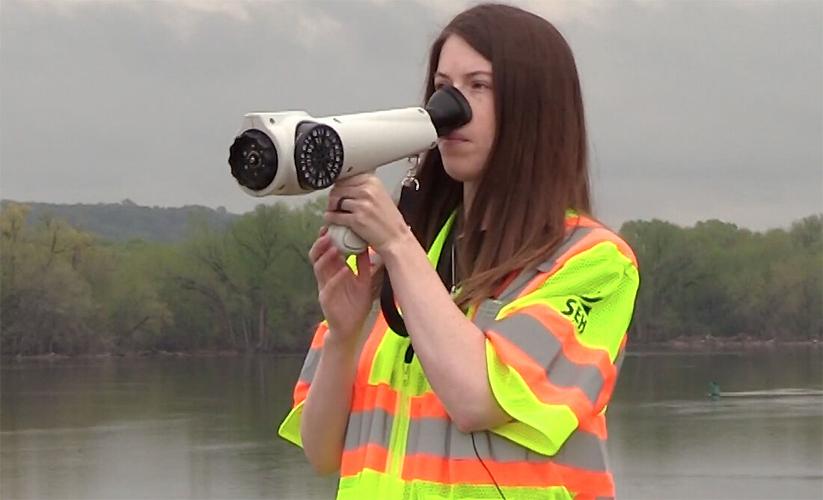
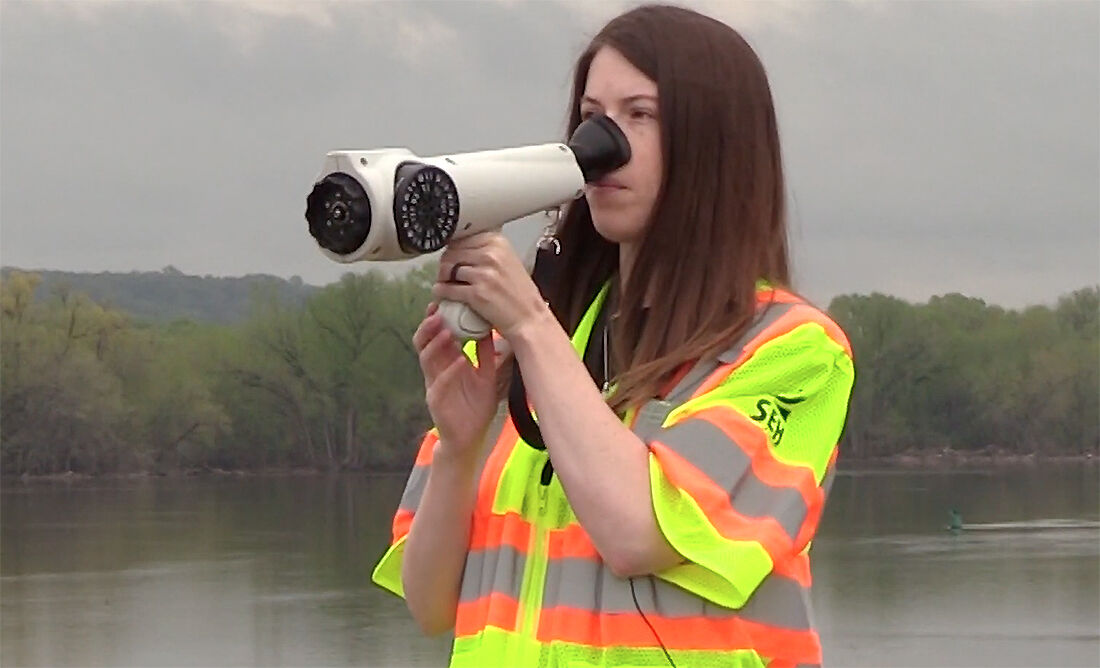
Nasal Ranger Field Olfactometer demonstration by SEH Inc. engineering. The Nasal Ranger is used by NCDEQ’s Division of Air Quality to measure odor intensity.
NCDEQ’s Division of Air Quality is investigating two odor complaints in the area of Rand Street, which is home to Case Farms. Though a source has not been identified, the investigations are still underway.
State air quality regulators are investigating new odor complaints near Case Farms in Morganton, after residents reported a “fecal, manure-like” smell spreading into neighborhoods, seeping indoors, and lingering through the evening hours.
While the strong odor’s source has not been determined by NCDEQ Division of Air Quality staff, Public Information Officer Shawn Taylor said the unpleasant aroma has been reported in the area of Rand Street, which is home to the Case Farms facility.
Morganton residents have grumbled for years about the distinct, unpleasant smell that occasionally permeates throughout the city, but recent complaints state the odor has gotten worse. NCDEQ’s Division of Air Quality records list 12 complaint investigations in the Rand Street area between 2013 and 2022, according to Taylor.
There had been no investigations since 2022 until this month, when the Division of Air Quality received two complaints during the week of Jan. 5 about the Rand Street area. Those complaints are now under investigation.
Area property owners have said publicly and privately that the odor limits their ability to enjoy outdoor activities, forces them to keep windows closed during pleasant weather, and reduces overall enjoyment of their properties.
One West Union Street resident, who requested anonymity, submitted an official complaint to NCDEQ’s Division of Air Quality on Jan. 8, citing recurring offensive odors throughout the evening hours, worsening for the two weeks preceding the date the report was filed. The odor is described as “strong, offensive, and fecal/manure-like, characteristic of poultry processing operations,” according to the complaint filed with the Division of Air Quality.
The resident noted that the odor is pervasive and penetrates the indoors, affecting air quality even with windows closed. The odor was also noted, in the complaint, to affect an estimated 2 square miles of the Morganton area surrounding the Case Farms facility, where multiple neighborhoods are impacted.
“This is not an isolated incident,” the resident noted. “The odor is a recent change and now occurs virtually every evening, typically beginning in the late afternoon/early evening hours and persisting throughout the night.”
The resident expressed concerns about potential health effects from chronic exposure to air emissions from the facility, particularly for family members with chronic asthma and other health concerns.
In the complaint, the resident asked state regulators to identify the source of the odor and review the facility’s permits and compliance with state rules, including 15A NCAC 2D .1806, a regulation that allows the state to require facilities to use the strongest practical odor controls when emissions create off-site odor problems.
The regulation states that facilities can’t let odor problems go unchecked. If odors leave the site and are bothering neighbors, the state can require action. If the odor is real and reaching neighbors, the state can require a facility to implement the strongest practical odor controls for the sources causing it.
Taylor noted that NCDEQ’s rules in Section .1800-Control of Odors require that non-exempt facilities ensure their emissions do not cause or contribute to objectionable odors beyond their property lines.
Objectionable odors, defined by the state, are odors that “may be harmful or injurious to human health or welfare, or may unreasonably interfere with the comfortable use and enjoyment of life or property.” The rule states that the Division of Air Quality may consider the nature, intensity, frequency, pervasiveness, and duration of odors, among other factors, when determining whether an objectionable odor exists, according to Taylor. The Division of Air Quality may use information from complainants, including odor logs, along with information on nearby operations to inform investigations.
Nasal Ranger Field Olfactometer demonstration by SEH Inc. engineering. The Nasal Ranger is used by NCDEQ’s Division of Air Quality to measure odor intensity.
SEH / FOR THE PAPER
Division of Air Quality staff are trained on the use of field olfactometers, specifically the Nasal Ranger, according to Taylor. The device, which is portable and made by S. Croix Sensory, Inc., determines ambient odor concentrations by sealing stinky air and then diluting it with purified air that has no odor particles.
“If an odor is at all noticeable at certain diluted concentrations, it is determined to be objectionable,” Taylor stated. “This is an EPA-approved methodology for measuring odor strength.”
The resident also requested that the Division of Air Quality require the facility to implement appropriate odor control measures, such as biofilters on exhaust systems, enclosed rendering operations with air treatment, covered wastewater lagoons, and/or the best available control technology if not already implemented.
Case Farms representatives did not respond to a request for current odor control measures and protocol at the Morganton facility. The company is currently in the process of expanding operations with a new breast packaging facility.
Morganton Mayor Ronnie Thompson said that city officials occasionally receive comments regarding the odor. “It is a problem, and we hope that with the expansion, they can control the odor.”
In February 2025, the company was granted three variances to build the facility, which included a maximum height increase for an air processing unit designed to improve air circulation in the room where meat is packaged.
In Burke Development Inc. ‘s roster of the 37 top employers in Burke County, Case Farms, with an employee range of between 500 and 1,000, ranks among the top alongside Burke County Public Schools, UNC Health Blue Ridge, and Leviton. Case Farms is also the City of Morganton’s largest water customer, according to Public Information Officer Jonelle Sigmon.
All odor complaints should be made to NCDEQ’s Asheville Regional Office by calling 828-296-4500.
Madison Lipe is the municipal reporter for The Paper. She can be reached at 828-445-8595 or madison@thepaper.media.
Keep it Clean. Please avoid obscene, vulgar, lewd,
racist or sexually-oriented language. PLEASE TURN OFF YOUR CAPS LOCK. Don't Threaten. Threats of harming another
person will not be tolerated. Be Truthful. Don't knowingly lie about anyone
or anything. Be Nice. No racism, sexism or any sort of -ism
that is degrading to another person. Be Proactive. Use the 'Report' link on
each comment to let us know of abusive posts. Share with Us. We'd love to hear eyewitness
accounts, the history behind an article.
























(0) comments
Welcome to the discussion.
Log In
Keep it Clean. Please avoid obscene, vulgar, lewd, racist or sexually-oriented language.
PLEASE TURN OFF YOUR CAPS LOCK.
Don't Threaten. Threats of harming another person will not be tolerated.
Be Truthful. Don't knowingly lie about anyone or anything.
Be Nice. No racism, sexism or any sort of -ism that is degrading to another person.
Be Proactive. Use the 'Report' link on each comment to let us know of abusive posts.
Share with Us. We'd love to hear eyewitness accounts, the history behind an article.