Stacy Sundell (left) of Western Piedmont Community College, looks on as Lake James Environmental Association community science director Marshall Taylor organize samples of water from Lake James.
Stacy Sundell (left) of Western Piedmont Community College, looks on as Lake James Environmental Association community science director Marshall Taylor organize samples of water from Lake James.
The summer recreation season is practically here, and one question seems to permeate nearly every discussion about Lake James: Is it safe?
Since Hurricane Helene roared through last fall and drastically altered the landscapes and ecosystems of Burke and other WNC counties, the lake’s water quality has been called into question repeatedly on social media and in ordinary conversation.
The Lakes James Environmental Association (LJEA) and its conservation partners, including Catawba Riverkeeper, are providing scientific answers to those questions on a weekly basis.
Every Friday from Memorial Day through Labor Day, the group posts the results of water quality studies conducted throughout the week in the lake and its tributaries.
The first report of the year came out last Friday. It revealed Lake James is indeed safe for swimmers.
Water samples came from several spots, including the mouths of the Catawba and North Fork rivers, Marion Moose Lodge, Bear Creek, Camp Lake James, and Goat Island.
The LJEA has expanded its testing range this year in the wake of Helene.
The most common contaminant, and the one most likely to cause health problems, is E. coli, a bacteria found in the intestines of warm-blooded animals.
The EPA and most state health departments use E. coli levels as the primary determinant of whether a body of water is safe for swimming.
Its presence in high amounts hints that failed sewer systems, or worse yet, straight-piping, could be behind the contamination.
“People want to know if there is sewage in the water,” LJEA President Joanne Deyo said. “Lake James is not drinking water, so it’s never going to meet drinking-water standards. But you start thinking about the human health aspects, and E. coli is a biggie.”
Other sources of contamination are much less likely to affect Lake James so testing for them isn’t necessary. There is no significant agricultural runoff, a potential source of toxic nitrates as well as pesticides and herbicides.
Toxic algae blooms can also occur and are monitored by the state Division of Environmental Quality (DEQ). But there is no record of a significant one occurring on Lake James, likely because it is so low in nutrients like nitrogen and phosphorus.
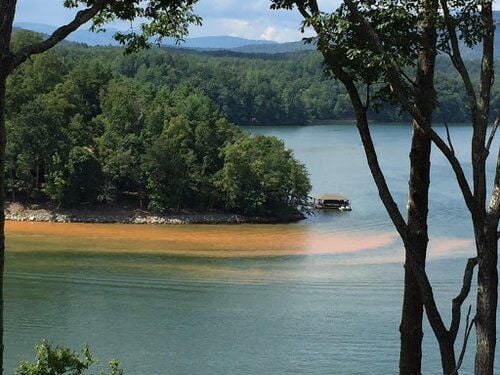
This photo shows muddy runoff on Lake James.
LJEA / FOR THE PAPER
High-water events caused by heavy rains stir up the sediments on the bottom of the lake and its tributaries. When that happens, E. coli levels tend to rise and can exceed safe levels as determined by the EPA.
That rarely happens in Lake James, which N.C. Wildlife Resources Commission biologists have long maintained is by far the cleanest and most pristine lake of the 11 impoundments on the Catawba-Wateree chain.
You can’t detect the presence of E. coli simply by looking at the water, but it’s easy enough to avoid murky or muddy spots.
“That’s why we always suggest that people don’t go swimming in turbid water,” Deyo said. “If the water looks icky, it could be. It’s not a guarantee that it is but maybe stay out for a few days.”
A couple of sampling locations around the mouth of the North Fork River and in the river itself showed higher than normal levels of the bacteria early last week in the wake of significant rainfall, but by Friday, those numbers had returned to normal.
“Even just a 24-hour wait makes a difference, because some of that stuff can settle,” Deyo said.
One area several miles upstream from Lake James, the Joseph McDowell Historic Catawba Greenway in Marion, exceeded safe standards in last week’s report. But, as evidenced by the low levels of E. coli where the Catawba empties into the lake, the bacteria didn’t affect the lake.
Deyo said she hopes the weekly swim guide will alleviate some unwarranted concerns.
“People get upset, and they get going, and then you show them the data,” she said. “The data doesn’t lie.”
“If you go into the water quality section, you’ll actually see the information, because we’re all about transparency. The data is there. We’re not going to try and tweak it to make it sound good or sound bad.”
The association has a pool of around 20 volunteers who conduct sampling. They logged 2,500 volunteer hours last year.
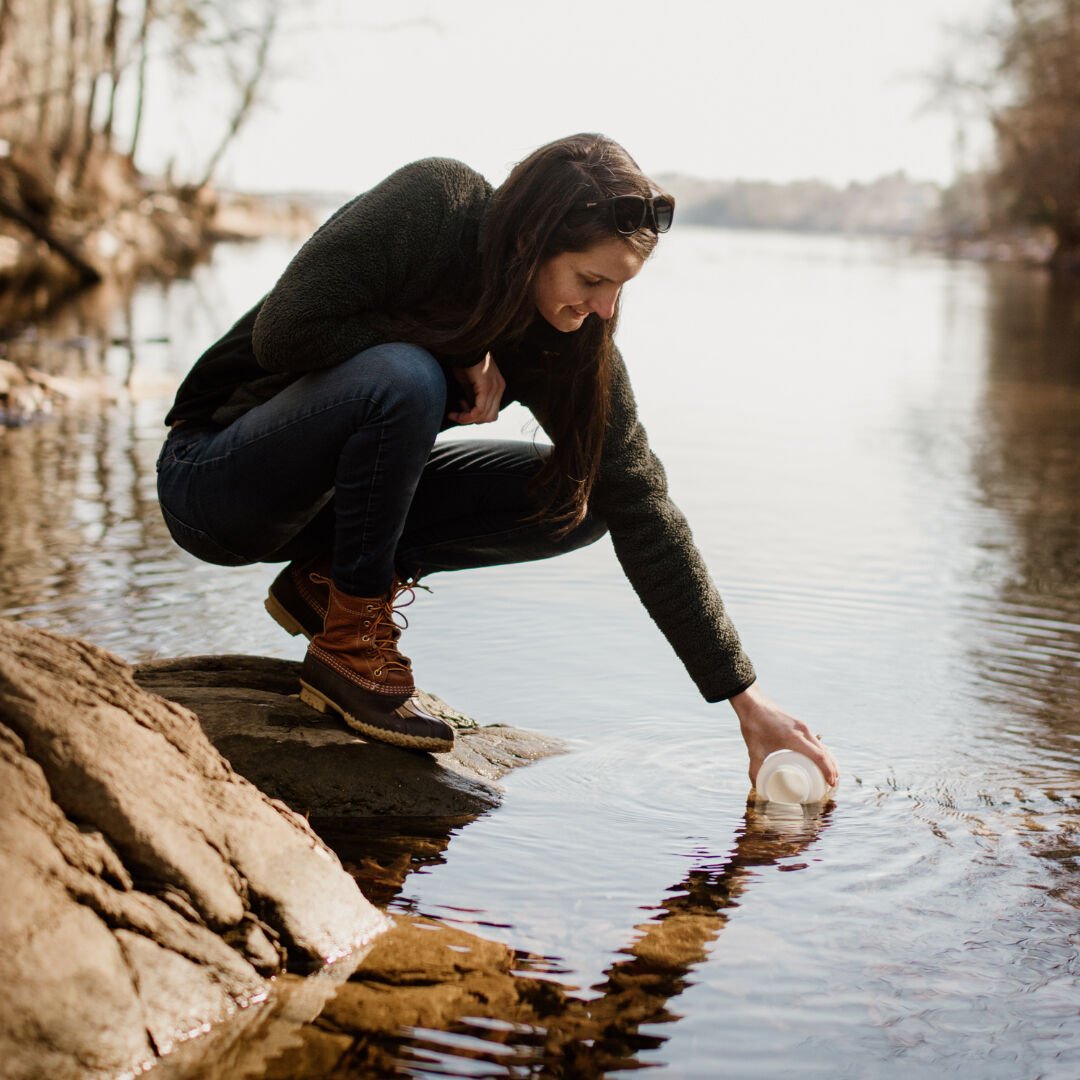
The Lake James Environmental Association’s Sophie McCarthy takes a water sample.
LJEA photos / FOR THE PAPER
Friends of Lake James State Park helps pay for the tests. The Environmental Quality Institute in Black Mountain does the lab work.
Keep it Clean. Please avoid obscene, vulgar, lewd,
racist or sexually-oriented language. PLEASE TURN OFF YOUR CAPS LOCK. Don't Threaten. Threats of harming another
person will not be tolerated. Be Truthful. Don't knowingly lie about anyone
or anything. Be Nice. No racism, sexism or any sort of -ism
that is degrading to another person. Be Proactive. Use the 'Report' link on
each comment to let us know of abusive posts. Share with Us. We'd love to hear eyewitness
accounts, the history behind an article.






























(0) comments
Welcome to the discussion.
Log In
Keep it Clean. Please avoid obscene, vulgar, lewd, racist or sexually-oriented language.
PLEASE TURN OFF YOUR CAPS LOCK.
Don't Threaten. Threats of harming another person will not be tolerated.
Be Truthful. Don't knowingly lie about anyone or anything.
Be Nice. No racism, sexism or any sort of -ism that is degrading to another person.
Be Proactive. Use the 'Report' link on each comment to let us know of abusive posts.
Share with Us. We'd love to hear eyewitness accounts, the history behind an article.