



Kathy Bailey did not leave college and go immediately into a health care management career.
Instead, upon graduation from UNC-Greensboro in the spring of 1978, she became a staff nurse in the Trauma and Surgical Intensive Care Unit at Duke University Medical Center.
It was, she remembers, “Trial by fire.”
It was also, she recalls, “A tremendous learning experience.”
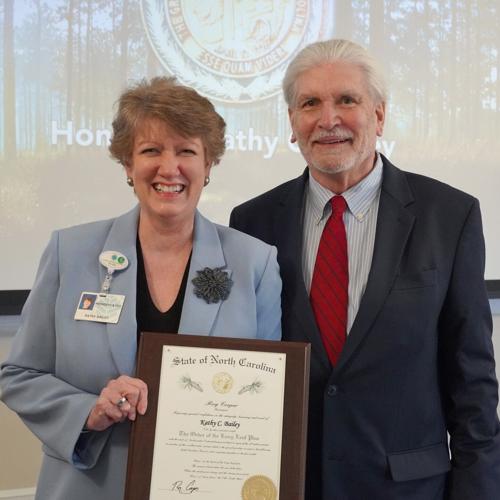
Those years as a trauma nurse gave Bailey, who will retire from her position as President and CEO of UNC Health Blue Ridge on Aug. 31, a perspective that has served her well over the years.
“I started at the bedside,” she said. “I know exactly what front-line staff goes through. The nights, the weekends, the holidays. Working Super Bowl Sunday. Working on Christmas morning.”
Those years as a nurse also provided a necessary component of Bailey’s management style.
“I can be tough when I need to be,” she said. “Again, I was an ICU nurse. When I have to go into ‘Code Mode,’ I can start barking orders and wanting immediate results.”
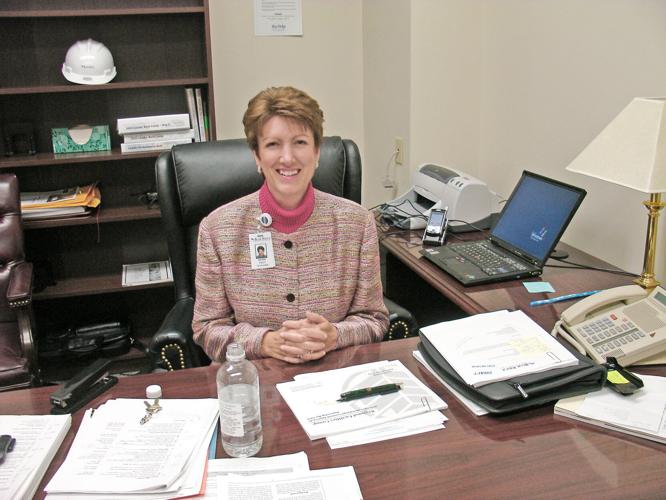
Bailey greets her interviewer in her spacious office in the administrative area on the ground floor of the hospital. Before the interview begins, she proudly points out a 12-inch tall mechanical dancing gorilla clad in a UNC shirt. When the gorilla dances, so does she.
Over the course of the next hour, Bailey is, by turns, wickedly funny, passionate, nostalgic, and thoughtful. The overall message conveyed: This is a highly successful woman who demands excellence from herself and from those around her.
NORTH CAROLINA BACKGROUND
Kathy Bailey lived the first dozen years of her life in Winston-Salem, then as now one of the larger cities in North Carolina.
At the age of 12 her family moved about 40 miles north up Hwy. 52 to the much smaller town of Mount Airy.
Mount Airy, of course, was also the childhood home of Andy Griffith, beloved star of “The Andy Griffith Show.” That show was just wrapping up its eight-year run on CBS when Bailey moved to town in 1968.
Bailey remembers happy times in both locations of her youth.
“In Winston-Salem, we were free to roam the neighborhood,” she recalled. “And in Mount Airy, we could walk or ride our bikes into town. It was very much a small town.”
Upon her graduation from high school in 1974, Bailey said she, like most young women who wanted a professional career, was presented with two options: nursing or teaching.
There was no “Road to Damascus” moment that Bailey can recall which led her to pursue nursing. “I knew I didn’t want to be a teacher,” she said, “And I had always been fascinated with health care and how doctors actually made people feel better.”
UNC-Greensboro offered a bachelor’s degree in nursing, but Bailey wanted a more traditional college experience – one that included boys and football.
Luckily for her, UNC-G and Appalachian State had a cooperative program at that time, through which nursing students could complete two years on the Boone campus and then do their junior and senior years in Greensboro.
INTO NURSING
Within weeks of her college graduation in the spring of 1978, Bailey was working her first job in the Trauma and Surgical Intensive Care Unit at Duke. It was a happy and productive time for the young woman.
“I was 22 years old, I was a registered nurse, I was living in Durham, I was working in a challenging environment, and I was making money,” she remembered. “What more could I ask for?”
Although only 22, Bailey was already mature enough to recognize, “that I was in a tremendous learning environment. The patients in that ICU were almost always dealing with multiple issues.”
After several years at Duke, Bailey completed one year of service at the Veterans Administration Hospital in Durham. She then went back to Winston-Salem to work in the ICU at Forsyth Hospital.
Her first opportunity to move into a leadership role came when she was hired as Director of Intensive Care at Lexington Memorial Hospital in 1983. She was only 27 years old.
“I simply answered an ad in the newspaper,” Bailey said. “I had no idea I would get the job. But I quickly learned that I really enjoyed being in management.”
Asked what she enjoyed about transitioning into management, Bailey responded, “It gave me the ability to make a difference in the lives of a number of people at one time. I could help make a whole team of nurses better.”
Recognizing that advanced degrees would further her progress into management, Bailey earned a master’s degree in public health from UNC-Chapel Hill (hence the dancing gorilla) and later received a doctorate in health care management from La Salle University.
From 1990 to 1999, Bailey served as vice president of patient care at Rowan Regional Medical Center in Salisbury.
While there, she received regional and national acclaim for being the first executive in North Carolina to implement the Shared Governance Model for nursing at a hospital.
The model implements a decision-making structure that allows bedside nurses and nurse leaders to collaborate on strategies and procedures.
'A ONCE IN A LIFETIME OPPORTUNITY'
In 1999, Bailey received an unexpected phone call asking if she would like to apply to be CEO of a hospital at Nags Head on North Carolina’s Outer Banks – a hospital whose construction had not yet begun.
“I was one of 200 applicants,” she said. “I interviewed. And I got the job.”
Was she intimidated at the thought of being responsible for building a new hospital to serve an area where the nearest hospital was 90 minutes away?
Her cool response? “I don’t get intimidated easily.”
Instead, she plunged into her new responsibilities, meeting first with the architects who had drawn the initial plans.
The hospital had no kitchen – the architects had assumed that at a small hospital, the staff could simply microwave meals for the patients. Bailey said, “No way.”
In addition, there was no room dedicated to emergency C-sections. Again, Bailey said changes must be made.
“My nursing background proved to be invaluable as we eventually developed a design that was absolutely phenomenal,” she said.
Bailey was faced with not only supervising the design and construction of the building. She also had to build a medical staff, a nursing staff, a lab staff, and a support staff.
Additionally, she had to win the community’s support for this new game in town.
“I spoke at every civic club that would let me through the door,” she said. “I gave tours to anyone who wanted to come. I hosted a Chamber After Hours function that attracted more than 600 people.”
The work paid off. Outer Banks Hospital, with 19 inpatient beds and 22 beds in the emergency department, opened its doors on March 19, 2002. “It was,” Bailey said, “the greatest accomplishment of my career.”
COMING TO MORGANTON
Although Bailey and her husband were happy with life on the North Carolina coast, she was a very long drive away from her aging father and her sister in Winston-Salem.
That distance was a prime consideration when CEO Ken Wood approached her about becoming chief operating officer at Blue Ridge Health in Morganton. She held that position for eight years until succeeding Wood as President and CEO in January of 2013.
Bailey found her first primary task was to change the perception of Blue Ridge Health in the community.
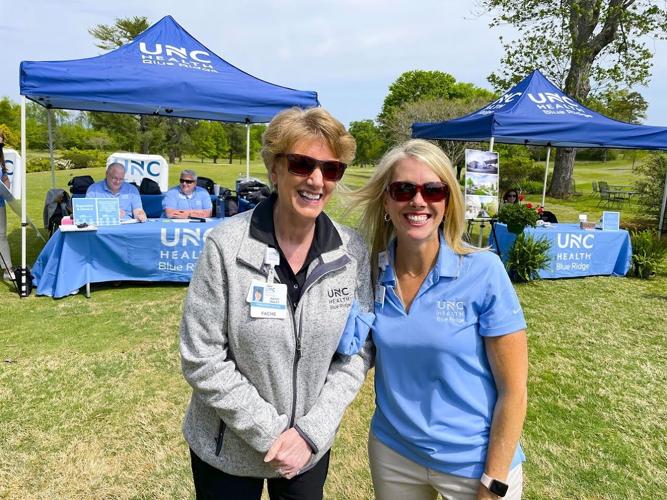
“At the very first meeting of the senior staff, I told them that things were changing immediately,” she remembered. “I told them that the building was not the face of Blue Ridge but that we are the face of Blue Ridge.”
“I told them that each of them was going to become individually involved in the community, joining clubs, serving on committees, doing the work that needed to be done,” she continued.
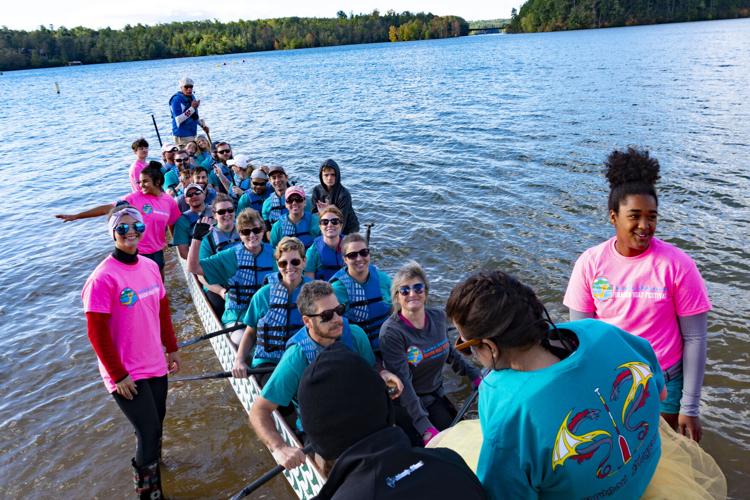
Bailey has also emphasized Blue Ridge support for and participation in events such as the Historic Morganton Festival and the Waldensian Festival in Valdese. “We don’t just write a check,” she said. “We send a crew. We show up. We’re there.”
UNC Health Blue Ridge, she said, has grown from being a basic, small-town hospital to more of a regional facility.
Unlike any other hospital in the Catawba Valley, UNC Health Blue Ridge is the sponsoring institution for a medical residency and fellowship program meaning the hospital serves as a teaching facility.
An array of specialists are now associated with the hospital, Bailey said, and that means Burke County residents no longer have to drive to Charlotte or Asheville to receive the care they need.
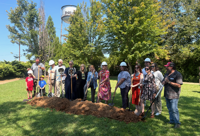
A $38 million cancer diagnostic and treatment center opened on the Blue Ridge campus in Valdese last summer.
The cancer and infusion center is housed in a new 34,272-square-foot addition that features new infusion therapy and treatment areas with private and open space, radiation and chemotherapy exam rooms, consultation areas, and treatment spaces.
Equipment includes two new Linear Accelerators, CT Simulator, and Superficial X-ray.
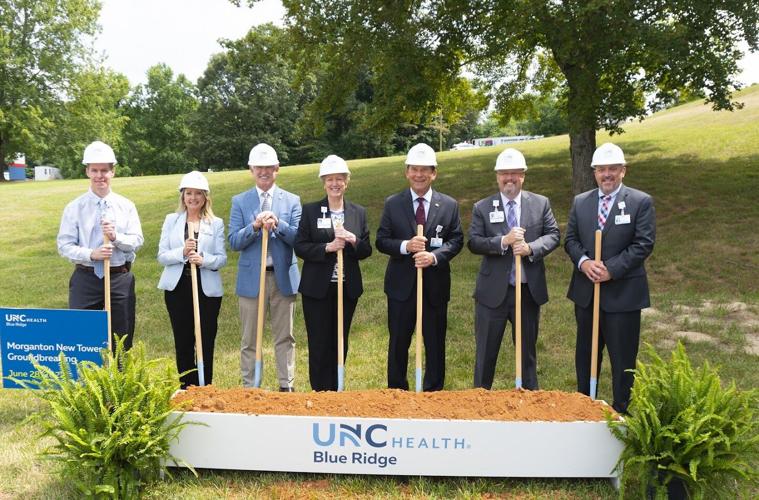
And, later this month, the hospital will be opening a new six-story tower on the Morganton campus to house its ICU and Emergency departments.
“The quality of care and of safety for our patients is absolutely excellent,” Bailey concluded.
LOOKING AHEAD
Life will undergo a seismic change for Bailey on Labor Day weekend. She has been working, and working very hard, for more than four and a half decades. On Sept. 1, that work will stop.
“I will do something,” she said of the future. “But I never want to work full time again. I’m open to a more flexible role. Perhaps in consulting. I don’t know what retirement looks like.”
Asked if she and her husband, Don, will continue living in Burke County after her retirement, Bailey said, “For the foreseeable future.”
Eventually, she said the couple is likely to move to the Triad, to be nearer to their adult children and their grandchildren.
“I’m proud of what we’ve accomplished here,” said Bailey. “These people, this staff, are absolutely tremendous.”




















(0) comments
Welcome to the discussion.
Log In
Keep it Clean. Please avoid obscene, vulgar, lewd, racist or sexually-oriented language.
PLEASE TURN OFF YOUR CAPS LOCK.
Don't Threaten. Threats of harming another person will not be tolerated.
Be Truthful. Don't knowingly lie about anyone or anything.
Be Nice. No racism, sexism or any sort of -ism that is degrading to another person.
Be Proactive. Use the 'Report' link on each comment to let us know of abusive posts.
Share with Us. We'd love to hear eyewitness accounts, the history behind an article.