

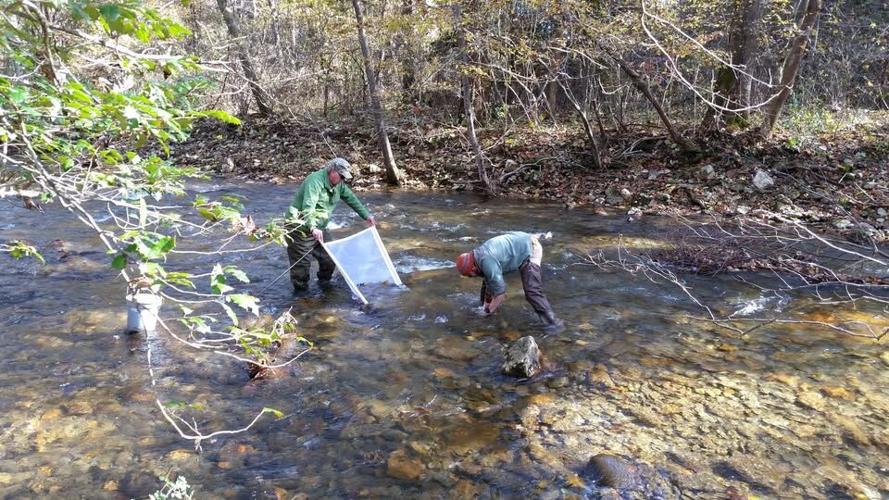

Volunteers gather macroinvertebrate samples in a tributary of Lake James.
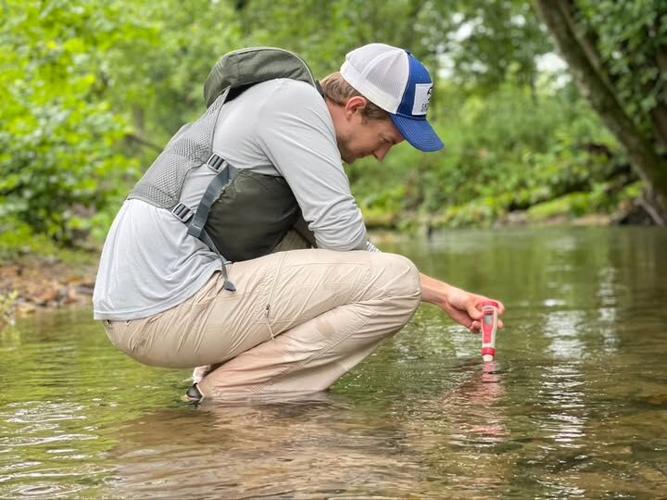
Grant Buckner of Catawba Riverkeeper samples the water in a creek.
LJEA / FOR THE PAPERWater quality testing is only one of the ways in which the LJEA monitors Lake James.
Marshall Taylor, who heads up the association’s community science committee, said the organization has conducted 88 stream habitat surveys since 2018, including 17 post-Helene. The LJEA plans to study 30 more sites this summer.
Lake James is fed by the Catawba River and its North Fork, the Linville River, Paddy’s Creek, and numerous smaller tributaries. Many of them sustained historic damage during Helene.
The health of those tributaries has a direct effect on the condition of the lake itself.
“If those feeder streams are healthy, the lake will be nice and healthy,” Joanne Deyo, president of the LJEA said. “If those feeder streams have issues, that can come into the lake and become an issue for the lake. So that’s why LJEA doesn’t just focus on the lake itself. We focus on the entire watershed.”
One way to determine how a creek or river ecosystem is faring is to look at some of its smallest inhabitants.
The LJEA has performed 107 macroinvertebrate studies and is awaiting the results of the five most recent ones.
Macroinvertebrates include small aquatic insects like mayflies, arthropods like crawfish, snails, and worms.
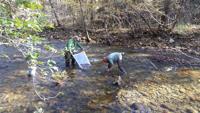
Volunteers gather macroinvertebrate samples in a tributary of Lake James.
LJEA / FOR THE PAPERIn a healthy stream environment, these species serve numerous purposes, such as feeding on and breaking down organic matter like leaves and twigs, scraping and consuming algae from rocks, and providing a food source for fish and other larger animals.
For scientists, the presence — or absence — of macroinvertebrates is a clear indicator of water quality and stream health.
Perhaps not surprisingly, the research found some species have been greatly impacted by Helene while others are flourishing.
Of the 17 sites studied since the hurricane, 14 had lower macroinvertebrate scores than before the deluge. Those scores have decreased anywhere from 15% to 60%. Feeder streams that originate higher in the mountains sustained more damage than their lowland counterparts.
The association also conducts sediment testing, looking for contaminants and metals. Environmental Quality Institute of Black Mountain tested for heavy metals recently and found none in the samples LJEA provided.
The LJEA also contracted Research Triangle Institute (RTI) in Cary to screen the lake’s sediment for contaminants, partnering with Western Piedmont Community College. The scientists at RTI checked samples taken at 10 different locations for compounds like herbicides and fungicides that don’t show up in routine water quality tests.
“Those compounds were there in levels we would consider to be of no concern, so that was encouraging,” Deyo said.
It will likely be years before all the effects of the unprecedented storm become apparent, Deyo said. But the data being collected now will be a crucial piece of the puzzle for scientists in the future.
“Pre-Helene and then post-Helene, the world changed around here, and we wanted to make sure we were focusing on the right things,” she said. “And we’re happy that these things came within limits that were not concerning to anybody.”
Marty Queen is the senior reporter. He may be reached at 828-445-8595 or marty@thepaper.media.















Success! An email has been sent to with a link to confirm list signup.
Error! There was an error processing your request.


Sorry, an error occurred.
Already Subscribed!
Cancel anytime
Thank you .
Your account has been registered, and you are now logged in.
Check your email for details.
Submitting this form below will send a message to your email with a link to change your password.
An email message containing instructions on how to reset your password has been sent to the email address listed on your account.
No promotional rates found.
Secure & Encrypted
Thank you.
Your gift purchase was successful! Your purchase was successful, and you are now logged in.
| Rate: | |
| Begins: | |
| Transaction ID: |
A receipt was sent to your email.




(0) comments
Welcome to the discussion.
Log In
Keep it Clean. Please avoid obscene, vulgar, lewd, racist or sexually-oriented language.
PLEASE TURN OFF YOUR CAPS LOCK.
Don't Threaten. Threats of harming another person will not be tolerated.
Be Truthful. Don't knowingly lie about anyone or anything.
Be Nice. No racism, sexism or any sort of -ism that is degrading to another person.
Be Proactive. Use the 'Report' link on each comment to let us know of abusive posts.
Share with Us. We'd love to hear eyewitness accounts, the history behind an article.