





A federal judge has struck down the management plan governing the Nantahala and Pisgah national forests, forcing federal agencies to start over and reopening key decisions about how nearby public lands will be used and protected.
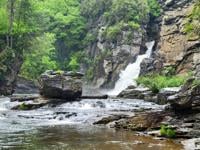
For Burke County residents, the ruling carries real consequences. Pisgah land in and around the Grandfather Ranger District and Linville Gorge falls within the affected forest system, shaping recreation, conservation, and long-term land use across the region.
The court found the U.S. Forest Service and U.S. Fish and Wildlife Service violated the Endangered Species Act by relying on flawed analysis of how the plan would affect protected bat species.
The now-invalidated plan was intended to guide management decisions for more than 1 million acres in Western North Carolina, including habitat protection, recreation access, restoration, and timber activity.
The lawsuit, brought by conservation groups represented by the Southern Environmental Law Center, argued the plan allowed for expanded logging without adequately accounting for impacts on endangered species such as the Indiana bat, northern long-eared bat, gray bat and Virginia big-eared bat.
The judge agreed the agencies’ biological analysis could not legally support the plan.
“Managing hundreds of thousands of acres of public forest land for multiple purposes and outcomes — such as habitat improvement, recreation, species protection, forest health, and the security of our water supplies, among many others — is a complex process,” said Andrew Kota, executive director of Foothills Conservancy of North Carolina, based in Morganton. “The planning involved in guiding the future of our public forests is equally intricate, time-consuming, and imperfect. It’s also challenging to balance diverse resource management objectives — some of which may seem to compete — while meeting the desired outcomes for the current and future state of our national forests for dozens of stakeholder groups.”
The ruling does not immediately close trails or campsites. But it does remove the legal foundation for long-range planning, meaning federal officials must revise the plan and correct the wildlife analysis before relying on it again.
That process is expected to take time and will influence future decisions on timber projects, conservation efforts and recreational use across Pisgah.
For Burke County, the stakes extend beyond environmental policy.
Pisgah National Forest is a central part of the county’s identity and economy. Areas like Linville Gorge draw visitors year-round, supporting local businesses while also serving as a backdrop for ongoing debates over access, habitat protection, wildfire risk and land use.
Supporters of the ruling see it as a necessary check on logging in one of the most biologically diverse forest systems in the Southeast. Critics are likely to argue it creates delays and uncertainty in managing public lands.

























(0) comments
Welcome to the discussion.
Log In
Keep it Clean. Please avoid obscene, vulgar, lewd, racist or sexually-oriented language.
PLEASE TURN OFF YOUR CAPS LOCK.
Don't Threaten. Threats of harming another person will not be tolerated.
Be Truthful. Don't knowingly lie about anyone or anything.
Be Nice. No racism, sexism or any sort of -ism that is degrading to another person.
Be Proactive. Use the 'Report' link on each comment to let us know of abusive posts.
Share with Us. We'd love to hear eyewitness accounts, the history behind an article.