

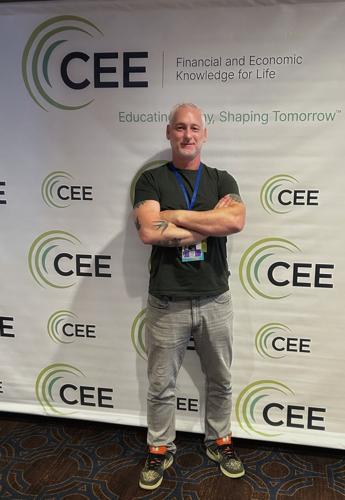
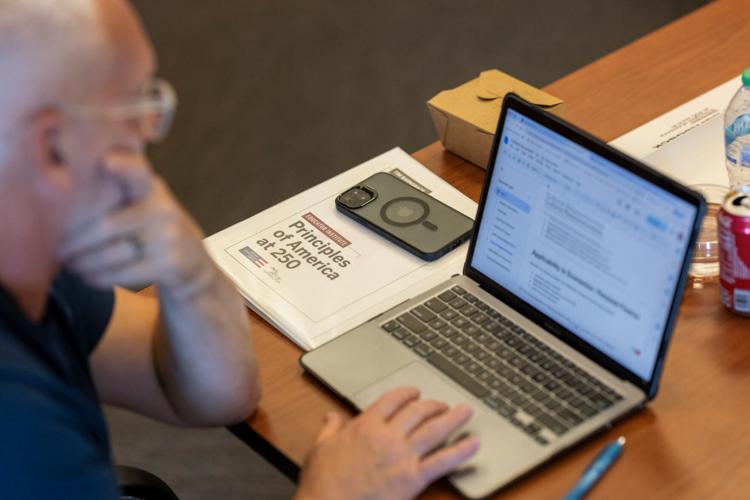

When Tim Barnsback slid into the booth at Little Guatemala in Morganton, he wasn’t dressed like a civics teacher who had just returned from Philadelphia after being selected as one of 31 educators nationwide for the “Principles of America at 250” weeklong institute at the National Constitution Center.
His “World Cup US ‘94” T-shirt, paired with shorts and flip-flops, reflected the summer season, but Barnsback only had his teaching to talk about, reflecting on time spent in the nation’s birthplace the week just before Independence Day.
The “Principles of America at 250” educational institute is a fellowship program that invites educators from across the nation to study how the concepts that formed the United States have grown and shifted since the signing of the Declaration of Independence 250 years ago.
“I can honestly say, since I left university, it was the most intense and exhausting intellectual experience of my life,” Barnsback said. “They brought in the most renowned judges, authors, professors, historians, (and) public educators from across the country to help facilitate.”
Barnsback teaches personal finance to juniors in the fall and civics to seniors in the spring at Burke Middle College in Morganton.
“We dug deep into the Declaration of Independence,” he said. “A lot of it, obviously, is to come back with tools for our students, to teach them how to use our founding documents and read historic documents and get a better understanding of how to apply past principles to modern day.”
“But there is also a civil-social part of it,” Barnsback continued. “We talked about the voices of the founders and the things that were said in the declaration versus the intent, and how the declaration obviously led to the great experiment of the constitution that becomes this living thing.”
To Barnsback, the week not only served as an exploration of the founding fathers’ intent, but it set a goal post for how he educates his students.
“What last week gave me the ability to do is to look at the idea of America and identify what the disconnect is, where we’re seeing a disconnect in society right now and how to wrap it into a way to get people to look at our founding documents with a lens on the future and how we talk about those in civil ways,” he said.
HOW THIS BLENDS WITH HIS TEACHING
The lessons he learned in Philadelphia build on a robust skillset he’s been developing for nearly three decades — a skillset that’s sending him to host a session at the Council for Economic Education’s 65th Financial Literacy and Economic Education Conference in Carlsbad, CA, in the fall.
The session, “Reason in an Uncertain World: When the News Breaks, What Do Students Do?”, will focus on teaching students how to slow down, look at facts and evidence objectively, and balance them with their values and the values of their peers.
He said the session is patterned after his teaching methods.
His goal, he explained, is to no longer have his students learn and regurgitate the “whats” of the world — as was the standard before internet access and AI became so prevalent — but to help them develop and understand their “whys.”
Currently, he leads his students in exercises such as choosing a topic they believe they’re passionate about and discussing it at-length for one minute. Many students can’t, he said.
“I think students sitting in information and discomfort and ignorance is good for them,” Barnsback explained. “Oftentimes, students at the end of these processes come out with a different thought than they had going in, or at least they have a way to reason the things that they believe.”
After spending his career reflecting on the nation’s first 250 years, Barnsback said he believes we are still in the era of a “rising sun,” referencing the rising sun chair that George Washington sat in and referred to during the debates at the constitutional convention.
The trick, he believes, is navigating the next 250 years while still adhering to the founding documents.
“(The founding fathers) never could have imagined this kind of democracy that we live in — things like facial recognition, the types of immigration issues that we’re struggling with right now,” Barnsback said, as a group of children ran past the booth to the soccer field behind the coffee shop. “What would they have said about where we are and where we’re going and how do we get kids to extrapolate that from our founding documents?”




















(0) comments
Welcome to the discussion.
Log In
Keep it Clean. Please avoid obscene, vulgar, lewd, racist or sexually-oriented language.
PLEASE TURN OFF YOUR CAPS LOCK.
Don't Threaten. Threats of harming another person will not be tolerated.
Be Truthful. Don't knowingly lie about anyone or anything.
Be Nice. No racism, sexism or any sort of -ism that is degrading to another person.
Be Proactive. Use the 'Report' link on each comment to let us know of abusive posts.
Share with Us. We'd love to hear eyewitness accounts, the history behind an article.