

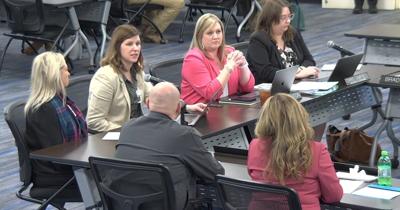


The Burke County Board of Education (BOE) finally met on Monday after a two-week delay because of the ice and snow, mostly to discuss positive feedback on the paper-and-pen initiative and testing rates.
BALANCED INSTRUCTION INITIATIVE
Dr. Kristin Edwards led the discussion alongside Director of Secondary Education Desarae Kirkpatrick. Edwards is the school district’s Director of Digital Teaching & Learning.
Edwards explained that the district sent a survey to parents and teachers, as well as monitored daily device usage during a week when students didn’t have testing. They compared the data from the week of Oct. 24, 2024, to the week of Oct. 27, 2025.
The data draws from students’ time spent in Burke County instructional apps during the school day, such as Renaissance, Lexia, and Schoolnet.
Edwards reported a 17% reduction in screen time for kindergarten through fifth grade students, and a 13% reduction for sixth through eighth grade students.
Although high school screen time saw a modest increase of 3.97%, average time spent in front of a device between both 2024 and 2025 remained lower than their younger counterparts overall.
Anecdotal parent and teacher feedback offered perceived improvements in student handwriting, reading comprehension, knowledge retention, overall well-being, social interactions, sleep patterns, and homework-related stress. Parents also reported less eye strain, screen fatigue, and fewer headaches from their students.
The long list of positives didn’t come without its drawbacks, however. Parents flagged challenges adapting from digital learning to paper-based learning, inconsistent reductions across classrooms, limited access to intentional technology skills instruction, and insufficient communication regarding changes to instruction.
Some teachers pointed out a need for guidelines in the classroom, requesting suggested time limits for instructional use. Both administrators and teachers said they would like to receive more professional development around balancing technology and paper learning.
Edwards said there were some unintended outcomes that the district has noticed since implementation: a 26.2% reduction in office referrals for misuse of technology from 2024 to 2025, an increase in the cost of printing and paper usage due to using more physical learning materials, and a 2% decrease in student device damage rates.
Board member Sonya Rockett asked administrators to develop suggested time windows for teachers who want less autonomy in implementation.
When BOE Chair Tiana Beachler asked how the district felt about their progress, Deputy Superintendent Dr. Karen Auton replied, “This is kind of a benchmark, a baseline year. But in less than six months, I feel like we’ve made some major steps forward.”
TESTING SCORES
Dr. Christie Abernathy, director of Advanced Learning, Testing, & Accountability, presented improvements across high school proficiencies in most subjects in fall testing metrics. The exception was biology, which did not have a comparable test in the fall of 2024.
Abernathy pointed out that this was the first time the district could retest in the fall and that retest metrics could apply to growth and proficiency scores.
Proficiency represents how the students did on individual tests, while growth reflects their improvement over time.
She specifically highlighted the 98% proficiency in Math 1 scores following retests, nearly a 12-percentage point leap from the 2024 fall semester score of 86.2%, and a 3.8 percentage point improvement from the score prior to retests in the fall 2025 semester.
English 2 proficiencies improved 7.3% from the fall of 2024, finalizing at 68.6%. Math 3 grew 22.3 percentage points from 55.1% in 2024 to 77.4% in 2025.
“I really feel like our schools, I want to commend them,” Abernathy said. “They did a great job of getting students back in, remediation, retests — all in five days. It was a lot, but I feel like we’re very successful overall.”
Across elementary school middle-of-the-year check-ins, all reading scores improved, with some dips in fourth grade math and fifth grade math. Abernathy clarified that math check-ins measured different standards between beginning-of-year and middle-of-year tests, so the results weren’t necessarily cumulative.
For middle school scores, there were slight declines in seventh grade reading and math as well as eighth grade math.
Abernathy said the district is focusing on how to assist individual students in growth throughout the remainder of the year.
Science scores improved across fifth grade tests, while eighth graders are testing this month, in February. Abernathy pointed out that these scores were based on two different sets of students but gives a good indication of where students are this year as compared to last year.



























(0) comments
Welcome to the discussion.
Log In
Keep it Clean. Please avoid obscene, vulgar, lewd, racist or sexually-oriented language.
PLEASE TURN OFF YOUR CAPS LOCK.
Don't Threaten. Threats of harming another person will not be tolerated.
Be Truthful. Don't knowingly lie about anyone or anything.
Be Nice. No racism, sexism or any sort of -ism that is degrading to another person.
Be Proactive. Use the 'Report' link on each comment to let us know of abusive posts.
Share with Us. We'd love to hear eyewitness accounts, the history behind an article.