

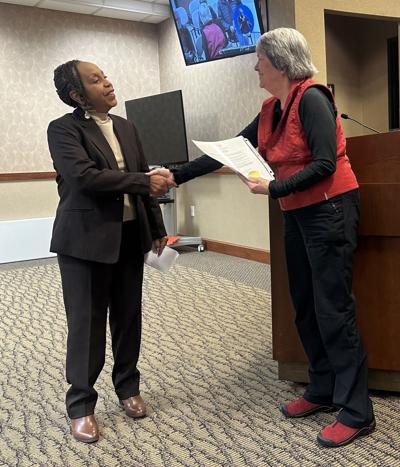


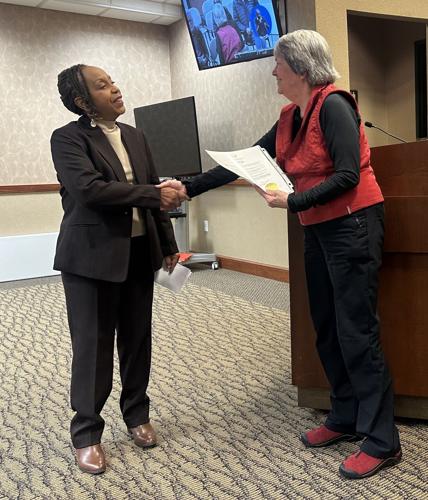
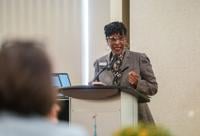
The Rev. Alicia Connelly, president of the Burke County Branch of the NAACP, is no stranger to emotional pain.
She carries the scars of the prejudice she has encountered throughout her life as an intelligent, passionate, and driven Black woman.
Yet despite those scars, or as she will tell you because of them, she remains optimistic, strong in her Christian faith, and proud to say, “I will never lose hope, because my hope is built on Christ.”
Alicia talks about her life, her heritage, and the priorities that guide her during a lengthy interview in The Paper’s conference room on a chilly February morning two days before Valentine’s Day.
She is by turns animated and reflective, taking time to think before answering questions, but speaking eloquently and with deep emotion when she does.
GROWING UP, BUILDING STRENGTH
Alicia grew up in the small, close-knit Black community known as Berrytown, just to the east of Drexel off Enon Road.
For first and second grade, she attended the all-Black East Drexel School, a tiny facility where students from several grades were housed in the same classroom and taught by the same teacher.
In August of 1965, however, that insular world came to an end and a new world began — the Burke County Public Schools would now be integrated and Alicia and the other Black residents of Berrytown would now attend the Drexel schools.
“My parents were very honest with me,” she recalled of their efforts to prepare her for the transition to a majority-white environment. “They told me exactly what to expect, exactly what prejudice I might encounter.
“But they also assured me,” she continued. “That they would be there for me. That they would be active and involved.”
Overall, Alicia said, “Everyone at Drexel Primary went out of their way to assure that the integration process went as smoothly as possible.” But the experience still had its negatives.
“We lost something when that little school in Berrytown was closed,” she said. “We lost part of our sense of community. We lost a part of our history, our legacy, our identity.”
“But” she added, “we now had to build a new place for ourselves.”
Building that new place was not always easy, particularly during her final year in high school at East Burke where Black students were a tiny minority in a huge student body — a minority which at times felt excluded from the basics of student life.
Had she been just one year older, Alicia would have been a graduate of Drexel High School. Instead, she was a member of East Burke’s first graduating class in 1975.
Asked if she wished she could have finished high school at Drexel, she answered, “God knew the path I was to be on. The good and the bad. But the bad helped me grow my strength, my faith, and my courage.”
HIGHER EDUCATION
Always a good student, Alicia was faced with attending either UNC-Chapel Hill or UNC-Greensboro after her high school graduation. She opted for UNC-G for at that time she foresaw herself as a high school biology teacher.
Time as a classroom intern changed those plans, however, and she opted to major in psychology, receiving her bachelor’s degree in December of 1978.
She then took a couple of years’ break to work and save money, before enrolling in the Master of Business Administration program at The Citadel in Charleston, S.C.
The first part of her career was spent working in the private sector, usually with firms that had government contracts.
Her final position was as director of contracts, compliance, and internal audit services for a company in Durham.
Despite her successes, in 2003, Alicia decided to make a change.
SHIFTING DIRECTIONS
Beginning that year Alicia resolved to put her skills and talents to work helping nonprofits, faith-based organizations, and small businesses develop business plans and find their niche.
She and her brother formed their own nonprofit, CBC and Associates, and now do work all over the United States. “We help with organization, incorporation, training, grant writing, program development, the whole gamut.”
Now an ordained minister, Alicia says her commitment is “to use everything that has happened to me, everything that I know, to help other people.”
That includes assuming the presidency of the Burke NAACP Branch, despite her initial reluctance to do so.
When asked if she is optimistic or pessimistic about the future of Burke County and the ability of people of all races, colors, and economic backgrounds to work together toward common goals, Alicia pondered the question before responding.
“I think in Burke County, we have shown the ability to sit at the same table, to build partnerships, and to do the hard work that needs to be done. Nothing is impossible.”
The current slogan of the Burke County NAACP is “Our Time is Now.”
What that means, she said, is “Every one of us must ask the question, ‘What can I do?’”
“We have to value each other,” she concluded. “We have to love each other. Love other people as we love ourselves. And never, ever lose hope.”






















(0) comments
Welcome to the discussion.
Log In
Keep it Clean. Please avoid obscene, vulgar, lewd, racist or sexually-oriented language.
PLEASE TURN OFF YOUR CAPS LOCK.
Don't Threaten. Threats of harming another person will not be tolerated.
Be Truthful. Don't knowingly lie about anyone or anything.
Be Nice. No racism, sexism or any sort of -ism that is degrading to another person.
Be Proactive. Use the 'Report' link on each comment to let us know of abusive posts.
Share with Us. We'd love to hear eyewitness accounts, the history behind an article.