




Longtime community leader Marsha Riddle sits at a concrete picnic table on an early March morning when spring is a hope and a promise but not yet a reality.
The sky is filled with torn and drifting clouds, the sun, when it does pop out, shines weak and feeble. The wind is a constant song, very nearly drowning out Marsha’s voice as she speaks quietly and reverently.
“This is a sacred place,” she says with passion in her voice. “This is a place that needs to be preserved and celebrated. A place that can teach us lessons if we will only be quiet and listen.”
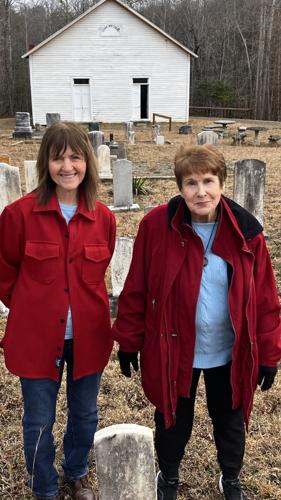
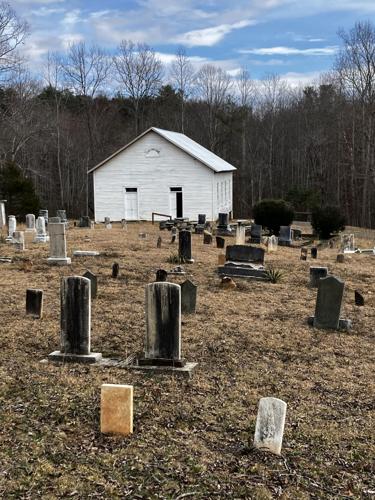
Ahead of Marsha sits the simple clapboard building that is Gilboa Methodist Church. Behind her the church’s historic cemetery, where veterans of both the American Revolution and the Civil War are buried, stretches up a slope.
Surrounding church and cemetery are towering hardwood trees, the thick forest completely blocking the noise from U.S. 64 South and making it possible to imagine what it was like here when Gilboa was established in 1793, 232 years ago.
A SENSE OF HISTORY
Marsha is active in the Historic Gilboa Foundation, a nonprofit group established in 2023 to “protect, historically preserve, and exhibit the unique physical and cultural history” of Gilboa Methodist Church.
With her when a reporter from The Paper comes to visit the site is Andrea Kiser, a woman who has made it her personal mission to restore and protect historic cemeteries around Burke County.
But before talking about the foundation’s goals for the property, it is perhaps best to review the history of Gilboa, which was the second church established in the county after Quaker Meadows Presbyterian.
According to the “Burke County Heritage Book, Vol 1,” Gilboa was established in 1793, a short distance from what is now U.S. 64. The church is considered the “Mother Church” of Methodism in Burke County.
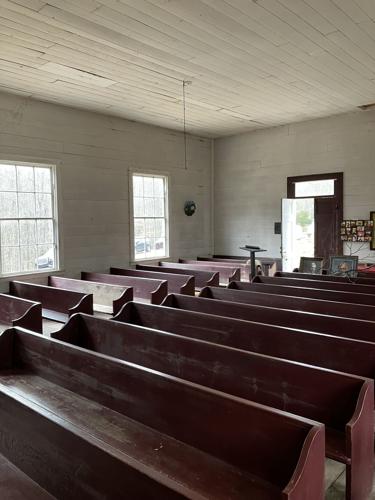
The present church building was constructed in 1879 and was predated by two log structures. The interior of the church is virtually unaltered from the original, which was built from native wood by members of the church.
As the 20th century progressed, Gilboa “seeded” congregations that grew to be the First Methodist Church of Morganton, Glen Alpine Methodist Church, Salem Methodist Church, and Denton’s Chapel Methodist Church.
As the membership of those churches grew, that of Gilboa shrank. The church was isolated. It had no Sunday School classrooms. No fellowship hall. No modern restrooms.
By the end of World War II, membership had fallen so low that Gilboa was closed. First United Methodist of Morganton became its caretaker, while the property was actually owned by the Western Conference of the United Methodist Church.
Morganton attorney Robert “Bob” Byrd, a member of First Methodist Morganton, was a tremendous advocate for Gilboa, Marsha remembered, and in 1997 the New Covenant Sunday School Class of First Methodist did repairs to the facility.
On Oct. 11, 1984, the Gilboa campus was approved for placement on the National Register of Historic Places by the U.S. Department of the Interior.
At one time, the Gilboa building and grounds were used for church suppers and reunions, but that practice faded as the 21st century progressed.
A BRIGHTER FUTURE
Marsha explained that the Historic Gilboa Foundation took possession of the property shortly after it was established in 2023 and is now responsible for its upkeep and maintenance.
One of the foundation’s first goals is to make the community aware of Gilboa and its historic significance.
“It’s important to understand the role that religion played in the settlement of Western North Carolina and of Burke County,” she said. “This church and this cemetery are living representations of that.”
The foundation will be seeking, Marsha said, to do the repairs and maintenance necessary to keep the church usable but to also make sure that “it remains as historic and as accurate as possible.”
The foundation has already received financial support from the Huffman-Cornwell Foundation and recently received a grant from the Central Appalachia Churches Project.
A new roof, costing nearly $40,000, has already been installed on the building.
Next up on the maintenance schedule is a repainting of the church, a repainting that will be done by the members of the BRIDGE Program, meaning the foundation will only have to pay for the paint, not the labor.
The BRIDGE (Building, Rehabilitating, Instructing, Developing, Growing, Employing) Program is a cooperative effort between the Department of Adult Correction and the N.C. Forest Service to train and utilize nonviolent young offenders, providing rehabilitation and education while helping manage the state’s natural resources.
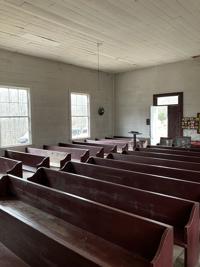
After discussing the painting project, Marsha and Andrea invite the reporter into the church. The sanctuary is the definition of simple. Wooden floor, wooden pews. All looking like something from the pages of a history book.
Later, the trio wanders through the cemetery with Marsha and Andrea pointing out the graves of relatives and the preservation work that has already been done.
“I think if people can come here and see this place, visit the graves, and feel the history, it will remind them of just how important Gilboa is,” said Andrea.
Want more information about the Historic Gilboa efforts? Check out the website at: https://historicgilboafoundation.org/home













(0) comments
Welcome to the discussion.
Log In
Keep it Clean. Please avoid obscene, vulgar, lewd, racist or sexually-oriented language.
PLEASE TURN OFF YOUR CAPS LOCK.
Don't Threaten. Threats of harming another person will not be tolerated.
Be Truthful. Don't knowingly lie about anyone or anything.
Be Nice. No racism, sexism or any sort of -ism that is degrading to another person.
Be Proactive. Use the 'Report' link on each comment to let us know of abusive posts.
Share with Us. We'd love to hear eyewitness accounts, the history behind an article.