

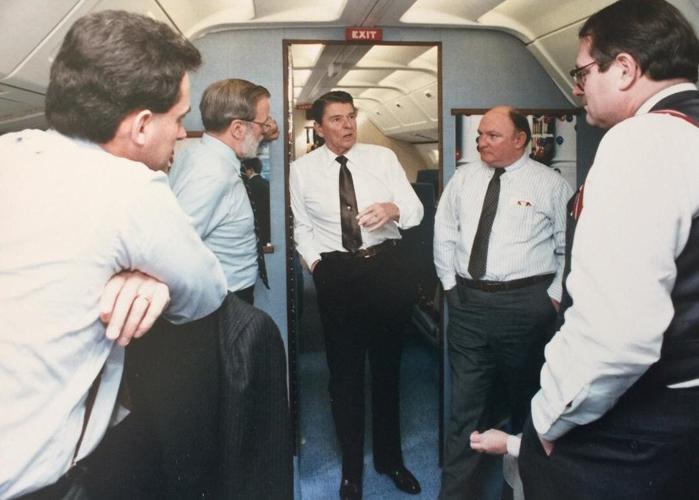
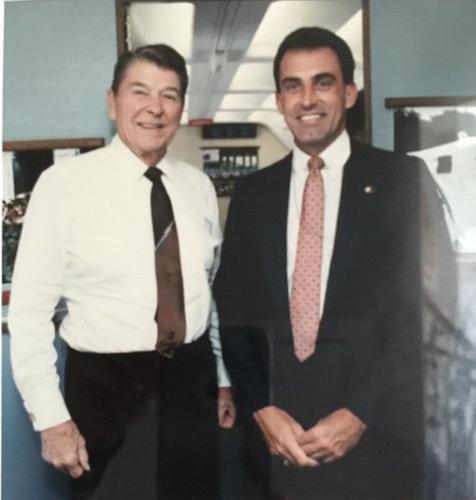
As an infantry combat medic treating wounded soldiers in the Mekong Delta in 1969, Jim Keller was no stranger to loud noises.
It’s ironic, then, that two of the most indelible memories of his subsequent career as the first Army Physician’s Assistant selected for presidential support came during moments of near-absolute silence.
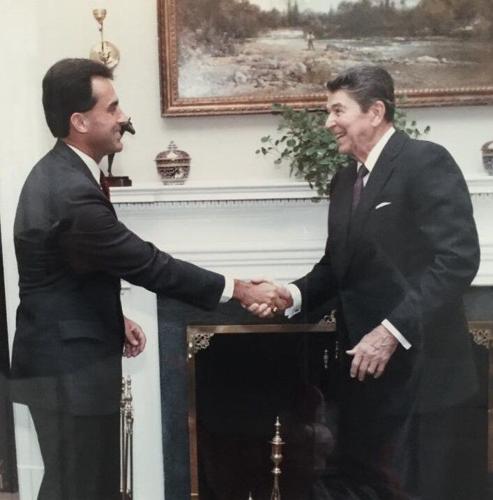
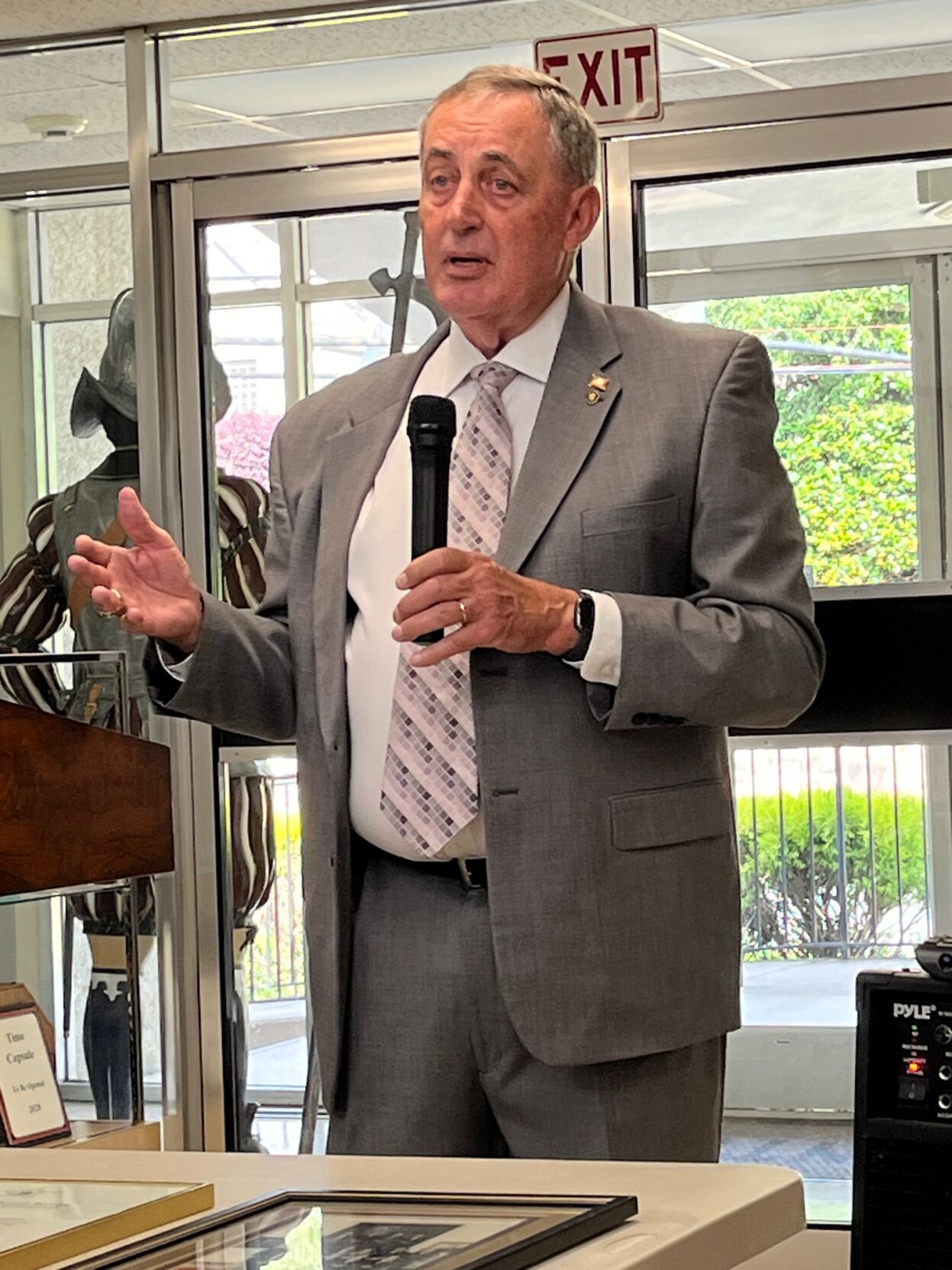
Speaking to a full house at the History Museum of Burke County’s monthly Coffee at the Museum event last Thursday, the Morganton native and retired Army Major told of witnessing a pair of quiet but profound handshakes that are forever etched in his memory.
The first came in May 1985, when President Ronald Reagan visited Bitburg Cemetery in Germany. Controversy erupted when the press learned Waffen SS soldiers were buried there, and the Reagan Administration was roundly criticized by the Jewish community.
After Reagan and German Chancellor Helmut Kohl laid wreaths at a memorial, German General Johannes Steinhoff, an ace pilot during World War II, suddenly reached out to shake the hand of 90-year-old Gen. Matthew Ridgway, who had commanded the 82nd Airborne during the war and later became the Supreme Allied Commander and Army Chief of Staff.
The impromptu gesture was unforgettable, Keller said. It also defused some of the escalating tensions.
“There was a moment there, with absolutely no sound, except in the distance, a bird chirping,” Keller said. “Then, all of a sudden, there was this deafening cacophony of camera clicks. That was one of those magic moments.”
Later that year, Keller accompanied Reagan at the Geneva Summit, when the U.S. President met Soviet General Secretary Mikhail Gorbachev for the first time. The two leaders were there to discuss monumental issues like diplomatic relations and the nuclear arms race.
“Again, that instant before their hands touched, there was absolutely no sound,” Keller recalled. “Nothing. Not even that bird.”
“It was another one of those moments I wished I’d had a camera.”
There were a number of similarly photo-worthy moments during Keller’s memorable tenure as part of the White House Medical Unit, which spanned the years 1984-88 and included portions of Reagan’s presidency and the vice presidency of George H.W. Bush.
Unfortunately, those were the days before smartphones, so Keller’s recollections will have to suffice. “It’s all just whatever’s left in this pea brain up here,” he said with a laugh.
Constantly self-effacing, Keller rattled off anecdotes matter-of-fact style. He sounded like a semi-reluctant uncle nonchalantly recounting his adventures to astonished family members while flipping burgers on the grill.
Accompanying the president with a briefcase full of medical supplies, while a Secret Service officer beside him carried the “football,” the briefcase containing the nuclear codes “in case the world came to an end.”
Drinking Coors beer and driving actor Fess Parker’s boat while Reagan’s people were below in the cabin trying to convince Parker, who portrayed Davy Crockett and Daniel Boone on TV, to run for the Senate.
Holding open a tent flap for a speaker at a Reagan event, only to see an entertainment legend emerge. “Lo and behold, Bob frigging Hope. I just about wet myself,” Keller said. Interestingly, Keller ran into Hope twice more over the next couple of years, and each time, Hope remembered Keller’s name.
Being sworn to secrecy by Reagan in Palm Springs not to reveal the president’s golf score.
Conversing with Queen Elizabeth’s husband, Prince Phillip, in an elevator in Sudan.
Accompanying Vice President Bush and his wife, Barbara, on their walk through the 12 stages of the cross in Jerusalem.
Touring the Great Pyramids at Luxor.
Marveling at the aurora borealis — “The most amazing thing I’ve ever seen in my life,” Keller said — during the Reykjavik, Iceland Summit, in 1986.
Countless flights on Air Force One and Marine One. Keller had a regular seat on both.
Watching a pair of F-15s escorting the presidential plane as it left Soviet airspace on the way to London. “That was the first time I saw them (the fighter jets), and that stays with you,” Keller said. “The hair stood up on my arms.”
The stories went on for more than an hour as the highly decorated veteran — Keller’s list of accomplishments, honors, and degrees could seemingly fill an entire newspaper page — regaled his enrapt hometown audience.
Keller retired from the army in 1994 after 26 years of active service.
These days, he lives with his family in Highlands Ranch, Colo. His sons and their families live nearby. His wife, Debra, is a retired Army colonel.
Keller is an adjunct professor at Red Rocks Community College, teaching in the school’s PA program. “I love it,” he said. “Those kids keep my brain going.”
There’s no doubt he does the same for them as he reminisces about his unforgettable life, especially some of its quieter moments.



















(0) comments
Welcome to the discussion.
Log In
Keep it Clean. Please avoid obscene, vulgar, lewd, racist or sexually-oriented language.
PLEASE TURN OFF YOUR CAPS LOCK.
Don't Threaten. Threats of harming another person will not be tolerated.
Be Truthful. Don't knowingly lie about anyone or anything.
Be Nice. No racism, sexism or any sort of -ism that is degrading to another person.
Be Proactive. Use the 'Report' link on each comment to let us know of abusive posts.
Share with Us. We'd love to hear eyewitness accounts, the history behind an article.