







Different branches of the justice system hold diverse roles but connect in the grand scheme of things to help victims, such as Megan Miller’s case.
Throughout Miller’s journey, she has encountered many officials and personnel in Burke County’s justice system. However, she said she has felt at times that she has been given the “run-around” on who would be in charge of a certain matter in her case.
In understanding the flow of information and what responsibilities lie where, The Paper took a look at the various branches and their roles in domestic violence cases.
The district attorney’s office did not return repeated requests for an interview.
MORGANTON PUBLIC SAFETY
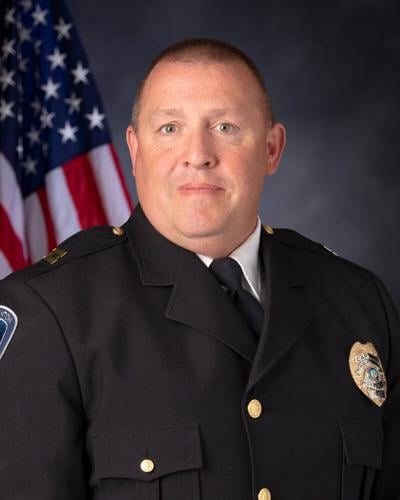
Sitting in a conference room, (then interim) Chief Ryan Lander and Captain Josiah Brown explained MPS’s role in Miller’s case.
Lander said the department prefers to “over report” by maintaining a paper trail of the calls officers respond to. This practice protects the victim and is a benefit to have in their domestic violence cases. MPS reports every domestic disturbance.
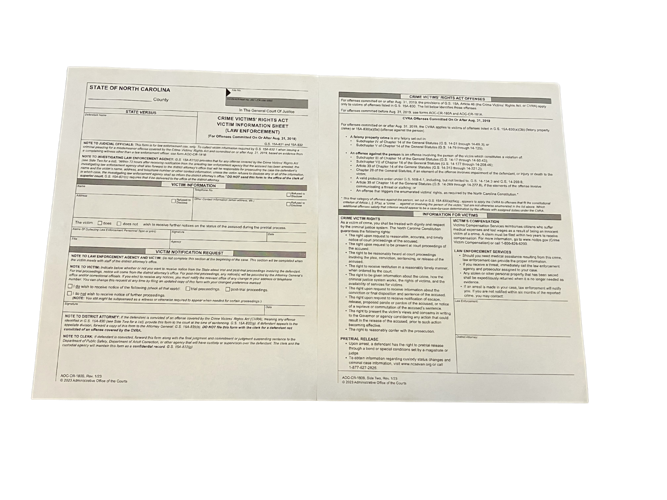
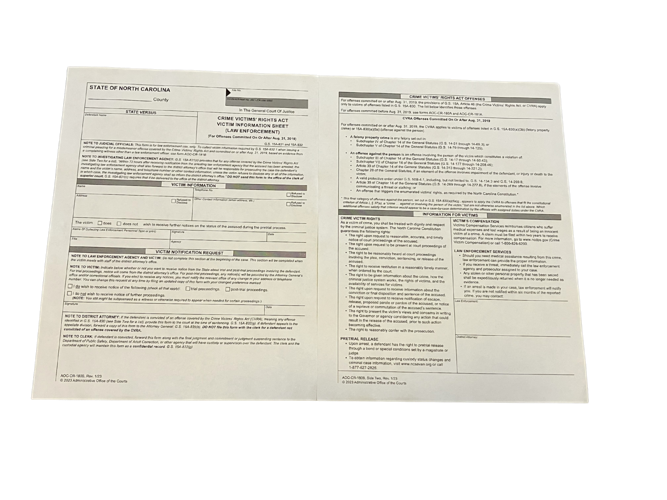
Victims receive a document called a Crime Victims’ Rights Act information sheet. The sheet details the victim’s information, the detective’s information, notification requests, explanation of offenses, and the rights of the victims. It also includes who to contact regarding the custody status of the offender, compensation, and law enforcement services.
Every victim should receive a copy of this document, which is filed through the courthouse. The document is confidential, but it is available through the district attorney’s office.
Additionally, the department is well-versed in Marsy’s Law, an initiative centered on the rights of victims. The law began in California, but has spread throughout the U.S.
Marsy’s Law was passed in North Carolina on Nov. 8, 2018. The law guarantees equal rights for crime victims by keeping them and their families informed about proceedings, developments, services available, changes in the offenders’ custodial status, and more.
The law was named after Marsalee (Marsy) Ann Nicholas, a student of the University of California Santa Barbara who was stalked and killed by her ex-boyfriend in 1983. A week after her murder and after the funeral service, her mother, Marcella, was confronted by Nicholas’ murderer in the checkout line of a grocery store.
The family received no notification that their daughter’s murderer was released on bail days after her murder.
Brown and Lander gave some background on Miller’s case and the arrest of Zachary Berryhill, which aligns with what Miller described. The district attorney’s office had decided to extradite Berryhill after he was apprehended by the U.S. Marshal Task Force. He was later released on bond by the Magistrate’s Office, but the two MPS leaders did not know the exact details of his release.
Lander noted that this case is different because there has been more activity from Berryhill, whereas offenders typically don’t return to the state they’re fleeing.
They did confirm that her detective, Lt. Edwards of the criminal investigations division, has been responsive to her and has entered Berryhill’s warrants into the National Crime Information Center (NCIC).
If Berryhill runs into law enforcement anywhere in the United States, his warrants will be in this database. He will be apprehended and then extradited to Burke County.
The two MPS leaders strongly encourage people to contact the department and ask questions. This could be their records department, Lt. Edwards, or either Lander or Brown.
MPS, the two men said, is a single part of the criminal justice system. They do what they can and help where they can, including in Miller’s case.
WARRANT SYSTEM
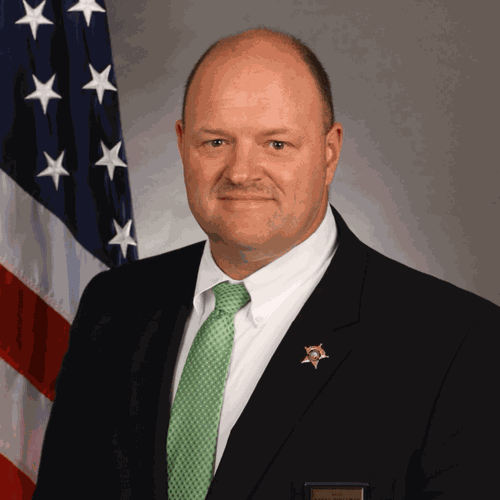
Apprehending a wanted person can be tricky, especially when they are on the run. Sheriff Robert “Banks” Hinceman explained the warrant system and how someone is taken in.
Warrants are uploaded into two databases: the statewide eWarrant system and the NCIC.
The eWarrant system is newer and electronic, which Hinceman said is easier. Law enforcement can more easily retrieve and print information from the system and give to a Magistrate.
The NCIC enables law enforcement anywhere in the country to see if a specific individual has outstanding warrants. They are arrested and law enforcement then works with the local district attorney’s office to extradite the person. Either a deputy is sent to retrieve the person, or a transportation officer of the state will bring them back.
Entry into the NCIC requires meeting specific criteria, Hinceman said, such as people who are “very hard to find or have serious charges.”
However, unless law enforcement has known locations of the offender, the person can go undetected.
MAGISTRATE’S OFFICE
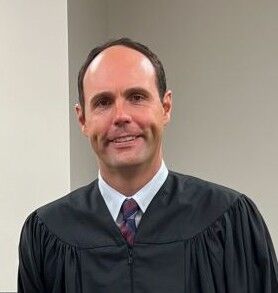
As the chief district court judge, Robert Mullinax sets the schedule for his nine colleagues on the district court bench while having administrative/supervisory authority over the Magistrate’s Office.
Mullinax can appoint a chief magistrate in each of the three counties (Burke, Caldwell, and Catawba). He has the authority to investigate complaints as well.
As a district court judge, he holds court in various matters such as civil domestic violence issues, juvenile court, and child custody-related cases.
Taking a look at assaults like Miller’s, Mullinax walked through how the case unfolds.
“If someone is assaulted, they can contact law enforcement. Law enforcement can investigate. If law enforcement finds that there’s probable cause that the person was assaulted, law enforcement has the power to arrest the perpetrator,” Mullinax said.
Law enforcement can bring the person before a magistrate. The officer would provide sworn testimony as a result of the investigation. If probable cause is found, the person is charged with assault.
Mullinax explained that probable cause shows a reasonable basis to think that a crime occurred.
An alleged victim can choose not to contact law enforcement and go directly to the Magistrate’s Office, which would hear the testimony. If probable cause is found, the magistrate could issue the process to charge the alleged offender with assault.
Magistrates are authorized to make those determinations, Mullinax said.
“I know and have met with all five of our full-time magistrates in Burke County, and have full faith in their confidence and integrity,” Mullinax said.
Moving forward, a court date will be set. If the person pleads not guilty, then a trial will be held in front of a district court judge.
If convicted, a sentence will be entered. If acquitted (not guilty), then the person gets to walk out the door, Mullinax said.
“The state is required to show beyond a reasonable doubt that all the elements of assault have taken place for a person to be convicted of assault. The overwhelming majority of cases in District criminal court result in some sort of plea negotiation, in which the defendant pleads guilty. If the defendant were to plead guilty of assault, the defendant would be sentenced appropriately,” he explained.
Mullinax could not comment on the specifics of Miller’s case nor offer any advice.
He did add, “I would like for the public to know that we (judicial system) take domestic violence seriously. Domestic violence is real. I feel like, as a system, we understand that. Each individual case has certain facts and circumstances that set it apart from others, and understanding our role in helping to prevent and helping those who suffer from domestic violence … We take each individual case as it comes.”






















(0) comments
Welcome to the discussion.
Log In
Keep it Clean. Please avoid obscene, vulgar, lewd, racist or sexually-oriented language.
PLEASE TURN OFF YOUR CAPS LOCK.
Don't Threaten. Threats of harming another person will not be tolerated.
Be Truthful. Don't knowingly lie about anyone or anything.
Be Nice. No racism, sexism or any sort of -ism that is degrading to another person.
Be Proactive. Use the 'Report' link on each comment to let us know of abusive posts.
Share with Us. We'd love to hear eyewitness accounts, the history behind an article.