



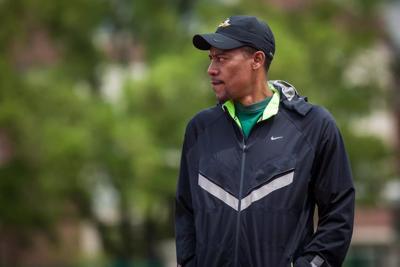
Robert Johnson started in the sport of track and field at Morganton Junior High School in the mid 1980s.
Nearly 40 years later, he’s remembered as one of the greatest coaches in the history of the sport.
His eye-popping resume as the head coach of the University of Oregon men’s and women’s track and field and cross country programs in 10 seasons from 2012 to 2022 includes 14 NCAA team championships (nearly half of Oregon’s 33 total national titles in those sports), a number that ranks him fourth in the history of the sport and ninth among Division I coaches spanning all sports.

Johnson
Johnson also coached the Ducks to 12 Pac-12 Conference titles and coached 62 NCAA individual champions with the storied program, leading Oregon’s men to a run of 15 consecutive Pac-12 outdoor track titles including his seven years as an assistant coach/associate head coach there. That stretch also included the men’s and women’s teams sweeping the Pac-12 outdoor titles for nine straight years from 2009 to 2017.
Under his guidance during the 2016-17 school year, the Oregon women became the first program in NCAA D-I history to sweep the cross country, indoor track, and outdoor track national titles in the same year. Only one other coach in history has led women’s teams to each of those three NCAA titles – the “triple crown” – in his entire career.
That season, the Ducks won the XC title by one point, crushed the opposition with a meet-record 84 points en route to the indoor title, and claimed the outdoor crown in the final event thanks to a collegiate-record 3:23.13 clocking in the 4x400-meter relay.
Johnson’s tenure included consecutive NCAA titles in men’s indoor track (2014-16), men’s outdoor track (2014-15), and women’s indoor track (2013-14 and 2016-17) as well as two national titles apiece in women’s cross country (2012, 2016) and women’s outdoor track (2015, 2017).
His first national title with the Ducks, in the fall of 2012 with women’s XC, was the program’s first in the sport in a quarter-century. In the spring of 2013, the Oregon men then claimed their first outdoor track national title in 29 years, setting a championship meet record with 88 points and recording the largest margin of victory in the meet in 20 years.
It was another romp to the men’s outdoor NCAA title in 2014 as the Ducks’ 29-point margin of victory represented the largest in 21 years.
In Johnson’s decade as Oregon head coach, his athletes broke all but one indoor and outdoor track women’s program record in the sprint, relay, and horizontal jump events and the Ducks claimed the NCAA D-I national women’s program of the year honor six times and men’s program of the year honor each year from 2013 to 2015.
Johnson was recognized as a 10-time Pac-12 coach of the year, 14-time U.S. Track and Field and Cross Country Coaches Association (USTFCCCA) national coach of the year, and 15-time USTFCCCA West Region coach of the year.
A Glen Alpine native nicknamed “Poose,” Johnson starred in track at Freedom High School, from where he graduated in 1991. As a Patriots senior, Johnson established what stands as FHS’ oldest boys track record with a distance of 47 feet, 8¼ inches in the triple jump in an NCHSAA 4A state championship meet runner-up performance, leading the Patriots to a third-place finish as a team.
He went on to what was then known as Brevard Junior College, where he became a three-time NJCAA All-American in the triple jump before transferring to Appalachian State University, where he was a two-time NCAA All-American in the same event, qualifying for the NCAA outdoor championships in 1996 as a Mountaineers senior.
Also as a senior at App State, Johnson was named to the All-Southern Conference squad in five events: the long jump, triple jump, high jump, 200 meters, and 4x100 relay. He was named SoCon men’s outdoor track athlete of the year that season, winning the league triple jump and high jump titles. He still holds the App State record in the high jump (7 feet, 1¾ inches).
Johnson then competed on the professional level for five years, finishing fifth place in the triple jump at the 1998 USA Senior Nationals and later qualifying for the 2000 U.S. Olympic Trials in the triple jump, where he placed 10th.
Johnson had already begun coaching the sport in 1997 as an assistant at App State, where as men’s and women’s jumps coach, he stayed until 2003 and helped coach 28 SoCon individual champions, 14 NCAA championship qualifiers, two SoCon freshmen of the year, two SoCon athletes of the year, and the program’s first All-American women’s jumper.
He then spent two years as an assistant at UCLA, coaching men’s long, triple, and high jumps and women’s long and triple jumps in addition to serving as the women’s team strength and conditioning coach before moving to Oregon as sprint, relays, and horizontal jumps coach.
The teams he helped coach at UCLA won one NCAA title and two Pac-12 titles and produced eight All-Americans.
Johnson, now 52, was inducted into the App State Athletics Hall of Fame in 2011.
Johnson recently exchanged emails with The Paper. Here’s some of what he had to say:
Q: How and when did you get started in track and field? And what other sports did you play growing up?
“I played baseball in elementary school at Glen Alpine and then got into basketball and track while at Morganton Junior High School. Once I got to Freedom High School, I wasn’t fast enough to run the 100 (meters), which everybody wanted to do during tryouts, so I ended up doing the triple jump. Robert McGimpsey – we call him “Weed Hopper” – was the coach when I got there, and he taught me how to triple jump. I remember going home, and I started triple jumping in my grandmother’s backyard into her flower bed. While I was at Freedom getting started in track, I also played on the basketball team under Terry Rogers. One of our family friends, Odell Williams, was instrumental in helping me get to college from Freedom, because my plan at the time was to go to the Army after JROTC. He helped me figure out what the SAT and the ACT was, and then when to get all my paperwork and transcripts to send them out.”
Q: What made Appalachian State and the track program there the right choice for you?
“I actually didn’t go to App State immediately out of high school, I went to Brevard Junior College first where Dave Rinker was the track coach. And what was interesting about that is during the recruiting process, I had quite a few schools come to my house and wanted to recruit me, but I remember very vividly Al Fereshetian, who was the men’s head coach at Appalachian State, came to recruit me and was showing me some drills out in the front yard. I thought that was kind of fun and unique out of all the schools that I was looking at, and when I found out that I didn’t have the grades and SAT score to go to App State right away, Brevard College was the right first step for me. When I was getting ready to graduate, Coach Fereshetian came to visit me again. He recruited me, and several of my teammates, John Moss and Raymond Brewer, who all ended up going to Appalachian as well. And so that’s kind of how my path led me to go to App State. The reason I chose App State is this guy just stayed with me over those two years, he continued to call and check on me, he wanted updates on how I was doing, and out of all the schools that I was looking at during this point in time, Appalachian was the one that stayed consistent.”
Q: Appalachian is also where you started your coaching career. How and when did you decide to get into coaching the sport?
“While I was at App State, I ended up doing really well. I was the Southern Conference athlete of the meet, the MVP of the meet. As my college career was winding down, I was competitive and had seen some success and wanted to try the whole post-collegiate pro running thing. At that point in time, John Weaver was the head coach over both men and women because Coach Fereshetian left and went to Bates College to accept the job there. During my senior year, I was training for the 1996 U.S. Olympic Trials but then I got hurt and didn’t get to compete. Coming back to App State after the season was over, I was training one day and Coach Weaver asked me to help the jumpers with some approaches. So, I helped him with some approaches and then helped them with some other little drills that we used to do there in training. Then one day led to two days, and two days led to two weeks, and then two weeks led to three months. After the fall season, he asked me if I wanted to coach, and I found myself doing more coaching than I was doing my own training. I would spend all day and all morning with the team coaching, and then I’d end up doing my workouts at like six, seven, eight o’clock at night. Of course, as you can imagine, human nature sets in, and you push those late-night workouts to the next day, and you end up missing more workouts. Going into my last year of competition as a professional, I competed at the U.S. Olympic Trials in Sacramento in 2000, and I knew at that point in time that it was over and done with, so I really started to lean into the coaching piece of things. Coach Weaver was an incredible mentor in helping me get started into that.”
Q: From there, you were off to UCLA before then heading up to Oregon. What do you feel like you picked up along the way at each college that made you such a successful head coach?
“I coached the vertical and horizontal jumps and helped out a little bit with the sprinters while I was at App State. I helped Meg Ritchie Stone who was the sprint coach at App State, and I learned a lot from her as well as her husband, Dr. Mike Stone, along with Dr. Harold O’Brien. I participated in a couple of their case studies where we were learning about performance in athletes, and that led me down the road of strength and conditioning training. They were instrumental in that piece of my learning and how strength and conditioning benefits track and field athletes specifically. When I got to UCLA, I was responsible for coaching the women’s sprints and jumps. And of course, you had some of the greats there at that time – Bobby Kersey, Art Venegas, Jeanette Bolden, Anthony Kern, Bob Larsen, and Tony Veney. All of them were at the track daily. I could go out and watch practice and pick some of the greatest minds in our sport. I had all these different resources and all these great minds there in Westwood that I could just sit and watch or sit and talk to about track. My experience and success at UCLA helped propel me on to Oregon, where during my first years I was coaching the jumps as well as the sprints and hurdles. Later, I started coaching the 400 and 800 meters, which was a little out of my wheelhouse but also where I found a lot of success. I think the different opportunities, experiences, and the many coaches I was able to work with along the way contributed to the success I had as a head coach at Oregon.”
Q: Was the move out to the West Coast an intimidating one at first since you were so far from home?
“It was intimidating almost to the point where I was reluctant to take the job at UCLA. I had a mentor at the time, Mr. Bowden, who said ‘You can always come back and coach at a smaller school, but if you’re ever going to see how good you’re going to be, and if this is something that you want to do for a career, you should take a chance.’ And he couldn’t have been more right, because one of the things that I was fearing most is that I wasn’t going to be good enough to go and coach at this big Power 5 school. I realized that I was wrong because it really came down to the exposure to different types of athletes, and there are higher ceilings on some of those athletes, like at App State. We were a developmental squad, and we would get kids and develop them, and they would go on to be NCAA All-Americans. At UCLA, those kids come in as freshmen with the talent and the same aspirations. You continue that same philosophy and develop them from where they are and continue to take them higher. And so that was unbeknownst to me at the time, but once I got to UCLA, it was one of the things that I realized very quickly is that these kids need development as well, we were just starting from a different point.”
Q: Your tenure as Oregon head coach included a slew of both team and individual national championships, for the men and women. To what do you attribute that incredible level of success with the Ducks?
“Reading and learning as much as you can, because it helps you separate what is real and actual versus what is not. Trial and error, every year is a different year – there is nothing that is a set in stone, there is no cookie-cutter model. You adapt the basics in the fundamentals to each athlete, because what works for some may not work for others. You must be individualistic in nature as far as being able to say the same thing over and over again in a different way to still get the same result as far as whatever drill or mechanic you’re trying to implement. I’m blessed and fortunate to have been surrounded by great people and great coaches at Oregon, and I would not have had the success I had as head coach without those people in my corner. I would be remiss if I didn’t acknowledge Vin Lananna, who gave me the opportunity to come to the University of Oregon. I remember conversations with Vin like they happened yesterday, but one of the things that he impressed upon me when I took over the program is that track and field at Oregon is bigger than just standing out there holding a stopwatch. There is so much more that goes into it, and he opened my eyes to the business, politics, and responsibilities that come with being the head coach of a storied program like Oregon.”
Q: Do you maintain any close ties to family or friends in Morganton? How often do you get back to visit?
“I have a lot of family and friends back in Morganton, and I try to make it back there as often as I can.”















(1) comment
Great article!! Thank you.
Welcome to the discussion.
Log In
Keep it Clean. Please avoid obscene, vulgar, lewd, racist or sexually-oriented language.
PLEASE TURN OFF YOUR CAPS LOCK.
Don't Threaten. Threats of harming another person will not be tolerated.
Be Truthful. Don't knowingly lie about anyone or anything.
Be Nice. No racism, sexism or any sort of -ism that is degrading to another person.
Be Proactive. Use the 'Report' link on each comment to let us know of abusive posts.
Share with Us. We'd love to hear eyewitness accounts, the history behind an article.