




There are certain places in Morganton that everyone recognizes, even if they don’t fully know their story.
The Old Courthouse on the square. The old train depot. Broughton Hospital.
And on a broad rise along West Fleming Drive and Burkemont Avenue — the North Carolina School for the Deaf.
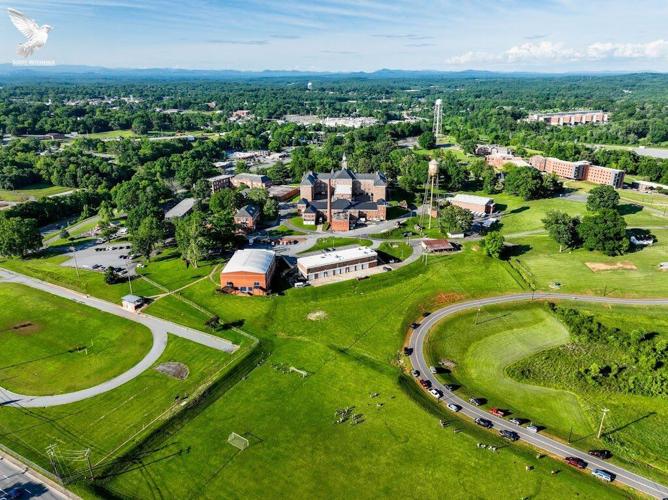
Most people simply know that “NCSD is there.” They know the clock tower. They know the brick buildings and the wide lawns. Some remember attending a football game or driving past as children and wondering what went on inside those walls.
But the story of the North Carolina School for the Deaf is far more than a campus with a tower. It is one of North Carolina’s most significant educational institutions, and for Morganton, one of its defining pillars.
The school was established in 1891 after decades of advocacy by deaf North Carolinians who believed students in the western part of the state deserved equal access to education.
Prior to that, students often had to travel long distances to Raleigh to attend what was then the state’s only school for the deaf and blind.
The creation of a western campus in Morganton was both practical and symbolic — a recognition that deaf students deserved opportunity, community, and dignity close to home.
From its earliest days, NCSD was designed not merely as a school, but as a self-contained campus community.
Over time it grew into a 160-acre campus with nearly 20 buildings, workshops, dormitories, athletic fields, and gathering spaces. Generations of students did not just attend classes here — they lived here, formed lifelong friendships here, discovered language and identity here.
For many students, NCSD was the first place they encountered American Sign Language as a fully expressed language and Deaf culture as something vibrant and shared rather than isolating.
In that way, the campus became far more than an educational facility. It became a cultural anchor.
And Morganton embraced it.
Local families worked on the grounds, taught classes, cooked meals, maintained buildings, and coached teams.
Businesses supported school events. Churches welcomed students. The school’s athletic teams competed against hearing schools across the region. NCSD was never isolated from the community — it was woven into it.
Over the decades, however, the school has faced periodic threats of closure or consolidation.
Budget pressures and shifting educational models have prompted state officials more than once to ask whether maintaining two residential schools for the deaf — one in Morganton and one in Wilson — is necessary.
Each time, the proposal has sparked deep concern in Burke County.
The arguments have not been merely sentimental. Supporters have pointed out the historic scale of the Morganton campus, its room for growth, and the economic and cultural impact it has on the region.
They have also emphasized that the school represents more than square footage — it represents identity, continuity, and a community built over more than a century.
In 2011, when consolidation was again discussed, citizens were urged to speak out. Letters were written. Meetings were held. Families shared stories of what NCSD meant to them. The effort reflected something distinctly Morganton: a willingness to defend institutions that matter.
Those battles revealed an important truth. While educational models may evolve, and while services for deaf and hard-of-hearing students continue to expand in public schools statewide, there remains something unique about a residential campus devoted entirely to deaf education. It provides immersion — in language, in culture, in shared experience — that cannot always be replicated elsewhere.
Architecturally, the campus itself tells a story. Several of its buildings are listed on the National Register of Historic Places. The red brick facades, classical details, and open green spaces reflect late-19th and early-20th-century institutional design — sturdy, symmetrical, intended to convey permanence. The clock tower, visible from the road, stands almost as a quiet sentinel over 130 years of change.
Yet NCSD is not simply a relic of the past. It continues to educate students from across western North Carolina. It continues to adapt to new technology, new instructional methods, and new expectations.
Inside those historic walls are modern classrooms, digital tools, and educators committed to helping students thrive in both Deaf and hearing worlds.
For Morganton, the school’s impact has always been twofold.
First, it has provided jobs and economic stability for generations of local families. Teachers, maintenance staff, administrators, support personnel — many have spent entire careers there.
The school’s presence has meant consistent employment and steady contribution to the local economy.
Second, and perhaps more importantly, it has shaped the town’s character. Morganton has long been known as a place that embraces difference — a place where the sight of hands signing in a restaurant or on a sidewalk is simply part of everyday life. That quiet normalization may be one of NCSD’s most lasting legacies.
Institutions endure not only because they are funded, but because they are valued.
As North Carolina continues to examine how best to serve students with specialized needs, the future of historic campuses like NCSD will likely remain part of the conversation.
When that conversation arises, it is worth remembering that the school is not merely a collection of buildings on Fleming Drive. It is a community built over generations — by students who found their voice there, by educators who devoted their careers there, and by a town that has long taken pride in having it here.
Many in Morganton know there is a clock tower on that hill.
Fewer know the depth of history behind it.
But for more than 130 years, time has marked something significant there — not just hours and minutes, but opportunity, resilience, and a quiet commitment to education that has shaped lives across western North Carolina.
And that is a story worth telling.














(0) comments
Welcome to the discussion.
Log In
Keep it Clean. Please avoid obscene, vulgar, lewd, racist or sexually-oriented language.
PLEASE TURN OFF YOUR CAPS LOCK.
Don't Threaten. Threats of harming another person will not be tolerated.
Be Truthful. Don't knowingly lie about anyone or anything.
Be Nice. No racism, sexism or any sort of -ism that is degrading to another person.
Be Proactive. Use the 'Report' link on each comment to let us know of abusive posts.
Share with Us. We'd love to hear eyewitness accounts, the history behind an article.