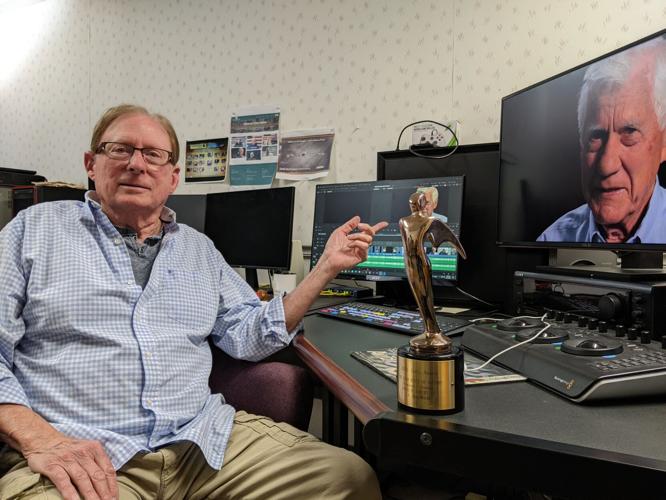
Louis Asbury points to Burke County native Vernon Rader from a scene in the WWII documentary which he produced, The High Price of Victory, with the Telly award in the foreground.
“Bozo’s Circus,” the popular children’s TV show that aired on WGN in Chicago for 40 years, had a job opening.
Elliott
FOR THE PAPER
Louis Asbury, a Charlotte native, who was living in a boarding house in Chicago while studying for a degree in Electronics Engineering at the DeVry Institute of Technology, wanted to get a job at WGN, the leading independent TV station in America in the 1960s.
“I’ll take it,” Asbury said, when told that the job required wearing a blue page suit and helping children with games and prizes in front of a live audience on the Bozo show.
Around the age of 15, Asbury built a Heathkit color TV, a project that he worked on continuously for four days, never leaving his room even for meals, as his mother, who was almost as excited as he was, brought food up to him.
When Asbury turned the TV on in the middle of the night and found that it worked perfectly, he woke up his parents, showing them a live-camera view of JFK’s flag-draped casket in the Capitol Rotunda in Washington, D.C.
After several months of paging for Bozo, Asbury went to the chief engineer at WGN and asked for a job in the engineering department, where he began color correcting all the cameras that were broadcasting live on the air.
Asbury was a technical director at WGN for the live feed during the 1968 Democratic National Convention in Chicago. “It was exciting stuff,” he said, referring to clashes between Vietnam War protestors and the thousands of police, Army, and National Guard troops deployed in the city, which resulted in hundreds of injured demonstrators, bystanders and reporters.
In 1969, Asbury was drafted into the Air Force. While in training at Keesler Air Force Base in Biloxi, Miss., he was assigned to search for bodies in homes destroyed by Hurricane Camille at Pass Christian, Miss., carrying dead children and adults out to refrigerated trailers.
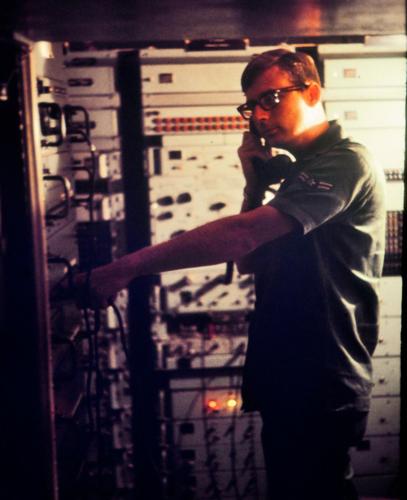
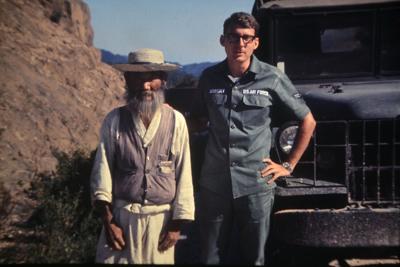
Louis Asbury in the Quonset hut communications station at Site 91 in Korea in 1970.
FOR THE PAPER
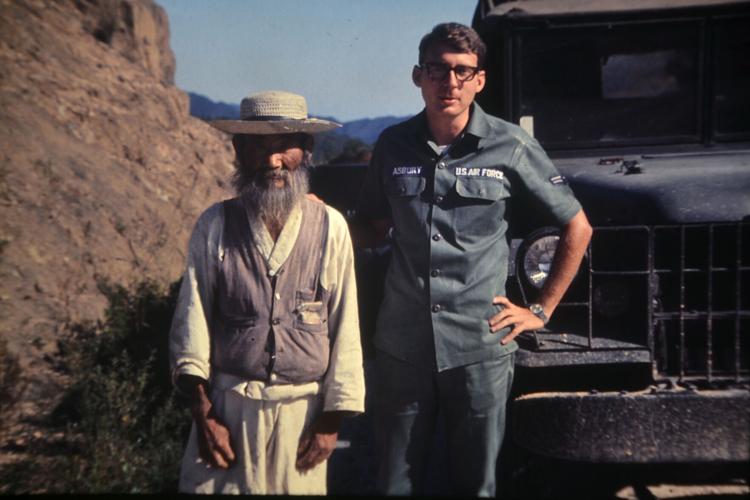
From Clark Air Force Base in the Philippines, as part of the 605th Tactical Control Squadron, Asbury went to Osan Air Base in Korea. On the way to Site 91, a remote mountaintop radio relay station, his sergeant told him, “Remember how to get there, because next time, you will be driving the truck by yourself.” Site 91 was part of a communication network that was used by the Army and Air Force during the Cold War.
Asbury also went to Da Nang, Vietnam, where he worked at Monkey Mountain, a strategic communications, radar, and surveillance facility. When he returned to the Philippines, his barracks was close to the flight line at Clark Air Force Base.
“Every morning, I looked out and counted the caskets coming in from Vietnam,” Asbury said. “When I later looked at the names on the Wall at the Vietnam Veterans Memorial in Washington, D.C., I wondered how many of their caskets I had seen on their way back to the U.S.”
Asbury was then assigned to the 3rd Mobile Communications Group at Tinker Air Force Base in Oklahoma, where he was on standby for immediate deployment to anywhere in the world.
Assigned to the White House communications team, Asbury went to the Azores in advance of a summit between President Nixon and French President Georges Pompidou in 1971, to set up top-secret radio and telephone communications.
Discharged in 1972, Asbury returned to Charlotte, where he founded his own company, Southern Video Corp., a full-service video production and editing service whose clients included numerous Fortune 500 companies.
In the 1980s, Asbury’s company provided live video at the World 600 NASCAR race (known since 1986 as the Coca-Cola 600) for the Charlotte Motor Speedway.
During the filming of the “Tribute to Vietnam Veterans” at the Memorial Day weekend race, which Asbury edited and distributed worldwide over the Armed Forces Radio and Television Service, a profound change came over him. “It was the first time,” he said, “that I felt honor and respect for what I did in the service.”
Asbury occasionally worked in film production as a colorist at several studios in Hollywood. “Television and color has fascinated me from an early age,” he said. “I became a colorist. That’s been my whole career, whether in photography, television or film.”
Asbury was the associate producer for the 2008 movie, “The Flyboys,” also released internationally as “Sky Kids,” which received many awards at numerous film festivals, including 14 for best feature film.
Louis Asbury points to Burke County native Vernon Rader from a scene in the WWII documentary which he produced, The High Price of Victory, with the Telly award in the foreground.
TAD ELLIOTT / FOR THE PAPER
In 2009, Asbury began working on “The High Price of Victory,” a documentary about World War II veterans, which he produced himself. The film features a dozen World War II veterans, including J.D. Law, a flight engineer on a B-29 bomber over Japan who was his neighbor at Lake James, and Vernon Rader of Morganton, who was captured and became a prisoner of war in a concentration camp in Germany.
“It was a thrill to get to know these World War II veterans,” Asbury said, “and how appreciative they were to tell their stories. My continuing desire is to honor the sacrifices of all veterans.” The film received a Telly Award in 2012, as well as other awards for best documentary.
Interviews with Burke County veterans who were featured in the film, as well as other local veterans, can be viewed at the History Museum of Burke County at 201 W. Meeting St. in Morganton, where Asbury volunteers as a film editor and serves on the board of directors.
The museum is open from 10 a.m. to 4 p.m. Tuesday through Friday and 10 a.m. to 3 p.m. on Saturday. Burke County veterans are welcome to share their military stories on video by visiting the museum or calling 828-437-1777.
“The High Price of Victory” is available on DVD at the museum store and can also be viewed online at Vimeo.com by entering 785450745 in the search bar.
Tad Elliott is a Navy veteran and hospice volunteer who contributes columns to The Paper.
Keep it Clean. Please avoid obscene, vulgar, lewd,
racist or sexually-oriented language. PLEASE TURN OFF YOUR CAPS LOCK. Don't Threaten. Threats of harming another
person will not be tolerated. Be Truthful. Don't knowingly lie about anyone
or anything. Be Nice. No racism, sexism or any sort of -ism
that is degrading to another person. Be Proactive. Use the 'Report' link on
each comment to let us know of abusive posts. Share with Us. We'd love to hear eyewitness
accounts, the history behind an article.























(0) comments
Welcome to the discussion.
Log In
Keep it Clean. Please avoid obscene, vulgar, lewd, racist or sexually-oriented language.
PLEASE TURN OFF YOUR CAPS LOCK.
Don't Threaten. Threats of harming another person will not be tolerated.
Be Truthful. Don't knowingly lie about anyone or anything.
Be Nice. No racism, sexism or any sort of -ism that is degrading to another person.
Be Proactive. Use the 'Report' link on each comment to let us know of abusive posts.
Share with Us. We'd love to hear eyewitness accounts, the history behind an article.