

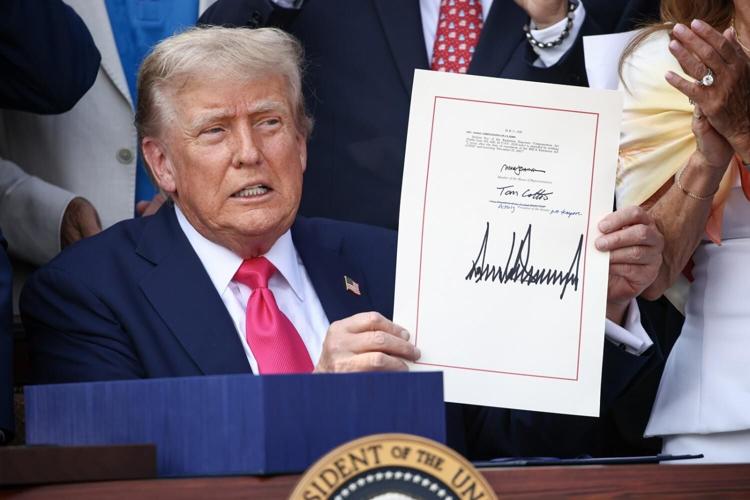



Washington may call the Big Beautiful Bill “reform,” but in Burke County it looks more like a cost shift.
The bill threatens to push new administrative and financial burdens onto a county already trying to stretch limited dollars across education, public health, social services, public safety, and economic development.
Our commissioners do not have the luxury of political slogans; they have to balance budgets in the real world. And the truth gets real extremely fast when it comes to budgeting.
When federal lawmakers promise savings by tightening aid, places like Burke County are left to ask whether those savings are simply costs pushed downhill.
The first blow will come through the Supplemental Nutrition Assistance Program (SNAP.)
Starting in October, Burke County will be expected to cover 75% of the program’s administrative costs. Washington may claim the savings, but Burke County will bear the cost.
And SNAP is only the beginning. The law adds tighter work-reporting rules and heavier administrative demands to a system Burke County already struggles to staff.
That means more paperwork, more chances for errors, and more pressure on our Department of Social Services with little room to spare. Those new demands could push an already strained safety net closer to the breaking point.
Health care is next. North Carolina has used Medicaid expansion to stabilize coverage and help keep rural providers afloat, including in Burke County. But new federal limits, work requirements, and financing changes put that progress at risk.
If more residents lose coverage, Burke County will feel it in crowded emergency rooms, more uncompensated care, and deeper pressure on the rural hospitals and public health systems this community depends on.
Burke County’s budget already shows why this bill is a threat. County Manager Brian Epley told commissioners the county is headed for a modest surplus and is trying to rebuild its fund balance after major storm Helene-related withdrawals.
But he also warned that rising costs and the Big Beautiful Bill could tighten that outlook quickly. No clear public estimate has been attached to Burke County’s future SNAP administrative costs, and that uncertainty is part of the problem.
Burke County is trying to rebuild reserves and will soon be forced to absorb new obligations without knowing the full price.
North Carolina lawmakers and county commissioners should be clear about the practical effect of this bill: it appears likely to shift more costs and administrative responsibility to local governments that are already working within tight constraints.
If Burke County does not fully account for those potential changes, our commissioners may face difficult budget choices as the impacts become clearer.
If Congress intends to make the safety net more restrictive or more complex, local governments will need greater clarity and support to manage those changes responsibly.
A bill should be judged not only by how it is described in Washington, but by how it affects counties like Burke. From that perspective, this legislation could leave local governments carrying a larger share of the burden.






















(0) comments
Welcome to the discussion.
Log In
Keep it Clean. Please avoid obscene, vulgar, lewd, racist or sexually-oriented language.
PLEASE TURN OFF YOUR CAPS LOCK.
Don't Threaten. Threats of harming another person will not be tolerated.
Be Truthful. Don't knowingly lie about anyone or anything.
Be Nice. No racism, sexism or any sort of -ism that is degrading to another person.
Be Proactive. Use the 'Report' link on each comment to let us know of abusive posts.
Share with Us. We'd love to hear eyewitness accounts, the history behind an article.