

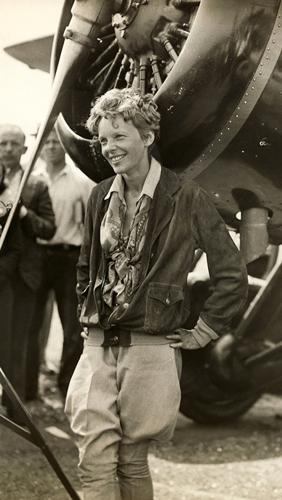



We need to just let go of the whirling speculation over pioneer aviator Amelia Earhart and her mysterious disappearance about 90 years ago while attempting to become the first pilot to fly around the world along the equator.
That’s taking The Long Way, in case you don’t have a globe handy. All 29,000 miles of it.
Earhart, 39, didn’t make it. She came close, having traveled 75% of the journey. Then her airplane, Lockheed Model 10-E Electra, a twin-engine, all-metal monoplane, disappeared en route to a tiny island far out in the Pacific Ocean.
That was the start of endless speculation, including A) adopted by naked midget island natives, B) captured and imprisoned by Japanese soldiers, C) defected to foreign countries, and D) devoured by man-eating creatures.
It was 1937. Earhart, fiercely independent, determined, smart, and braver than the bravest humans, already was in the record books for being the first woman to fly solo across the Atlantic Ocean (1932), the first person to fly solo from Hawaii to the U.S. mainland (1935), and holder of many distance and altitude records.
Navigation depended on maps, compasses, celestial sightings, landmarks, and basic radio direction finders. Weather forecasts were crude, which meant long flights demanded both courage and judgment. And extraordinary piloting skills.
I have trouble backing out of the driveway in a modern car with rear cameras and proximity alerts. And even then, I have to stop for a bathroom once or twice.
Earhart’s around-the-world flight began in Miami on June 1, 1937. With navigator Fred Noonan, she flew to South America. Then headed east along the equator to Africa. India. Southeast Asia.
By late June, they had flown 22,000 miles, three-quarters of the globe, and reached New Guinea. The next leg was formidable: 2,556 miles across the vast Pacific Ocean to a tiny island only 1.5 miles long. Howland Island.
Earhart and Norman couldn’t find it and vanished. Earhart sent a blind radio transmission that they couldn’t find Howland Island and were running out of fuel. That was the last confirmed communication.
I’m not surprised they missed a speck of land in the middle of the ocean. At night.
I’m a pilot, commercially instrument-rated with a couple thousand hours of flight time. I’ve been lost over Hickory at night. While looking for the Hickory airport. Which was right beneath me. (True, it was a student-pilot night training flight. When I get older, I’ll tell that story.)
Speculation on the whereabouts and fate of Earhart did not stop. One popular version: She landed on a coral reef 350 miles off course and was a castaway.
British colonial officials reported discovering her bones on that coral reef. A shoe, too. I can’t count the number of reports from explorers who claimed to locate her Lockheed Electra on the ocean floor.
So far, everything is inconclusive.
But now — the poor woman — the latest reports are that she was EATEN ALIVE by COCONUT CRABS after she crashed on the coral reef and swam ashore.
I had never heard of Coconut Crabs. Having researched extensively, they are the size of a dog, described as Jurassic Park-caliber monster crabs with huge claws that can CRUSH a whole coconut AFTER climbing the tree to grab it. They are “opportunistic omnivores,” meaning they eat anything.
Think of them as the garbage collectors of the tropical islands.
If something dies on an island, they will take it apart and carry away pieces. (No wonder the British found only a shoe.)
I accept, and am comfortable with, Earhart getting lost, running out of fuel, and crashing into the Pacific. I am OK with her swimming ashore somewhere and living peacefully with naked midget natives. Fine.
But I draw the line at the eaten-alive-by-Coconut Crabs-deal.
March is Women’s History Month, a time when we remember the women who pushed open doors that had been nailed shut for generations. Amelia Earhart did not just push on the door. She climbed into an airplane and flew straight over the wall.
I would have liked Earhart. A lean, athletic-looking radical woman with a modern bob haircut. Confident, comfortable, curious, career-driven, willing to disregard social expectations, emotionally steady, a slightly mischievous independence. Someone who has accepted risk and independence as the price of discovery.
Before marrying publisher George Putnam in 1931, Earhart handed him a letter that read less like a love note and more like a pilot’s preflight checklist. She warned him she would not live by the “medieval code of faithfulness” expected of women in 1931. Independence, she made clear, was not negotiable.
Somewhere out there in the Pacific, the final chapter of her story is still missing. Maybe the sea holds it. Maybe some lonely coral island does.
But the real story never depended on bones or wreckage.
Amelia Earhart showed the world that a woman could fly farther, higher, and bolder than anyone expected.
Ninety years later, we are still searching for how her journey ended. But Women’s History Month reminds us that the important part is how she lived.
And in that sense, Amelia Earhart never disappeared at all.

















(0) comments
Welcome to the discussion.
Log In
Keep it Clean. Please avoid obscene, vulgar, lewd, racist or sexually-oriented language.
PLEASE TURN OFF YOUR CAPS LOCK.
Don't Threaten. Threats of harming another person will not be tolerated.
Be Truthful. Don't knowingly lie about anyone or anything.
Be Nice. No racism, sexism or any sort of -ism that is degrading to another person.
Be Proactive. Use the 'Report' link on each comment to let us know of abusive posts.
Share with Us. We'd love to hear eyewitness accounts, the history behind an article.