


On Sunday, Sept. 29, the public is invited to visit the Captain Charles McDowell House at 119 St. Mary’s Church Road in Morganton to learn about the very unique role Burke County played in the American Revolution.
Sponsored by Historic Burke Foundation, the event, 1-5:30 p.m., is free and open to all ages. The program promises to be interactive, fun, and fascinating!
Special guest speakers include Sen. Warren Daniel, Rep. Hugh Blackwell, Deputy County Manager Alan Glines, and Tourism Development Authority CEO Ed Phillips.
Other special guests will be members of the Overmountain Victory Trail Association (OVTA) who will be observing the 50th anniversary of their commemorative Annual March from Abingdon, Va., on Sept. 23 to Kings Mountain on Oct. 7 to celebrate the “long shot” victory of the Overmountain Men at Kings Mountain.
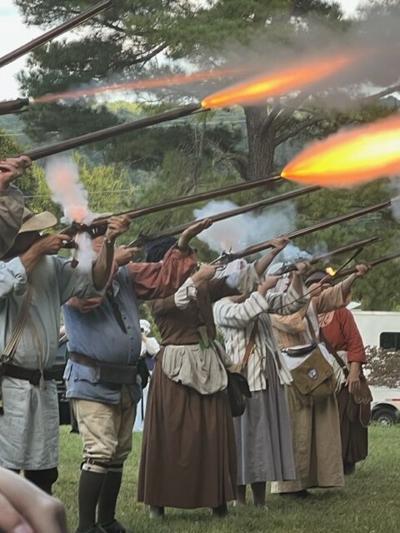
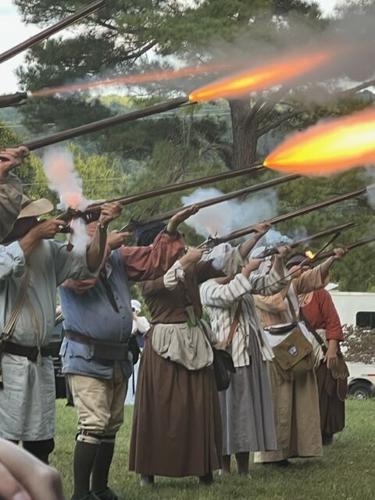
During this, their 50th visit to Burke County, they will tell the story of the Overmountain Men and fire their muskets to honor their memory.
In the fall of 1780, both leaders and ordinary citizens of Burke County were caught up in the struggle with Great Britain for freedom, even though the Declaration of Independence had been signed four years earlier.
The focus of fighting in the American Revolution had shifted from the Northeast to the South and few were exempt from the resulting turmoil and suffering.
Charles McDowell of Quaker Meadows, as head of the Burke Militia, was the ranking County official, and he and his younger brother, Joseph, had forded rivers and crossed mountains to warn neighbors near and far of the threats from British Major Patrick Ferguson.
Ferguson, on assignment from British General Charles Cornwallis, was in western South Carolina and North Carolina with the express purpose of defeating the Patriot cause.
He and his troops were looting Burke homesteads of cattle, pigs, chicken, clothing, and food and they had every intention of bringing the revolution here to a halt. He had pledged to “lay waste the land with fire and sword” if residents did not swear allegiance to the Crown.
Volunteers — farmers, hunters, tradesmen — from Virginia, what is now eastern Tennessee, and what are now Avery, Mitchell, McDowell, Forsyth, Surry, Wilkes, and Lenoir counties, gathered at McDowell’s Quaker Meadows on Sept. 30, 1780.
They were not trained militia. They carried the long rifles they used to hunt food and what they could carry on their horses and their backs. Fourteen hundred strong, they forded the Catawba River at Greenlee Ford on Oct. 1, 1780, and pursued Ferguson and his Tories until they confronted — and defeated — them on Oct. 7, 1780, in an hour-long battle on top of Kings Mountain, S.C.
These ordinary men changed the course of history. The battle of Kings Mountain “turned the tide” of the war and led to the British surrender at Yorktown one year and 12 days later.
The Sept. 29 exhibits and activities will focus on ordinary, everyday life in Burke County in 1780. There will be demonstrations of fire-starting with steel and flint, making black powder, powder horns, long rifles, militia kits packed for travel on horseback, and musket firing.
There will be tours of the house, restoration kitchen, and garden along with an example of food preparation for a funeral. There will be wool processing, spinning wool, needlework, and opportunities to make items from sprang.
Learn about how pioneers depended on chickens, rabbits, frogs, and ducks for food. Try your hand at colonial toys and games and enjoy colonial music and dancing.
For questions or additional information, call Historic Burke Foundation at 828-437-4104 or 828-448-2923.
















(0) comments
Welcome to the discussion.
Log In
Keep it Clean. Please avoid obscene, vulgar, lewd, racist or sexually-oriented language.
PLEASE TURN OFF YOUR CAPS LOCK.
Don't Threaten. Threats of harming another person will not be tolerated.
Be Truthful. Don't knowingly lie about anyone or anything.
Be Nice. No racism, sexism or any sort of -ism that is degrading to another person.
Be Proactive. Use the 'Report' link on each comment to let us know of abusive posts.
Share with Us. We'd love to hear eyewitness accounts, the history behind an article.