

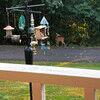

One of the truly marvelous joys of being semi-retired is the peaceful rapture of sitting in a rocking chair on my front porch at sunrise and relishing that second cup of hot, black Folgers coffee.
And, more mornings than not, if I linger on the porch long enough, I will be doubly blessed by the sight of a deer or two, wandering along the edge of the yard or, as has been more likely lately, promenading down the middle of the street.
Of course, my faithful companion, one Bo the Wonder Dog, shares my morning porch time with me, although he does normally eschew the morning cup o’ joe.
If he is feeling frisky, Bo will leap off the porch like a surface-to-surface missile in the hunt of early morning prey, but he always falls far short in his pursuit. That’s probably why most mornings he simply admires the parade as I do.
As I have noted before, I have the pleasure of living in the same house I grew up in near downtown Drexel. Then as now, the house was surrounded by woods. Then, however, a deer was never seen.
Absent too were the wild turkeys who I often hear calling in the woods and who occasionally venture into the yard to march about or to roost in a towering white pine at the edge of the yard.
And certainly, as a lad I never once awakened in the night to hear the ghostly, spine-tingling, goosebump-raising song of the coyotes, seemingly from just under our bedroom window.
So, what gives? How come 60 years ago the only wildlife seen on the Poteat homestead were rabbits and squirrels, and it is now home to deer, turkey, coyote, and the occasional red fox?
Loss of habitat is one reason, of course. A lot of Burke County acreage that was field and forest 60 years ago is now covered with subdivisions, shopping centers, and highways.
But the bigger part of the answer, a little bit of research reveals, is restoration and resource management.
For the abundance of turkeys in our county, we can primarily thank the National Wild Turkey Federation.
In 1970, when this old man was 15, the estimated wild turkey population in North Carolina stood at under 2,000. Today, that number is believed to be in excess of 270,000. That’s a lot of turkeys.
In the last three and half decades alone, about 1,800 wild turkeys have been relocated to North Carolina from other states, including 150 that came from West Virginia in a trade for 100 river otters.
Wild turkeys now flourish in all 100 of North Carolina’s counties, and nearly 10,000 of the birds are harvested each year, primarily during the spring hunting season.
Now about all those deer … The N.C. Wildlife Resource Commission reports that more than one million of white tails now inhabit our state, compared to only around 10,000 of the graceful animals back in 1900.
That continuing low number led to a full-scale restoration effort back in the 1960s and 1970s, with more than 4,000 deer stocked in different locations around the state.
The commission reports that the deer population has basically been stable for the last quarter-century, thanks to lots of harvesting during the autumn deer seasons.
Deer, according to the commission and to anyone else who is familiar with them, will eat just about any green-leafed plant and in the autumn love to feast on acorns.
As to those coyotes … Until 1988, coyotes didn’t exist in our state, other than a few illegally imported individuals for sport hunting. Their arrival was due to natural expansion from South Carolina, Georgia, and Tennessee.
Now, coyotes can be found in every North Carolina county, including the Poteat backyard in Drexel, and are estimated to number around 60,000 across the entire state.
Folks with vegetable gardens have to worry about deer eating those veggies before they can be harvested.
Folks who raise cattle or who leave their cats outside at night have reason to be annoyed with coyotes.
And some folks simply don’t appreciate the sounds of turkeys calling to each other across the woods.
But as for me and Bo, well, we’ll simply continue to sit on the porch and enjoy the show.
Bill Poteat is editor emeritus of The Paper. He may be reached at 828-445-8595 or via email at bill@thepaper.media.
















(0) comments
Welcome to the discussion.
Log In
Keep it Clean. Please avoid obscene, vulgar, lewd, racist or sexually-oriented language.
PLEASE TURN OFF YOUR CAPS LOCK.
Don't Threaten. Threats of harming another person will not be tolerated.
Be Truthful. Don't knowingly lie about anyone or anything.
Be Nice. No racism, sexism or any sort of -ism that is degrading to another person.
Be Proactive. Use the 'Report' link on each comment to let us know of abusive posts.
Share with Us. We'd love to hear eyewitness accounts, the history behind an article.