



EDITOR’S NOTE: In lieu of an editorial this week, The Paper commemorates the 25th anniversary of the 9/11 terrorist attacks upon America with this column of remembrance from Valdese and Education Reporter Mica Banks.
Twenty-five years ago, on the morning of Sept. 11, 2001, a confused 9-year-old was told that two planes had hit the Twin Towers in New York City.
As a kid in rural Georgia, I was far removed from it. All my life I was aware it had happened. I knew it was terrifying. I knew a lot of lives were lost that day. I knew it changed a lot of things in our nation.
But it wasn’t until 2019 that I actually came face-to-face with it and saw, with my own eyes, just a fraction of the nightmare that countless people lived through that day.
I saw the 9/11 exhibit at the Newseum in Washington, D.C.
September 11 suddenly went from a concept I had no tangible experience with to a horrifying reality.
Rewinding to 2001, I thought my teacher was just upset because people had died. I didn’t clock the terror in her red-rimmed, teary eyes, nor did I know just how many casualties there had been.
All things considered, Mrs. Croome held it together well. The school day went on.
I didn’t even know exactly what the World Trade Center was at that age, much less did I realize that every adult had to go about their day with such dread hanging over them.
This was the first and only time I ever attended a school during my K-12 years. For three months, I was a student at a private school and being in a classroom was a novel experience for a sheltered homeschooled kid.
So, when my mother picked me and my sister up early that day, I was devastated. I still didn’t understand the severity of the situation. All I knew was that we were going to watch a movie in class that afternoon and I didn’t want to miss it.
I know now why my mother came to get us. We lived in the middle of nowhere, two hours from the state’s only metropolitan area, so it wasn’t likely our school was a target. But Mother didn’t know what was happening or how widespread it was. No one did.
I would have picked up my kids, too.
In the following weeks, I started to understand what had happened. I still didn’t grasp just how scary it was, but I knew that it was very, very bad.
Years later, I was a college student attending a journalism conference in D.C. My group visited the Newseum just months before its permanent closure, but given our conference schedule, we only had about an hour to explore.
As a lover of both museums and journalism, I was instantly overwhelmed.
A museum worker must have noticed. He told me exactly what to do: First, I should go to the lowest level. See the Berlin Wall exhibit. Next, I should go to the top floor and look down. Then, I needed to go down a couple floors to the 9/11 exhibit.
I didn’t understand why I was going from the bottom floor to the top just to go back down, but I did as he instructed.
Immediately out of the elevator on the top floor was a catwalk, if memory serves. I could already see something massive below, but I didn’t know what it was.
I walked out and looked down.
I think my heart stopped for a second.
Below me was an enormous structure, twisted and warped out of shape.
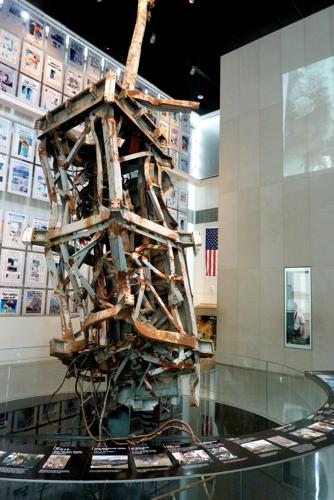
It was a piece of the North Tower’s antenna.
The fragment stood at least two-and-a-half stories tall in the center of the exhibit. Behind it, a three-story wall was covered with rows upon rows of newspapers from one side to the other, floor-to-ceiling. All of them had front page stories about 9/11.
I’m not sure how long I stood staring at the crumpled steel below, but I can tell you it was one of the most chilling moments of my life.
It’s hard to describe what I felt, but I think it was profound sorrow accompanied by grief and even fear — not for my safety, no. It was almost like an echo from the past as grim reality gripped me.
Finally, I tore my eyes away and went down a couple floors to see the exhibit up close. A timeline of that morning was arranged in a ring around the antenna. I think there were a lot of photos on the walls that weren’t covered in newspapers.
Behind a glass case sat three cameras that once belonged to Bill Braggart, the only photojournalist killed documenting 9/11. Each camera was broken in different ways, and all were covered in debris. Braggart’s ruined glasses and singed identification — likely his press pass — were also on display alongside a busted roll of film.
It was the closest I had ever been to 9/11. It remains scored in my memory.
And if that was how I felt seeing an exhibit, I cannot fathom the fear, pain, and grief of those who were there. My heart will always go out to them.


















(0) comments
Welcome to the discussion.
Log In
Keep it Clean. Please avoid obscene, vulgar, lewd, racist or sexually-oriented language.
PLEASE TURN OFF YOUR CAPS LOCK.
Don't Threaten. Threats of harming another person will not be tolerated.
Be Truthful. Don't knowingly lie about anyone or anything.
Be Nice. No racism, sexism or any sort of -ism that is degrading to another person.
Be Proactive. Use the 'Report' link on each comment to let us know of abusive posts.
Share with Us. We'd love to hear eyewitness accounts, the history behind an article.