

Numbers have always played a prominent role in Phil Hatcher’s life.
Numbers like four, as in years he lettered in track and field as a decathlete at N.C. State.
Or the figures he juggled in his head and on paper as a utilities engineer.
Or 63, as in the races — 5Ks, 10Ks, marathons, triathlons, cycling events – in which he competed in his 50th year of life.
In the span of a heartbeat, all those numbers changed.
First, there was three — the number of times his wife, Kelly, resuscitated him after a horrifying mountain biking accident five years ago.
And C-3, the cervical vertebra he fractured when he crashed into a tree that had fallen onto one of his favorite bike trails, leaving him a quadriplegic with extremely limited use of his limbs.
There were the 28 hours he survived without a ventilator, convincing his doctors Hatcher was strong enough to be weaned off the machine.
Five months of inpatient rehab. One year away from his home on Gingercake Mountain. Nearly 100% dependent upon others.
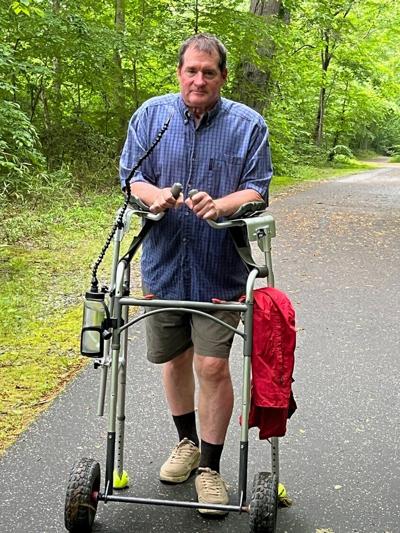
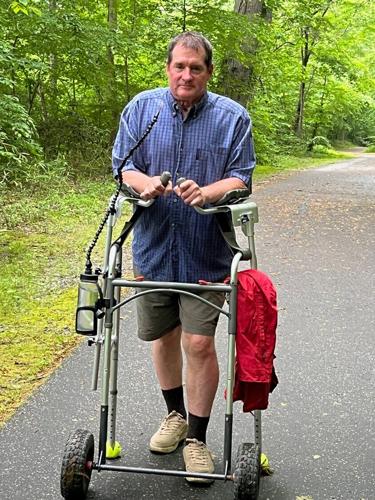
Then there’s the number that stands out as the most amazing of all as you watch Phil Hatcher on one of his twice-weekly walks along the Catawba Meadows Greenway: Eight, as in the 8% of quadriplegics who ever regain the ability to do what Hatcher does.
Treading methodically behind his modified walker, the 63-year-old Hatcher exits via the rear entrance of River’s Edge Physical Therapy directly onto the Greenway each Monday and Friday afternoon. He heads left one trip and right the next. One path is a mile, the other 1.2. It takes him a good two hours to complete either.
“This is my race right now,” the Morganton native said. “Walking twice a week and getting two hours in.”
It’s far cry from the long distances Hatcher covered as an endurance athlete, but these miles, he said, are much more difficult. “This is by far harder. Every day is a challenge. It’s more mentally challenging than physically,” said Hatcher.
“That was the hardest; being independent and going to all these races, and now, it’s just a totally different race. It was a hard change, and it’s still hard. It’s hard to see people riding their bike past me, or run or swim. I want to make those movements. But we’ve all got to go through some type of trials and tribulations. And when you go through that, it’s how you handle it on the other side. I could sit there in front of the TV and waste away, but I’ve got new goals in life, and the biggest one is kind of selfish: I want to improve my health.”
Hatcher said his health is indeed getting better. His walking regimen has allowed him to retain bone mass in his legs and keep his muscles from atrophying, two of the biggest problems quadriplegics face.
But his routine has proven beneficial in other ways — and for other people.
“Will I ever be able to walk without this walker again? Probably not,” he said. “I hope so one day. Miracles happen. It’s happening right now. But it’s really nice to hear people say you’re an inspiration. That really makes me feel good. I’m doing it for personal reasons, to help keep my mind sane and my body fit, but it’s also nice to hear people saying you’re an inspiration.”
Hatcher said that happens at least once nearly every time he walks. Other things occur regularly as well.
“It’s so nice to get out here,” he said with a smile as he stopped to sip water from a specially designed bottle mounted on his walker. “I see a lot of the same people. It’s amazing; I have a lot of people who will come up and ask if they can say a prayer for me, and I say ‘absolutely.’ It’s incredible. People will come by and say, ‘way to go. You’re going to get there.’”
Although Hatcher isn’t always sure where ‘there’ is, he knows he has zero chance of arriving without Kelly. She has been his constant caregiver since the accident. He’s almost completely dependent on her.
“She has given up her life to take care of me,” Hatcher said. “Sometimes I feel insanely guilty, until she reminds me that she loves me and she’s always going to do it. I got lucky. I couldn’t imagine where I’d be today without her.”
On the days Hatcher walks, Kelly heads over to Bigfoot Climbing Gym. His one-hour therapy sessions and subsequent two-hour strolls give her a chance to unwind for three hours. “That’s her passion,” Hatcher said. “She had to find something to relieve her stress, so that’s her outlet.”
Hatcher said there are other helpful angels in his life.
A group of his friends modified the couple’s log cabin with a no-threshold shower and other conveniences while he was in the hospital. Friendly neighbors sometimes drive him to doctor’s appointments to give Kelly a break. Money from a grant helped him purchase an all-terrain wheelchair that will easily tackle the dirt roads near his home so Hatcher can walk his beloved dogs. A pack of college buddies picked him up one weekend last fall and took him to an N.C. State football game.
Hatcher is also making progress in other areas of his life. He’s working with Vocational Rehabilitation to obtain a computer that will allow him to operate the cursor via a pair of eyeglasses, and he has spoken with a utilities company about possibly returning to the working world.
Next month, Hatcher is scheduled to deliver a motivational speech to a group of engineers in Georgia, where he worked for a time prior to the accident.
Regardless of where the future leads him, you get the feeling Hatcher’s positive attitude and strong support system will be enough to sustain him on the journey.
This much is certain: He is highly unlikely to quit.
“I felt like I had a charmed life growing up,” said Hatcher. “I had a good job and things just fell into place. And then, boom. You can either sit back on your laurels and be pitiful, or you can get out there and do it. Whatever happens in your life, whatever problems you’re facing, there’s hope. I feel like that’s kind of what I display when I’m out here doing this.
“There’s another reason why I’m here; there’s another purpose. The path I was leading was not the right path. I thought it was, but there is something better I can do on Earth while I’m here.”
In fact, there might just be a number of things.
Marty Queen is the senior reporter at The Paper. He may be reached at 828-445-8595 or marty@thepaper.media.




















(0) comments
Welcome to the discussion.
Log In
Keep it Clean. Please avoid obscene, vulgar, lewd, racist or sexually-oriented language.
PLEASE TURN OFF YOUR CAPS LOCK.
Don't Threaten. Threats of harming another person will not be tolerated.
Be Truthful. Don't knowingly lie about anyone or anything.
Be Nice. No racism, sexism or any sort of -ism that is degrading to another person.
Be Proactive. Use the 'Report' link on each comment to let us know of abusive posts.
Share with Us. We'd love to hear eyewitness accounts, the history behind an article.