



One of the biggest complaints surrounding the education system of today is the lack of real-world skills training, like home maintenance and money management. With the assistance of the State Employees Credit Union (SECU), Burke County high schools are tackling financial literacy in teens.
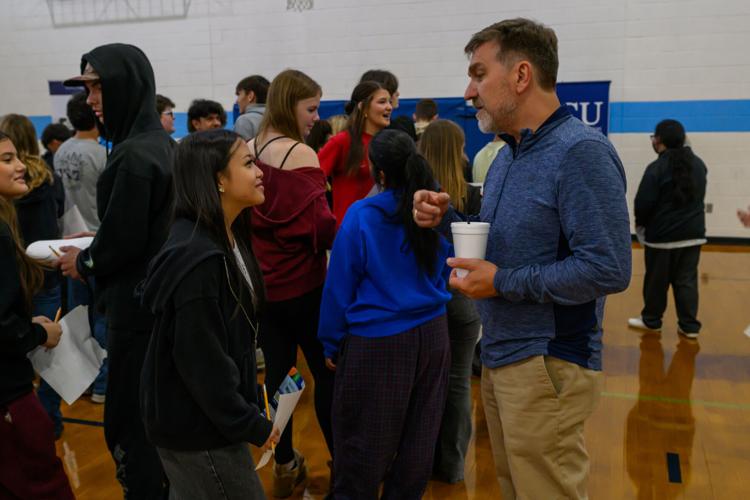
On Oct. 23, East Burke High School (EBHS) hosted the fall SECU Reality of Money event in its auxiliary gym. Throughout the day, more than 700 students in the Career and Technical Education (CTE) and JROTC program visited the gym, taking part in a simulated life activity to learn about the implications of decisions such as attending college, having children, and choosing a career.
SECU led the event, giving each student a random 25-year-old profile sheet that included a career, income, credit score, marriage status, and number of children.
SECU Vice President David Buchanan explained, “We have advisory boards at each branch across the state, and we get teachers, counselors, and the CTE folks on those boards. They pretty much said, ‘We’d love to have you come into the schools and teach us about financial literacy.’”
Following the explanation of the activity, participants spread across the 12 schools and SECU volunteer-manned tables, ranging from health insurance and groceries to child care and transportation. SECU developed the program, creating the materials and pricing salaries and expenses according to the North Carolina averages.
While the program is offered in a smaller size for both middle and high school students, Burke County high schools host the event once each semester. For the 2025-26 school year, EBHS hosted the exercise last week, and Draughn High School will invite its CTE students to participate in the spring semester on Feb. 10.
Students who visited all of the tables could return to the “Next Payday” table when they finished, symbolizing the hamster wheel that is pre-retirement life. In the back of the room, SECU placed a “Help” table for participants with too many financial responsibilities or frivolous spending decisions.
“We do try to design most of our scenarios so they don’t fail,” Buchanan said. “[Help] doesn’t get any business for the first 20 to 25 minutes, while everybody’s spending their money, but there are several profiles that will need it, especially if they’re married and if they have children that are going to need child care where they have to visit those extra stations.”
Buchanan explained that many students are money-savvy. Some even visited the Help table not out of necessity, but to get second jobs for savings accounts. For profiles that were single, without children, roommate options were available to split expenses. For “single parents,” child support was offered in lieu of secondary employment.
SECU based each income and subsequent second job on the educational level. Profiles that didn’t finish high school saw fewer opportunities for high-paying revenues as compared to options for four-year degree profiles that maintain corresponding employment or that can tutor, using less time and making more money.
Oftentimes, this exercise directed students to the GEAR UP table — Gaining Early Awareness and Readiness for Undergraduate Programs — where students could explore college options and discuss what their real-world futures looked like.
GEAR UP Coordinator Isabel Jensen said, “Another thing they’ve been having questions about [is] if they’re interested in a particular job that they happen to have gotten. We’ve gotten a lot of questions about ‘What college can I go to learn how to do that job?’”
Between directing students to specific postsecondary education, the GEAR UP team also reminded students about their free FAFSA form assistance; the Common App, which allows GEAR UP students to apply to postsecondary institutions for free; Money Mondays, virtual sessions throughout the year offering live financial aid assistance; and the GEAR UP cords students could earn for graduation by completing a checklist before April 1st.
The Reality of Money seemed to resonate with many students as they thought about the future and how their decisions could have ramifications.
“Most kids realize how expensive they are or that children in general are,” Buchanan said. “Most of them are like, ‘Can I sell my kids? Can I trade my wife?’ because they realize how much more money that costs to have a fuller household.”
EBHS Principal Dr. Anna Moose reiterated the importance of understanding financial literacy for students, “It’s the first thing that’s going to hit them when they graduate. They don’t even go to college right away — most of them — or a job right away. This is the very first thing, day one, they’re going to be responsible for.”
Understanding economic capabilities runs deeper than a one-day event at EBHS, though. Moose explained that civics and economics courses were split several years ago, resulting in an economics personal finance class and a class focused on civics. The state has since made a personal finance course mandatory.
“They actually have a whole semester in their junior year where they focus on basic economic principles, but a lot of personal finance,” Moose said. “One of our special points that we have here — in Burke County schools and at East Burke — is the theme: Enroll, Enlist, or Employ … That’s what events like this teach kids is the ‘What’s next?’ conversation, because a lot of them don’t necessarily see that.”
SECU’s involvement is about more than acquiring new customers.
“We just love for them to do it. If they go somewhere else and get an account, that’s fine,” Buchanan said. “As long as they understand the importance of a savings account and how a checking account works. It’s sort of a community involvement project for us. Other than having our name associated with it, that’s about the only advertising we’re doing with it.”
While there aren’t specific resources regarding the Reality of Money event that students can access from home, SECU does provide financial literacy information, mortgage and car payment calculators, and other budgeting tools for free on their website. This allows families to take advantage of smart money management education and develop it into a lifelong skill.
























(0) comments
Welcome to the discussion.
Log In
Keep it Clean. Please avoid obscene, vulgar, lewd, racist or sexually-oriented language.
PLEASE TURN OFF YOUR CAPS LOCK.
Don't Threaten. Threats of harming another person will not be tolerated.
Be Truthful. Don't knowingly lie about anyone or anything.
Be Nice. No racism, sexism or any sort of -ism that is degrading to another person.
Be Proactive. Use the 'Report' link on each comment to let us know of abusive posts.
Share with Us. We'd love to hear eyewitness accounts, the history behind an article.