

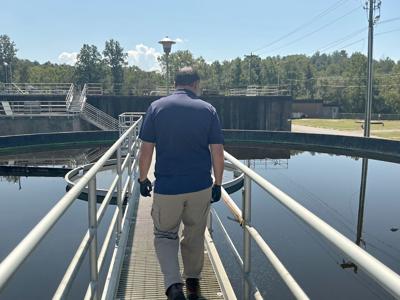

Officials in Morganton and Drexel said recent hurricane-related overflow spills of an estimated 870,000 gallons of sewage and floodwater were expected to have minimal environmental impact on local waterways, but the overflows underscore the need for upgrades.
Morganton Water Resources Director Randy Smith and Drexel Town Manager Bill Carroll were careful not to downplay the fact that raw sewage had entered waterways leading to the Catawba River, which supplies drinking water for much of the region, but both said the vast majority of what spilled was rainwater brought on by Hurricane Isaias.
“At that time, (the system) was so surcharged, the amount of raw sewage would be a very low percentage of that amount,” said Smith.
Even then, Carroll said, “Wastewater is regulated, and rightfully so, but it’s not like it’s toxic sludge. It’s not nuclear waste that’s going to make you grow a third arm or anything. It’s not pleasant stuff, but it’s natural.”
Smith said Morganton’s 840,000-gallon spill occurred Sunday, Oct. 11, at a junction box near the wastewater treatment plant on Vine Arden Road in Morganton, where several large trunk lines enter the same area. From there, the spill entered Hunting Creek, which drains into the Catawba River nearby.
Smith said his team is examining the junction box as part of a broader effort over the past decade to identify weak spots in the system and incorporate them into capital improvement plans. According to Smith, the city uses specialized transducers in manhole covers that monitor flow and alert crews to potential issues.
But when creeks rise and stormwater infiltrates the system to the extent that it did in the wake of Hurricane Isaias, it’s next to impossible to prevent spillage, said Smith and Carroll.
In Drexel, where the town’s aging Bryant Road pump station lost 30,000 gallons of sewage and floodwater during the storm on Oct. 11, repairs and upgrades had already been in the planning stage for some time. Flooding from Hurricane Helene prompted the work on the pump station, and at least $5 million of the total $15 million project cost will come from Helene-related federal funding.
As for the other $10 million, the town is seeking other funding options, Carroll said, and if the full amount isn’t available, planners will scale the project accordingly.
Carroll said since pump stations are generally installed in low-lying areas, they tend to be close to creeks. The Bryant Road pump station sits close to Howard Creek, also known as Propst Creek, and the main inflow line runs next to the watercourse.
In this case, Carroll said, floodwater entered the aging inflow system, though it’s unclear where, and overloaded the pump. An exposed section of headworks used for monitoring flow is where the system overflowed, and the wastewater followed the topography into the creek.
Carroll, who is also a certified biological wastewater operator, said he was not concerned about contamination. By the time the contents of the spill entered the Catawba River, which supplies drinking water for much of the region, Carroll said it was “diluted so much it will not have an effect.”
Smith said he takes great pride in his work, as does his team, so Morganton’s more substantial spill stung.
“Nobody wants to report 840,000 gallons of sewer hitting a stream,” he said, “but that’s the responsible thing to do. … We documented that, we submitted it as we were supposed to, called it in to the (North Carolina Department of Environmental Quality), and filed our report as we were supposed to.”
These types of spills are more common than people think, Carroll said, especially during floods.
Carroll said state law requires sewer operators to issue a news release when a spill exceeds 1,000 gallons. But he said it could take a spill of 1 million gallons in a densely populated area such as Charlotte to prompt a broader state response, such as a no-swim advisory or environmental alert. When the spill is flood-related and the contents are mostly rainwater, officials “aren’t terribly concerned,” said Carroll.
While the improvements to the Bryant Road station are still in the earliest stages, Carroll hopes the project will both prevent further spills and ease the financial burden on Drexel residents.
After all, he said, Drexel residents are paying for wastewater treatment, and any rainwater infiltrating the system ends up getting treated right alongside it.
“Utility payers are having to pay for that water to be treated,” he said. “It’s unideal. We don’t want to have to pay for that water because it’s rainwater.”

























(0) comments
Welcome to the discussion.
Log In
Keep it Clean. Please avoid obscene, vulgar, lewd, racist or sexually-oriented language.
PLEASE TURN OFF YOUR CAPS LOCK.
Don't Threaten. Threats of harming another person will not be tolerated.
Be Truthful. Don't knowingly lie about anyone or anything.
Be Nice. No racism, sexism or any sort of -ism that is degrading to another person.
Be Proactive. Use the 'Report' link on each comment to let us know of abusive posts.
Share with Us. We'd love to hear eyewitness accounts, the history behind an article.