

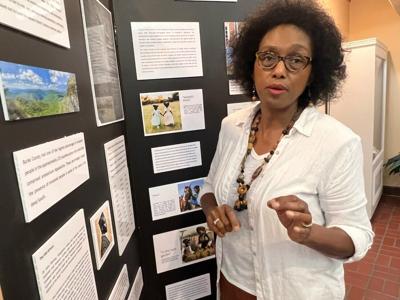
The story of Burke County’s African American community is extensive, filled with seemingly insurmountable difficulties, proud achievements, and breathtaking courage.
Dr. Leslie Dula McKesson is passionate about sharing that story, and about ensuring that the contributions and sacrifices of local Black people are not lost to history.
A native of Caldwell County, McKesson moved to Burke in 1992. Her extensive educational background includes an undergraduate degree in criminal justice from UNC-Chapel Hill, and masters of arts and doctoral degrees in adult education.
McKesson has spent much of her adult life in front of a classroom. She taught and served as an administrator at Western Piedmont Community College for 28 years, including seven years as dean of business, public services and academic support.
She also taught at Appalachian State University, where she continues to hold a position as an adjunct professor
It is through her work at ASU that McKesson has accompanied her students on a journey exploring much of Burke County and Western North Carolina’s Antebellum history, with a focus on the experience through the eyes of enslaved people.
Her spring 2023 course interpreted the experiences of enslaved people at Burke County’s Quaker Meadows Plantation. Much of the material from that course is now part of an exhibit currently on display at the Historic Burke County Courthouse in downtown Morganton.
The topic is close to her heart and McKesson’s passion for preserving an often forgotten slice of Burke County history is evident when she speaks.
“You talk about the (Burke County) McDowells and what they did in the Revolutionary War,” she said, “but what the enslaved people did that enabled those things to go on hasn’t been a part of the story. We’re trying to tell a broader story of the people who lived at these plantations in greater numbers than the people who’ve been talked about for 150 years or so.
McKesson explained one of her passions is helping people be aware of the diversity that existed among Africans when they came to the United States.
“The culture was just incredibly diverse, but then you come to the United States and you become one thing – you’re Black people and that's all the identity that you have,” she said. “Forget that they were from Ghana and Ethiopia and Nigeria, and different countries on the biggest continent on the planet.
“And that identity has this artificial genesis in slavery, like there’s nothing that your people ever did before that,” McKesson added. “That's part of what enables you to be dehumanized, and not valued.”
“All of that contributed to the negative thinking that society as a whole tended to have toward Black people,” McKesson noted.
That’s a perspective McKesson is trying to change. She said the inclusion of stories of Black contributions to local economies and culture are vital in helping people understand that Black history is about far more than what students traditionally find in books.
“Stories like that haven’t been told, stories that would help Black people understand their worth and value and talent,” she said. “It's all about helping people feel like they belong and recognizing the contributions they’ve made to this country.
“Apart from the forced labor of unfree people, this country would be a lot different,” McKesson explained. “Capitalism would be a whole lot different than it is if it had not had that solid foundation built on unpaid labor. Think how wealthy people were able to become people who maintain that wealth until today because they were able to capitalize on the labor of unfree people.”
McKesson’s current ASU class is interpreting experiences of enslaved people at Fort Defiance, the Caldwell County plantation of Col. William Lenoir, an American Revolutionary War officer and statesman for whom “virtually everything in “Lenoir” is named,” McKesson said.
According to McKesson, one of her students toured Ft. Defiance many times as a child and, “Never once was there a mention of enslaved people.” she said. “It never crossed his thinking that enslaved people would have been there.”
Although McKesson is not a Burke County native, her roots run deep in local soil. “My goal is to help preserve the history of Burke County,” she said. “I didn’t grow up here, but three of my grandparents were from Burke County and it’s a goal of mine to see history documented.”
Sandra Wilkerson Queen is the education and business reporter for The Paper. She may be reached at 828-445-8595, Ext. 2002, or via email at sandra@thepaper.media .













(0) comments
Welcome to the discussion.
Log In
Keep it Clean. Please avoid obscene, vulgar, lewd, racist or sexually-oriented language.
PLEASE TURN OFF YOUR CAPS LOCK.
Don't Threaten. Threats of harming another person will not be tolerated.
Be Truthful. Don't knowingly lie about anyone or anything.
Be Nice. No racism, sexism or any sort of -ism that is degrading to another person.
Be Proactive. Use the 'Report' link on each comment to let us know of abusive posts.
Share with Us. We'd love to hear eyewitness accounts, the history behind an article.